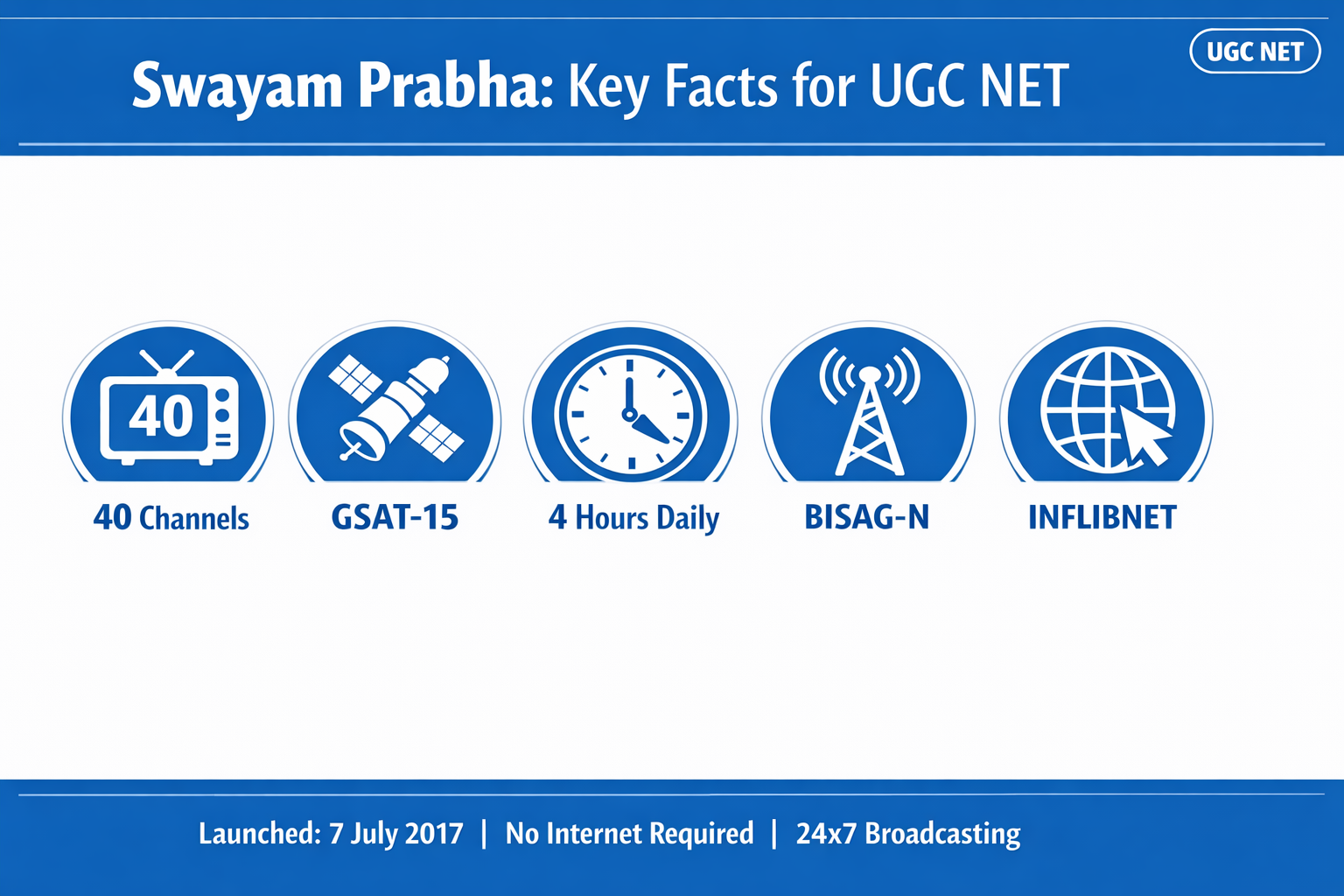
Master Swayam Prabha for UGC NET. Quick guide covering 40 channels, GSAT-15, BISAG-N, INFLIBNET, and SWAYAM vs Prabha differences with exam tips. This article is written by Neeli Neelay Shah, Senior Legal Content Writer at LawSikho.

If you are preparing for UGC NET Paper 1, you have probably noticed that digital education initiatives like Swayam Prabha appear in almost every examination cycle. This DTH-based educational platform is a favorite testing ground for NTA, with questions appearing in matching columns, statement-based MCQs, and assertion-reason formats. The good news? Swayam Prabha questions are scoring opportunities if you know the right facts. This guide cuts through the clutter and gives you exactly what you need to know for exam success, covering the essential technical specifications, channel details, and the all-important SWAYAM vs Swayam Prabha distinction that trips up many aspirants.

Before diving into exam-specific preparation, you need a clear understanding of what Swayam Prabha actually is. This section gives you the foundational knowledge that forms the basis of most examination questions.

What Swayam Prabha Means and When Was It Started

Swayam Prabha is a Sanskrit term that translates to “self-luminous” or “self-shining.” The name reflects the initiative’s vision of empowering learners to shine through accessible education. Unlike acronym-based names, Swayam Prabha is simply a meaningful Sanskrit phrase chosen to represent the platform’s mission.

Download Now

The platform officially launched on 7 July 2017 under the Ministry of Human Resource Development (now renamed Ministry of Education). This date is worth remembering because NTA has asked about launch timelines in previous papers. At its inception, Swayam Prabha operated 32 DTH channels. Over time, this expanded to the current 40 channels, making it one of the most comprehensive free educational broadcasting initiatives in the world.

The initiative falls under the broader Digital India programme and represents the government’s commitment to making quality education accessible regardless of geographical location or economic status. For examination purposes, remember these two key facts: launched 7 July 2017, and currently operates 40 DTH channels.

Core Objective: Education Without Internet Barriers

The fundamental purpose of Swayam Prabha addresses a critical challenge in Indian education: internet connectivity remains inconsistent across large parts of the country. While urban areas enjoy reliable broadband, many rural and semi-urban regions still struggle with internet access. Swayam Prabha solves this problem by using satellite-based DTH technology instead of internet delivery.

This means a student in a remote village can access the same educational content as someone in a metropolitan city. The only requirement is a television with basic DTH setup, which is far more common than reliable internet connections in rural India. The platform broadcasts curriculum-based content covering disciplines from arts to engineering, at levels ranging from school education to postgraduate courses.

For your exam, understand that the core objective is bridging the digital divide by providing internet-independent access to quality education. Questions often test whether you understand why DTH was chosen over online delivery, and the answer lies in reaching learners where internet infrastructure is inadequate.

This is arguably the most important section for exam preparation. Confusing SWAYAM with Swayam Prabha is one of the most common mistakes aspirants make, and NTA specifically designs questions to test whether you understand the difference.

Key Differences 

SWAYAM and Swayam Prabha are two distinct initiatives launched within days of each other in July 2017. Despite their similar names, they operate on completely different models. SWAYAM (Study Webs of Active-Learning for Young Aspiring Minds) is an online MOOC platform that requires internet connectivity. You access it through the swayam.gov.in portal, enroll in courses, watch video lectures, complete assignments, participate in discussion forums, and earn certificates upon completion.

Swayam Prabha, in contrast, is a DTH television initiative that broadcasts educational content through satellite signals. No internet is required. You simply tune in to the relevant channel on your DTH service and watch the content. There are no enrollments, no assignments, no discussion forums, and no certificates. The content is purely supplementary and passive.

The critical distinctions to remember are: SWAYAM offers certificates and credit transfer (up to 20% of degree credits), while Swayam Prabha offers neither. SWAYAM requires internet, Swayam Prabha does not. SWAYAM is interactive with assessments, Swayam Prabha is passive viewing. When exam questions mention certificate provision or credit transfer, the answer is always SWAYAM, not Swayam Prabha.

Why NTA Tests This Comparison Frequently

NTA tests this comparison because it assesses whether aspirants have genuine conceptual clarity or merely surface-level familiarity with terms. The similar names create natural confusion, and distinguishing between the two requires understanding the fundamental nature of each platform.

Typical question formats include: “Which of the following provides certificates for course completion: SWAYAM or Swayam Prabha?” or “Statement 1: Swayam Prabha requires internet connectivity. Statement 2: SWAYAM offers credit transfer up to 20%.” You might also encounter assertion-reason questions like: “Assertion: Swayam Prabha can reach areas without the internet. Reason: Swayam Prabha uses DTH satellite broadcasting.”

The key to handling these questions is creating a clear mental separation between the two platforms. Think of SWAYAM as an “online course platform” and Swayam Prabha as “educational television.” This simple framing helps you instantly identify which platform a question refers to based on the context clues provided.

Technical specifications are a favorite testing area for NTA. Matching-type questions frequently ask you to connect components like the satellite, uplinking centre, and web portal manager with their correct identifications.

Broadcasting Infrastructure (GSAT-15, BISAG-N, INFLIBNET)

Three technical terms appear repeatedly in UGC NET questions, and you must memorize them with their exact functions. GSAT-15 is the satellite used for broadcasting Swayam Prabha channels across India. When a question asks about the satellite, the answer is always GSAT-15.

BISAG-N (Bhaskaracharya National Institute for Space Applications and Geo-informatics) in Gandhinagar, Gujarat is the uplinking centre. This is where the content is transmitted up to the satellite for nationwide distribution. When questions ask about the uplinking location or centre, the answer is BISAG-N Gandhinagar.

The INFLIBNET Centre (Information and Library Network) manages the web portal at swayamprabha.gov.in. While Swayam Prabha is primarily a DTH service, the web portal allows those with internet access to stream channels online and access archived content. When questions ask about portal management or digital archive maintenance, the answer is INFLIBNET.

Create a simple association: “G-B-I” for Satellite-Uplinking-Portal, mapping to GSAT-15, BISAG-N, and INFLIBNET respectively. This mnemonic helps you quickly match components in examination questions.

The 40 Channel Ecosystem and Content Providers

Swayam Prabha operates 40 DTH channels managed by different institutions. Understanding this ecosystem helps you answer questions about content providers and channel allocation. The major content providers are CEC (Consortium for Educational Communication), NPTEL (National Programme on Technology Enhanced Learning), IGNOU (Indira Gandhi National Open University), NCERT, NIOS, and IITs.

CEC manages Channels 1 to 10, covering humanities, social sciences, law, commerce, and natural sciences. These channels have distinctive Sanskrit names like VAGEESH, SANSKRITI, and KAUTILYA. IGNOU manages Channels 11 to 16 following the September 2023 reorganization. NPTEL provides engineering and technology content. IIT-PAL (Professor Assisted Learning) manages various channels, providing school-level content in Physics, Chemistry, Mathematics, and Biology.

Remember that the channel count has evolved: 32 channels at launch in 2017, expanded to 40 currently. Some older resources mention 32 or 34 channels, but for 2025 examinations, the answer is 40 channels.

Understanding how content is scheduled and accessed helps you answer questions about the platform’s operational details and viewer convenience features.

Daily Fresh Content (4 Hours) and Repeat Telecasts

Each Swayam Prabha channel broadcasts at least 4 hours of fresh content every day. This new content is then repeated 5 more times throughout the 24-hour cycle, giving viewers 6 opportunities to watch the same material. This scheduling model is specifically designed for learner convenience, allowing students to choose viewing times that fit their personal schedules.

The 24×7 broadcasting combined with repeat telecasts means students are not constrained by fixed timings. Whether you prefer studying early morning or late night, you can access the content. This flexibility is particularly valuable for working professionals and students balancing multiple commitments.

How to Access Swayam Prabha

You can access Swayam Prabha through multiple platforms. The simplest method is DD Free Dish, the government’s free DTH service. If you already have a commercial DTH connection like Dish TV, JioTV or Tata Play, Swayam Prabha channels are available in the educational channels section at no additional cost.

For those with internet access, the official web portal at swayamprabha.gov.in provides live streaming of all channels. The portal requires no registration or payment, making it completely free and accessible to anyone with an internet connection and a web browser.

Archive and On-Demand Viewing Options

Beyond live broadcasts, the INFLIBNET-managed web portal maintains a comprehensive archive of all previously broadcast content. This digital repository allows students to search for specific topics, access lectures from any date, and download videos for offline viewing.

The archive feature transforms Swayam Prabha from a purely broadcast platform into a searchable educational library. For exam preparation, you can focus on specific topics relevant to your syllabus rather than waiting for the relevant content to air. This on-demand capability significantly enhances the platform’s utility for serious learners.

This section focuses specifically on examination preparation, covering the facts you must memorize, the question types you will encounter, and strategies to avoid common mistakes.

Numbers and Statistics to Memorize

Certain numerical facts appear repeatedly in examinations and require straight memorization. Create flashcards for these and review them regularly during your preparation.

The essential numbers are: 40 channels (current total), 4 hours (fresh content daily), 5 times (repeat telecasts per day), 6 times (total viewing opportunities), 7 July 2017 (launch date). For channel allocation: 10 CEC channels (1-10), 6 IGNOU channels (11-16 from September 2023), IIT-PAL channels. Remember that broadcasting happens 24×7 across all 40 channels.

Use memory techniques to retain these numbers. For example, “7-7-17” encodes the launch date (7th day, 7th month, 2017). “40-4-5” represents channels-fresh hours-repeat times. Such patterns make recall easier under exam pressure.

Important Names and Technical Terms

Beyond numbers, several technical terms and institutional names require memorization. The satellite is GSAT-15. The uplinking centre is BISAG-N (Bhaskaracharya National Institute for Space Applications and Geo-informatics) in Gandhinagar. The web portal manager is INFLIBNET Centre.

Content providers include: CEC (Consortium for Educational Communication), NPTEL (National Programme on Technology Enhanced Learning), IGNOU (Indira Gandhi National Open University), NCERT (National Council of Educational Research and Training), NIOS (National Institute of Open Schooling), and IIT-PAL (Professor Assisted Learning by IITs).

Other terms worth knowing: DTH (Direct-to-Home), MOOC (Massive Open Online Course, used for SWAYAM comparison), Ministry of Education (formerly MHRD, the parent ministry). Familiarity with these terms helps you understand question contexts quickly.

Channel Names That You Must Know for UGC NET

NTA frequently tests CEC channel names and their subject areas through matching-type questions. Memorizing at least the key channels significantly improves your chances of scoring.

Important Channel Names

The CEC-managed channels (1-10) have Sanskrit names connected to their subject areas. VAGEESH (Channel 1) covers Language and Literature. The name means “Lord of Speech,” reflecting its focus on linguistic content. SANSKRITI (Channel 2) covers History, Culture, and Philosophy. The name means “Culture,” directly indicating its content domain.

PRABODH (Channel 3) covers Social and Behavioral Sciences. SAARASWAT (Channel 4) focuses on Education, Psychology, and Home Science. PRABANDHAN (Channel 5) covers Management and Information Science. The name means “Management,” making it easy to remember.

VIDHIK (Channel 6) is dedicated to Law and Legal Studies. This is particularly relevant for law aspirants. The name means “Legal,” directly indicating its content. KAUTILYA (Channel 7) covers Economics and Commerce. Named after the ancient economist Chanakya (also known as Kautilya), this channel is essential for Commerce aspirants.

ARYABHATT (Channel 8) covers Physical Sciences including Mathematics, Physics, and Chemistry. Named after the renowned mathematician and astronomer, this channel serves science students. SPANDAN (Channel 9) focuses on Life Sciences. DAKSH (Channel 10) covers Applied Sciences.

For quick memorization, focus on the channels most relevant to your UGC NET Paper 2 subject and the ones with the most memorable names: VIDHIK for Law, KAUTILYA for Commerce, ARYABHATT for Sciences, PRABANDHAN for Management.

Common Question Types in UGC NET

Understanding question patterns helps you prepare more effectively. Swayam Prabha questions typically appear in five formats.

Statement-based MCQs present multiple statements and ask you to identify correct or incorrect ones. Example: “Which statements are correct? (1) Swayam Prabha uses GSAT-15 satellite. (2) The web portal is managed by NCERT. (3) There are currently 40 channels.”

True/False questions test specific facts. Example: “Swayam Prabha was launched in 2015. True or False?”

Assertion-Reason questions test causal understanding. Example: “Assertion: Swayam Prabha reaches areas without internet. Reason: Swayam Prabha uses DTH satellite broadcasting.”

Matching the Column questions are extremely common. Example: “Match List I (Component) with List II (Identification): A. Satellite – I. INFLIBNET, B. Uplinking Centre – II. GSAT-15, C. Web Portal – III. BISAG-N.”

Fill in the blanks test specific recall. Example: “The Swayam Prabha web portal is managed by ________.”

Practice all five formats during your preparation. Pay special attention to matching questions, as they require precise memorization of associations.

Quick Revision Strategies for SWAYAM Prabha

Effective revision strategies can make the difference between vague familiarity and exam-ready clarity. Focus on techniques that maximize retention in minimum time.

Memory Techniques for Channel Details

Create category-based groupings for easier recall. Group CEC channels by subject: Humanities (VAGEESH, SANSKRITI), Social Sciences (PRABODH, SAARASWAT, PRABANDHAN, VIDHIK), Commerce (KAUTILYA), Natural Sciences (ARYABHATT, SPANDAN, DAKSH). This grouping helps you remember that CEC has “2 Humanities, 4 Social Sciences, 1 Commerce, 3 Natural Sciences” channels.

Use the first letters to create mnemonics. “VSPSPV KAS D” represents the ten CEC channel names in order. While not a meaningful word, practicing this sequence helps you recall all names quickly. Associate channel names with their meanings: Vidhik means legal, Kautilya was an economist, Aryabhatt was a scientist.

Last-Week Revision Checklist

In the final week before your exam, focus on consolidation rather than learning new material. Day 1-2: Review all numerical facts (40 channels, 4 hours, 7 July 2017, etc.) using flashcards. Test yourself by writing down all numbers from memory.

Day 3-4: Focus on technical infrastructure (GSAT-15, BISAG-N, INFLIBNET) and practice matching exercises. Create your own matching questions and solve them. Day 5-6: Review SWAYAM vs Swayam Prabha distinctions. Ensure you can instantly identify which platform offers certificates, requires internet, or provides credit transfer. Day 7: Quick review of channel names, solve 2-3 previous year questions, and relax.

Common Errors to Avoid in SWAYAM Prabha Questions

Being aware of common mistakes helps you avoid them during the actual examination. These errors cost many aspirants marks they could have easily scored.

SWAYAM vs SWAYAM Prabha: Key Differences

The most common error is confusing SWAYAM (online MOOC platform) with Swayam Prabha (DTH television initiative). When questions mention certificates, credit transfer, or online enrollment, the answer involves SWAYAM, not Swayam Prabha. When questions mention DTH channels, satellite broadcasting, or no internet requirement, the answer involves Swayam Prabha.

Remember: SWAYAM is “web-based” and Swayam Prabha is “TV-based.” SWAYAM has a full form acronym (Study Webs of Active-Learning for Young Aspiring Minds), while Swayam Prabha is simply a Sanskrit phrase meaning “Self-Luminous.” These simple distinctions help you avoid confusion during the exam.

Updated Facts and Technical Specifications

Another common error is using outdated information. Many online resources still mention 32 or 34 channels, but the current count is 40. The September 2023 reorganization assigned Channels 11-16 to IGNOU, changing the previous allocation. Using old information in answers can cost you marks.

Similarly, ensure you use the current name “Ministry of Education” rather than the older “Ministry of Human Resource Development” unless the question specifically refers to the historical context. Technical specifications like GSAT-15, BISAG-N, and INFLIBNET have remained consistent, so these are safe to memorize without worrying about updates.

Swayam Prabha questions in UGC NET are designed to test your factual recall and ability to distinguish between similar-sounding initiatives. By mastering the key facts covered in this guide, you position yourself to score confidently on these questions.

Remember the essentials: Swayam Prabha launched on 7 July 2017, operates 40 DTH channels, uses GSAT-15 satellite, has content uplinked from BISAG-N Gandhinagar, and its web portal is managed by INFLIBNET. Never confuse it with SWAYAM, the online MOOC platform that offers certificates and requires internet. The CEC channels (1-10) have memorable Sanskrit names like VIDHIK for Law and KAUTILYA for Commerce. With these facts firmly in your memory, Swayam Prabha questions become easy scoring opportunities rather than challenging obstacles. Focus on the distinctions, practice matching questions, and approach the exam with confidence!Want to know about this topic in greater detail? Click here to view my article on LawSikho.

Serato DJ Crack 2025Serato DJ PRO Crack


News
Berita Teknologi
Berita Olahraga
Sports news
sports
Motivation
football prediction
technology
Berita Technologi
Berita Terkini
Tempat Wisata
News Flash
Football
Gaming
Game News
Gamers
Jasa Artikel
Jasa Backlink
Agen234
Agen234
Agen234
Resep
Cek Ongkir Cargo
Download Film
Master Swayam Prabha for UGC NET. Quick guide covering 40 channels, GSAT-15, BISAG-N, INFLIBNET, and SWAYAM vs Prabha differences with exam tips. This article is written by Neeli Neelay Shah, Senior Legal Content Writer at LawSikho. If you are preparing for UGC NET Paper 1, you have probably noticed that digital education initiatives like Swayam Prabha appear in almost every


Discover the best books for UGC NET Law Paper 2 with our quick guide. Top picks for IFAS, Arihant guides, subject-wise recommendations, and budget-smart buying strategies. This article is written by Urvi Shah, Senior Associate at LawSikho.

Open any UGC NET Law preparation group, and you’ll see the same question asked a hundred different ways: “Which books should I buy?” 

The answers? Overwhelming. Someone recommends 15 textbooks. Another person swears by just previous year questions.

Download Now

 A third suggests expensive coaching material. And there you are, more confused than when you started.

Here’s what most book recommendation lists won’t tell you: buying more books doesn’t equal better preparation. In fact, the opposite is often true. 

The most successful NET qualifiers typically use 4 to 6 well chosen books that they read thoroughly, rather than 20 half finished ones gathering dust.

This guide cuts through the confusion. No lengthy analysis of 30 different publishers. 

Just straight answers to the questions that actually matter: Which specific books should you buy this week? How much will they cost? And how do you use them effectively to clear Paper II?

Whether you have a ₹1,500 budget or ₹5,000 to spend, whether you’re starting preparation today or revising in your final month, you’ll find exactly what you need to know, no fluff, no filler, just actionable book recommendations that work.

Let’s get started.

The Two Categories of Books You Must Have

Standard Law Textbooks for Conceptual Foundation

Think of standard law textbooks as your foundation builders. These are the books authored by legal scholars like M.P. Jain, K.D. Gaur, and Avtar Singh that you probably encountered during your law degree. 

They explain the “why” behind legal principles, help you understand how different concepts connect, and prepare you for those tricky MCQs that test application rather than mere recall.

Here is the catch though: standard textbooks were written for law students, not competitive exam aspirants. They contain way more detail than UGC NET requires, they do not have MCQ practice sections, and they certainly do not tell you which topics appear most frequently in the exam. 

So use them strategically for high weightage subjects, but do not try to read them cover to cover.

UGC NET Specific Guides for Exam Oriented Preparation

NET specific guides from publishers like IFAS Publications and Arihant are built specifically for exam success. They condense the 10 unit syllabus into digestible content, provide thousands of MCQs for practice, and include previous year questions with explanations. 

These books train your brain to think in MCQ format, which is a skill that standard textbooks simply cannot teach you.

Top 5 Must Buy Books for Paper II

Your core book collection should include these five resources that together cover both depth and breadth. 

  • First, get IFAS Publications’ UGC NET Law Paper II PYQ book (₹400 to 500), which contains 12 plus years of previous questions sorted unit wise. 
  • Second, pick up Arihant’s NTA UGC NET Law Study Guide (₹550 to 775) for comprehensive theory and 4000 MCQs. 
  • Third, add M.P. Jain’s or V.N. Shukla’s Constitutional Law book for the highest weightage unit.
  • Fourth, include K.D. Gaur’s Indian Penal Code textbook for Criminal Law, which is another heavily tested area. 
  • Fifth, keep Avtar Singh’s Contract Law book handy for Commercial Law concepts. 

This five book combination gives you everything you need: PYQ practice, exam focused content, and conceptual depth for the three most important units. You can add more books later if time permits, but these five will carry you through.

Books for High Weightage Units (Constitutional Law, Jurisprudence, Criminal Law)

Constitutional and Administrative Law (Unit II) carries the maximum weightage, so invest in a solid textbook here. V.N. Shukla’s “Constitution of India” offers exam friendly coverage without being overwhelming, while M.P. Jain’s book provides more depth if you have time. 

For Administrative Law specifically, I.P. Massey’s textbook covers principles of natural justice and judicial review comprehensively. Pay special attention to landmark judgments and constitutional amendments, as these appear frequently in MCQs.

Jurisprudence (Unit I) tests your understanding of legal philosophy and different schools of thought. Dr. B.N. Mani Tripathi’s “Jurisprudence: Legal Theory” explains complex concepts in accessible language. 

For Criminal Law (Unit IV), K.D. Gaur’s IPC textbook remains the standard choice, but remember to also study the new Bharatiya Nyaya Sanhita provisions since the law has changed. Your NET guide should cover BNS basics, but check the Ministry of Home Affairs website for the official text.

Books for Medium Weightage Units (Torts, Commercial Law, Family Law)

For Torts and Consumer Protection (Unit V), R.K. Bangia’s “Law of Torts” provides concise coverage of negligence, nuisance, defamation, and strict liability principles. 

The Consumer Protection Act, 2019 provisions are best studied through your NET guide combined with bare act reading. Do not invest in a separate heavy textbook for this unit unless you are particularly weak in tort concepts.

Commercial Law (Unit VI) covers Contract Act, Sale of Goods, Company Law, Partnership, and Negotiable Instruments. Avtar Singh’s books are the gold standard here, but for UGC NET purposes, your Arihant guide plus bare act familiarity should suffice. 

Family Law (Unit VII) is best covered through Paras Diwan’s “Modern Hindu Law” if you need a textbook, though most aspirants find NET guide coverage adequate for this unit.

Buying Too Many Books Without a Reading Plan

The moment you decide to prepare for UGC NET, resist the urge to order every recommended book you find online. Collecting 15 books feels productive but actually sabotages your preparation. 

Each unfinished book adds to your stress, and you end up knowing a little about everything instead of knowing enough about the important topics. 

Stick to 5 to 7 books maximum and commit to reading them thoroughly rather than superficially skimming through a dozen sources.

Ignoring the Previous Year Question Collections

Some aspirants treat PYQ books as “last minute revision material” and focus entirely on theory during their main preparation phase. This is a costly mistake. 

Previous year questions reveal exactly how NTA frames questions, which topics they love testing, and what level of detail they expect. 

A good PYQ book should be your first purchase, not your last. Start solving previous papers from day one, even before you finish reading theory.

Using Only Standard Textbooks for MCQ Preparation

Your LLM textbooks taught you to analyze, argue, and write essays. UGC NET Paper II asks you to pick one correct answer from four options in under two minutes. These are fundamentally different skills. 

Standard textbooks do not train you for speed, elimination techniques, or the specific question patterns that appear in NET. You absolutely need MCQ focused practice through NET guides, even if your conceptual understanding from standard books is strong.

Following Senior’s Recommendations Blindly Without Considering Your Learning Style

What worked for your senior who cleared NET in 2022 might not work for you in 2025. The exam pattern evolves, new books get published, and most importantly, everyone learns differently. 

Some aspirants prefer comprehensive guides while others work better with PYQs plus selective reading. Take recommendations as starting points, but evaluate each book against your own preparation style, timeline, and budget before buying.

Quick Comparison of Top Previous Year Question Books

IFAS Publications’ UGC NET Law Paper II book leads the market with papers from 2013 to 2025 (June), unit wise sorting, and detailed explanations for every question. At around ₹400 to 500, it offers the best value for PYQ practice. 

Arihant’s Solved Papers book covers 2012 to 2024 with 5 additional practice sets, priced slightly lower. 

How to Use PYQ Books Effectively?

Do not just solve questions and check answers. For each wrong answer, go back to your textbook or guide and understand why you made the mistake. 

Track which units give you trouble and allocate extra revision time there. In the final month, shift to solving full papers under timed conditions. 

Aim to complete at least 8 to 10 full papers before your exam date. This builds both speed and confidence that theory reading alone cannot provide.

Essential vs Optional Books for Different Budgets

If you have under ₹1,500 to spend, prioritize two purchases: IFAS PYQ book (₹400 to 500) and Arihant Study Guide (₹550 to 600). These two books together cover previous questions, theory, and MCQ practice for all 10 units. 

Add V.N. Shukla’s Constitutional Law (₹400 to 500) if you can stretch slightly. With a ₹2,500 plus budget, add K.D. Gaur for Criminal Law and Avtar Singh for Contract Law. 

Skip individual textbooks for lower weightage units like Comparative Public Law and IPR; your NET guide handles these adequately.

Free and Online Resources to Supplement Your Books

The NTA UGC NET official website publishes the complete syllabus, exam pattern, and notifications. 

India Code portal offers free access to all bare acts including the Constitution, which is invaluable for statutory subjects. 

For Constitutional Law updates and landmark judgments, the Supreme Court website provides free access. YouTube has decent free lectures on most Paper II units, though quality varies. Use these free resources to supplement, not replace, your core book collection.

Here is your action plan: buy the IFAS PYQ book and Arihant Study Guide this week. These two resources give you 80% of what you need for Paper II  preparation. 

If your budget allows, add V.N. Shukla’s Constitutional Law as your third purchase since Unit 2 carries the highest weightage. 

Start by solving one unit’s PYQs to understand the exam pattern, then read the corresponding theory from your guide, and repeat this cycle for all 10 units. 

Do not wait for the “perfect” book collection before starting. The best time to begin was yesterday; the second best time is today.

If you want to read a detailed guide on the best books for UGC NET Paper II, then you can read it here. 

Serato DJ Crack 2025Serato DJ PRO Crack


News
Berita Teknologi
Berita Olahraga
Sports news
sports
Motivation
football prediction
technology
Berita Technologi
Berita Terkini
Tempat Wisata
News Flash
Football
Gaming
Game News
Gamers
Jasa Artikel
Jasa Backlink
Agen234
Agen234
Agen234
Resep
Cek Ongkir Cargo
Download Film

Discover the best books for UGC NET Law Paper 2 with our quick guide. Top picks for IFAS, Arihant guides, subject-wise recommendations, and budget-smart buying strategies. This article is written by Urvi Shah, Senior Associate at LawSikho. Open any UGC NET Law preparation group, and you’ll see the same question asked a hundred different ways: “Which books should I buy?” 


How to become a US CPA: Learn eligibility, exam syllabus, application process, costs, and career opportunities for Indian professionals. This article is written by Medha Vinod, Senior Associate at LawSikho.

The US CPA certification has become one of the most sought-after credentials for Indian accounting professionals looking to build global careers. If you’re wondering how to become a Certified Public Accountant from India, the process involves three essential components: meeting education requirements, passing a four-part examination, and gaining relevant work experience. Whether you’re a commerce graduate exploring international credentials, a CA aspirant considering alternatives, or a qualified Chartered Accountant seeking global recognition, the CPA pathway is accessible from India. This guide walks you through each step clearly, from assessing your eligibility to earning your license and launching your career.

The Certified Public Accountant designation is awarded by the American Institute of Certified Public Accountants (AICPA) and represents the gold standard for accounting professionals in the United States. CPAs are licensed professionals authorized to perform audits, sign tax returns, and provide attestation services. The credential is recognized in over 130 countries and has become increasingly valuable in India as multinational corporations expand their operations.

Download Now

Unlike the Indian CA, which is regulated by ICAI, the US CPA operates under a state-based licensing system where each of the 55 US jurisdictions sets its own requirements. This means you choose which state to apply through, and the requirements vary accordingly. The good news for Indian candidates is that since 2020, you can take all CPA exam sections at Prometric centers across eight major Indian cities, eliminating the need for expensive international travel.

Yes, Indian citizens can absolutely take the US CPA exam and obtain licensure. The exam and licensing process is the same for international candidates as it is for US citizens, with a few additional considerations around credential evaluation and state selection. Thousands of Indian professionals successfully earn their CPA licenses every year while living and working in India.

The key requirement is meeting the education standards set by your chosen state board of accountancy. Indian qualifications like B.Com, M.Com, CA, CS, and CMA are accepted, though they must be evaluated by an approved credential assessment agency to determine US credit equivalency. States like Guam, Montana, etc have established international-friendly policies that accommodate candidates without US Social Security Numbers.

Indians from commerce backgrounds are particularly well-positioned for CPA success. Your foundational knowledge in accounting, taxation, and business law provides a strong base for the CPA exam content. Many CA aspirants and qualified CAs pursue CPA to add international credentials to their profile, and the overlap in fundamental concepts makes the transition manageable.

CPA eligibility operates on a credit-based system rather than specific degree requirements. Most states require 120 credit hours to sit for the exam and 150 credit hours for full licensure. The challenge for Indian candidates is understanding how their qualifications translate to this US credit system and identifying which states align with their academic profile.

Indian commerce degrees convert to US credits based on years of study, with one academic year typically equaling 30 credit hours. A three-year B.Com translates to approximately 90 credits, while adding an M.Com brings you to around 150 credits. Professional qualifications like CA add additional credits, typically 30 to 60 hours, depending on the evaluation agency’s assessment. This means a B.Com plus CA combination often meets or exceeds the 150-credit threshold.

The credential evaluation process is mandatory for all international candidates. You’ll submit your transcripts and certificates to agencies like NASBA International Evaluation Services (NIES) or World Education Services (WES), which translate your Indian qualifications into US-equivalent terms. This evaluation typically costs $150 to $200 and takes four to eight weeks to complete. For detailed eligibility pathways based on Indian qualifications, you can refer to the comprehensive guide on CPA Exam Eligibility for Indian B.Com Graduates published on SkillArbitrage.

How do Indian Qualifications Convert to US Credits for CPA Exam?

The 120-credit threshold gets you into the exam room, while 150 credits are needed for your actual license. Understanding this distinction is crucial for planning your CPA journey. A standard three-year Indian B.Com provides roughly 90 credits, leaving you 30 credits short of exam eligibility. However, completing an M.Com or MBA adds approximately 60 credits, bringing your total to 150 and meeting full licensure requirements.

For CA-qualified professionals, the picture is more favorable. Your CA credential typically adds 30 to 60 credits when evaluated, meaning a B.Com plus CA combination often reaches 120 to 150 credits. CS and CMA India qualifications similarly contribute additional credits. The exact count depends on your evaluation agency and the specific state board’s policies, so getting your credentials evaluated early provides clarity on where you stand.

The evaluation process requires official transcripts sent directly from your Indian universities to the evaluation agency. You’ll also need degree certificates and detailed mark sheets. For CA, CS, or CMA credentials, certificates from the respective institutes (ICAI, ICSI, ICMAI) are required. Budget two to three months for the complete evaluation process, including time for your institutions to send documents and the agency to complete their assessment.

Choosing the Right US State for Your CPA Journey

State selection significantly impacts your CPA journey because requirements vary considerably across jurisdictions. For Indian candidates without a US Social Security Number, this narrows your options to international-friendly states that waive the SSN requirement. Making the wrong choice can mean delays, additional costs, or even the inability to complete licensure.

Guam is a popular choice for Indian candidates. This US territory accepts 120 credits for exam eligibility, has no SSN or residency requirements, and participates in NASBA’s experience verification service for candidates whose work experience wasn’t supervised by a US CPA. 

When selecting your state, consider these factors: Do you have 120 or 150 credits? Can you get your experience verified by a US-licensed CPA, or do you need a state that accepts alternative verification? Are there any specific accounting or business credit requirements you might not meet? Answering these questions honestly points you toward the right state for your situation.

The CPA exam underwent major restructuring in January 2024 with CPA Evolution, replacing the traditional four-section format with a Core plus Discipline model. Understanding this new structure and navigating the application process efficiently sets you up for a smooth journey from application to exam day.

CPA Exam: Core Sections and Discipline Choices

Under the current structure, all candidates must pass three Core sections: Auditing and Attestation (AUD), Financial Accounting and Reporting (FAR), and Taxation and Regulation (REG). These tests are fundamental knowledge every CPA needs regardless of career specialization. Each Core section is four hours long with a 50-50 split between multiple-choice questions and task-based simulations.

The fourth section is a Discipline of your choice from three options. Business Analysis and Reporting (BAR) suits those pursuing financial reporting and analysis careers. Information Systems and Controls (ISC) aligns with IT audit and cybersecurity roles. Tax Compliance and Planning (TCP) extends your REG knowledge and fits tax practice aspirations. Current pass rate data shows TCP with the highest success rate at 75-78%, followed by ISC at around 68%, and BAR at 34-41%.

Your discipline choice should reflect your career goals rather than just pass rates. If you’re targeting Big 4 tax practice or corporate tax roles, TCP makes sense. For those interested in technology-focused positions or IT audit, ISC provides relevant specialization. BAR aligns with CFO-track positions and financial analysis roles in corporate settings.

Application Process and Scheduling at Indian Prometric Centers

The application process begins after your credential evaluation is complete. Create an account on NASBA CPA Central and submit your application to your chosen state board. 

Your NTS is valid for six to nine months, depending on your state. Within this window, you must schedule and complete your exam sections through Prometric. India has eight testing centers: Ahmedabad, Bangalore, Calcutta, Chennai, Hyderabad, Mumbai, New Delhi, and Trivandrum. Schedule your preferred date early, especially at popular locations like Mumbai and Bangalore that fill up faster.

The typical timeline from starting your application to sitting for your first exam section is three to four months. This includes credential evaluation (6-8 weeks), state board application review (2-4 weeks), and scheduling lead time. International candidates pay an additional testing surcharge of approximately $120 per section, bringing the total per-section cost to around $510.

Successful CPA preparation requires structured study using quality review materials, realistic time investment, and strategic planning around your work and personal commitments. The total study time needed varies by section based on content volume and complexity, and understanding these differences helps you allocate your preparation time effectively.

FAR (Financial Accounting and Reporting) demands a study time of approximately 120 to 150 hours due to its extensive content covering US GAAP, governmental accounting, nonprofit accounting, and financial statement preparation. Most candidates find FAR the most challenging simply because of the sheer volume of material to master. REG (Taxation and Regulation) requires around 80 to 110 hours, with the learning curve focused on understanding the US federal tax code from scratch since Indian candidates have no prior exposure to these concepts.

AUD (Auditing and Attestation) typically needs 110 to 140 hours, and candidates with audit experience or CA backgrounds often find this section more intuitive due to conceptual overlaps with Indian auditing standards. For the Discipline sections, TCP and ISC do not need as much as BAR. Working professionals studying 15 to 20 hours weekly should budget five to six weeks per section, with FAR potentially requiring seven to eight weeks.

Each CPA exam section covers specific competency areas defined in the AICPA’s Exam Blueprints, and understanding the topic-wise breakdown helps you prioritize your preparation effectively. The syllabus was restructured under CPA Evolution 2024, with some topics shifting between sections and a new emphasis on technology and data analytics throughout.

  • AUD (Auditing and Attestation) tests your knowledge across four major areas. Indian candidates familiar with Indian Standards on Auditing will find conceptual similarities, though US-specific standards like PCAOB requirements need focused learning.
  • FAR (Financial Accounting and Reporting) covers the broadest content range. FAR’s challenge lies in memorizing specific US GAAP treatments that differ from Indian Accounting Standards.
  • REG (Taxation and Regulation) is divided into two main areas. Federal taxation and business law. For Indian candidates, the entire federal taxation portion requires fresh learning since US tax concepts differ fundamentally from Indian taxation.
  • Discipline sections dive deeper into specialized areas. Your discipline choice should align not just with pass rates but with the content you’re most interested in mastering for your career.

Review Course Selection for Indian Candidates

A comprehensive CPA review course is the most critical investment in your preparation journey. These courses provide structured video lectures, extensive question banks, simulated exams, and study planning tools that self-study simply cannot replicate. The market offers several reputable options with different strengths, price points, and learning approaches suited to various candidate profiles.

Becker remains the market leader with the most comprehensive content library, typically priced at $2,400 to $3,500 (₹2,00,000 to ₹2,94,000). It offers structured learning paths, extensive practice questions, and strong brand recognition among employers. 

Surgent uses adaptive learning technology that customizes your study path based on performance, priced at $1,500 to $2,200 (₹1,26,000 to ₹1,85,000), potentially reducing total study time by focusing on weak areas.

Indian coaching institutes offer localized alternatives, bundling international review materials with Indian support. Miles Education, Simandhar Education, and Zell Education provide programs ranging from ₹1,00,000 to ₹2,00,000 that include live classes scheduled for Indian time zones, application assistance, and peer study communities. These can be particularly valuable if you prefer structured classroom-style learning or need guidance navigating the registration process. 

SkillArbitrage offers the CPA Prep & Global Finance Career Acceleration Program. It is a structured 6-month online certification course designed to help learners prepare for the U.S. CPA (Certified Public Accountant) exam and build a global finance career, with an expected commitment of about 8–10 hours per week. The program also includes mentoring on freelancing, networking, client proposals, and job‐readiness skills, and on successful completion, students receive a certificate co-branded by NSDC and Skill India. It features live online classes, practical assignments, instructor feedback, and support through an LMS, with a waitlist for enrollment.

Before committing, take advantage of free trials offered by most providers to assess which teaching style and platform interface works best for your learning preferences. For detailed comparisons of CPA courses and their features, refer to the CPA Course Guide on SkillArbitrage.

Passing all four exam sections is a major milestone, but licensure requires meeting experience requirements as well. Most states require one to two years of relevant accounting experience verified by a licensed CPA. Understanding these requirements and planning for them ensures you can obtain your license after passing your exams.

Experience Verification and License Application Process

The experience requirement typically involves 2,000 hours of work in accounting, auditing, taxation, or related areas. This experience must be verified, traditionally by a supervising US-licensed CPA. For Indian candidates working in India, this creates a challenge since most supervisors hold CA credentials rather than CPA licenses.

States like Guam and Montana address this through NASBA’s experience verification service, which provides alternative pathways for international candidates. Through this service, your experience can be verified even without direct US CPA supervision, though the process involves additional documentation and fees. Some states also accept verification from non-CPA supervisors in specified circumstances.

After meeting all requirements, you submit your license application to your state board with applicable fees. The board reviews your documentation, and upon approval, you receive your CPA license. Ongoing requirements include completing 40 hours of Continuing Professional Education (CPE) annually and paying license renewal fees to maintain active status.

For Indian professionals seeking CPA licensure, here’s the complete journey summarized:

For B.Com Graduates:

  • Get your credentials evaluated through NIES or WES (90 credits from 3-year B.Com)
  • Complete additional coursework or postgraduate studies to reach 120 credits for exam eligibility
  • Select an international-friendly state (Guam, Montana, or Washington recommended)
  • Apply through NASBA CPA Central and receive your NTS
  • Prepare using a quality review course (budget 300-400 total study hours)
  • Pass all four exam sections within the 30-month rolling window
  • Accumulate 1-2 years of relevant experience and get it verified
  • Apply for licensure and complete ethics requirements if applicable
  • Maintain license through annual CPE and renewal

For CA Qualified Professionals:

  • Get your B.Com plus CA credentials evaluated (typically 120-150 credits total)
  • Select your state based on experience verification options
  • Apply and receive your NTS
  • Leverage your CA foundation while learning US-specific content
  • Pass all four exam sections
  • Verify your Indian work experience through NASBA’s verification service or eligible state processes
  • Apply for licensure upon meeting all requirements
  • Continue CPE obligations annually

The CPA credential opens significant career opportunities in India’s growing economy. Big 4 firms (Deloitte, PwC, EY, KPMG) actively recruit CPAs for audit, tax, and advisory roles across their Indian offices. Beyond the Big 4, multinational corporations like Amazon, Accenture, JP Morgan, and Fortune 500 companies with Indian operations hire CPAs for finance leadership, internal audit, and compliance positions.

Location impacts salary significantly. Mumbai, Bangalore, and Delhi NCR offer the highest compensation, reflecting the concentration of employers and cost of living. The CPA also provides global mobility; if international opportunities arise, your credential transfers across borders far more easily than India-specific qualifications.

Conclusion

Becoming a US CPA from India follows a clear path: assess your eligibility through credential evaluation, select an international-friendly state, pass four rigorous exam sections, and fulfill experience requirements for licensure. The journey typically takes 12 to 24 months and requires an investment of ₹3 to ₹5 lakhs, including exam fees, review courses, and application costs.

The returns justify this investment through enhanced career opportunities, significant salary premiums, and global professional recognition. Whether you’re a B.Com graduate building international credentials or a CA adding global mobility to your profile, the CPA pathway is proven and achievable. Thousands of Indian professionals complete this journey successfully every year, and with proper planning and commitment, you can too. Your first step is getting your credentials evaluated to understand exactly where you stand and which states align with your profile.

For detailed information on become a CPA, visit here.

Serato DJ Crack 2025Serato DJ PRO Crack


News
Berita Teknologi
Berita Olahraga
Sports news
sports
Motivation
football prediction
technology
Berita Technologi
Berita Terkini
Tempat Wisata
News Flash
Football
Gaming
Game News
Gamers
Jasa Artikel
Jasa Backlink
Agen234
Agen234
Agen234
Resep
Cek Ongkir Cargo
Download Film
How to become a US CPA: Learn eligibility, exam syllabus, application process, costs, and career opportunities for Indian professionals. This article is written by Medha Vinod, Senior Associate at LawSikho. The US CPA certification has become one of the most sought-after credentials for Indian accounting professionals looking to build global careers. If you’re wondering how to become a Certified Public

🎰 Apa Itu “Slot Gacor Anti Rungkad Demo”?

  1. Slot Gacor
    • Istilah populer untuk slot yang dianggap “mudah memberikan kemenangan/freespin”.
    • Tidak ada jaminan menang nyata, karena semua slot online menggunakan RNG (Random Number Generator) → hasil acak setiap putaran.
  2. Anti Rungkad
    • Maksudnya slot tidak kalah berturut-turut.
    • Secara teknis, tidak ada metode resmi untuk membuat putaran selalu menang; istilah ini biasanya marketing di situs judi online.
  3. Demo Mode
    • Slot versi demo = mode gratis dengan kredit virtual
    • Aman untuk hiburan, latihan, dan mengenal fitur game
    • Tidak melibatkan uang asli

🔑 Cara Akses Slot Demo Resmi

  1. Kunjungi portal demo resmi developer (Pragmatic Play, PG Soft, NetEnt, Play’n GO, Microgaming).
  2. Pilih game slot populer, misalnya:
    • Sweet Bonanza
    • Gates of Olympus
    • Starlight Princess
    • Lucky Neko
    • Wolf Gold
  3. Klik Play / Demo / Main Gratis → kredit virtual otomatis tersedia.
  4. Mainkan dan pelajari fitur game: freespin, scatter, multiplier, bonus rounds.

📌 Tips Aman & Realistis

  • Demo slot aman untuk hiburan dan belajar.
  • Jangan percaya klaim “anti rungkad” untuk uang nyata → semua hasil acak.
  • Fokus pada:
    • Memahami fitur permainan
    • Mengenal volatilitas (tinggi/rendah)
    • Melihat RTP game Agen234

🎰 Apa Itu “Slot Gacor Anti Rungkad Demo”? 🔑 Cara Akses Slot Demo Resmi 📌 Tips Aman & Realistis


Quick shortcuts for UGC NET Logical Reasoning: SPEED method for Venn diagrams, PAUSAA formula for Pramanas, and essential tricks to score 8-12 marks in Paper 1. Start practicing today. This article is written by Urvi Shah, Senior Associate at LawSikho.

There’s a moment in every UGC NET Paper I where candidates split into two groups: those who freeze when they see “Arthapatti” and “Anupalabddhi,” and those who smile because they know these are free marks.

Last year, one aspirant spent three weeks trying to “understand” Indian Logic by reading dense philosophy textbooks. 

Download Now

She walked into the exam confused and skipped every Pramana question. 

Her batchmate? Memorized one simple trick: “PAUSAA” and practiced 20 questions, and scored full marks on the same section in under 10 minutes.

Same syllabus. Completely different outcomes.

Here’s what nobody tells you about Logical Reasoning in Paper I: it’s not designed to test whether you’re naturally smart or philosophically inclined. It’s testing whether you know the patterns. 

Can you spot the difference between deductive and inductive reasoning in 30 seconds? Can you identify which Hetvabhasa makes an argument invalid? Can you classify proposition types without overthinking?

The students who score well aren’t necessarily the brightest; they’re the ones who stopped trying to “deeply understand” everything and started learning strategic shortcuts instead.

This guide hands you the exact techniques that turn a confusing 8 to 12 mark section into one of your safest scoring zones. No theoretical lectures. No unnecessary jargon. Just proven methods, memory tricks, and speed techniques that work when you’re racing against the clock and every mark matters.

Let’s get started.

Western Logic Topics at a Glance

The Western Logic portion of Unit VI covers four interconnected areas that form the backbone of formal reasoning. 

First, you need to understand the structure of arguments, which includes argument forms, categorical propositions, mood and figure, formal and informal fallacies, uses of language, connotations and denotations, and the classical square of opposition. 

Second, you must be able to evaluate and distinguish between deductive and inductive reasoning.

Third, the syllabus includes analogies, which test your ability to identify relationships between pairs of concepts. 

Fourth, and perhaps most practically useful, you need to master Venn diagrams for establishing the validity of arguments. 

If you have prepared for any competitive exam before, you likely have some familiarity with these topics. The key difference in UGC NET is the depth of theoretical understanding expected alongside practical problem solving ability.

Indian Logic Topics You Cannot Skip

The revised UGC NET syllabus introduced three topics from the Nyaya school of Indian philosophy that many aspirants find intimidating. 

These include Indian Logic and means of knowledge, the six types of Pramanas (Pratyaksha, Anumana, Upamana, Shabda, Arthapatti, and Anupalabdhi), and the structure of Anumana, including Vyapti and Hetvabhasas.

Do not let the Sanskrit terminology scare you. These concepts are fundamentally about how we acquire valid knowledge and reason correctly. 

The Pramanas are simply different sources of knowledge (perception, inference, comparison, testimony, implication, and non apprehension). Hetvabhasas are fallacies of inference. Once you strip away the unfamiliar terms, you will find logical concepts that parallel Western reasoning in many ways.

How Many Questions Come from Unit VI: Logical Reasoning?

Logical Reasoning typically contributes 4 to 6 questions per exam session in UGC NET Paper I. However, it is not a uniform pattern followed by NTA. The question distribution keeps changing. 

With each question worth 2 marks, you are looking at 8 to 12 marks from this single unit. 

That represents roughly 10 percent of your entire Paper I score, making it a significant contributor to your overall performance.

What makes this unit particularly valuable is its predictability. Unlike theory heavy units, where questions can come from unexpected corners, Logical Reasoning questions follow recognizable patterns. 

Venn diagrams, syllogisms, Pramanas, and deductive versus inductive reasoning appear consistently across exam sessions. This predictability means that focused preparation yields reliable results.

How is Logical Reasoning Different from Mathematical Reasoning in UGC NET?

Many aspirants confuse Logical Reasoning (Unit VI) with Mathematical Reasoning and Aptitude (Unit V), but they test fundamentally different skills. 

Mathematical Reasoning focuses on numbers: series, percentages, ratios, coding and decoding, time and distance, profit and loss. It tests your quantitative aptitude and calculation speed.

Logical Reasoning, in contrast, deals with the structure of arguments and the validity of conclusions.

It asks questions like: “Does this conclusion follow from these premises?” or “Which Pramana is being used in this scenario?”

While Mathematical Reasoning requires calculation, Logical Reasoning requires analysis of logical relationships. Both are important, but they require different preparation approaches.

Categorical Propositions: The AEIO Quick Reference

Every syllogism in UGC NET uses combinations of four proposition types, labeled A, E, I, and O. 

  • Type A is “All S are P” (universal affirmative). 
  • Type E is “No S are P” (universal negative). 
  • Type I is “Some S are P” (particular affirmative). 
  • Type O is “Some S are not P” (particular negative). 

Memorize these four types because they appear in nearly every syllogism question.

Here is a memory trick that works: A and I come from the Latin “AffIrmo” (I affirm), so they are affirmative. E and O come from “nEgO” (I deny), so they are negative. 

Additionally, A and E are universal (about all members), while I and O are particular (about some members). 

With this framework, you can instantly identify any proposition type and predict how it will behave in logical relationships.

Deductive vs Inductive: Spotting the Difference in Seconds

Deductive reasoning moves from general principles to specific conclusions with certainty. If the premises are true and the form is valid, the conclusion must be true. “All lawyers are graduates. Rahul is a lawyer. Therefore, Rahul is a graduate.” 

This is deductive because the conclusion follows necessarily.

Inductive reasoning moves from specific observations to general conclusions with probability. “Every swan I have seen is white. Therefore, all swans are probably white.” 

This is inductive because even if all observed swans are white, the conclusion could be false (black swans exist in Australia).

The shortcut: if the conclusion claims certainty based on premises, it is deductive. If it claims probability based on observations, it is inductive.

Venn Diagrams: Meaning and Use

Venn diagrams are diagrams that use overlapping circles to represent categorical propositions and their relationships. 

Each circle represents a category, and overlapping regions show where categories intersect. For testing syllogisms, you use three circles representing the major term, minor term, and middle term of the argument.

The power of Venn diagrams lies in their ability to make abstract logical relationships visible. 

Instead of mentally juggling premises and conclusions, you diagram the premises and then visually check whether the conclusion is already represented.

If diagramming the premises automatically shows the conclusion, the argument is valid. If not, it is invalid. This visual approach is faster and more reliable than trying to apply validity rules from memory.

Solving Venn Diagrams in Under 2 Minutes

Use the SPEED method for maximum efficiency. 

  • S: State the premises in standard A, E, I, O form. 
  • P: Plot three overlapping circles labeled with your terms. 
  • E: Eliminate empty regions by shading (do universal premises first). 
  • E: Evaluate whether the conclusion appears in your diagram. 
  • D: Decide validity based on whether the conclusion is already represented.

The critical rule is to shade before marking. 

Universal premises (A and E) require shading certain regions as empty. 

Particular premises (I and O) require placing an X to show that at least one member exists. 

Always complete all shading before placing any X marks, because shading eliminates regions where X cannot go. 

With practice, you can complete this entire process in 60 to 90 seconds.

The Square of Opposition: 4 Rules That Always Work

The Square of Opposition shows logical relationships between the four proposition types when they share the same subject and predicate. Instead of memorizing the diagram, memorize these four rules that solve any question instantly.

Rule 1: Contradictories (A-O and E-I pairs) always have opposite truth values. If A is true, O must be false, and vice versa. 

Rule 2: Contraries (A-E pair) cannot both be true, but both can be false. 

Rule 3: Subcontraries (I-O pair) cannot both be false, but both can be true.

Rule 4: Subalternation means truth flows downward: if A is true, I must be true; if E is true, O must be true. 

Apply the relevant rule and you have your answer.

Syllogisms: Understanding Mood, Figure and Valid Forms

A syllogism’s mood is determined by the types of its three propositions (like AAA or EIO). Its figure is determined by the position of the middle term in the premises. 

There are 256 possible combinations of mood and figure, but only 24 are valid. You do not need to memorize all 24; focus on the most common ones.

The most frequently tested valid forms include Barbara (AAA in Figure 1), Celarent (EAE in Figure 1), Darii (AII in Figure 1), and Cesare (EAE in Figure 2). 

The vowels in these medieval names tell you the proposition types. 

Barbara has three As, meaning all three propositions are “All S are P” type. Rather than memorizing names, focus on using Venn diagrams to test validity, which works for any form.

Recognizing Fallacies Without Memorizing Definitions

Formal fallacies occur when the logical structure is flawed, regardless of content. 

The most common is “undistributed middle,” where the middle term does not refer to all members of its class in at least one premise. “All cats are animals. All dogs are animals. Therefore, all cats are dogs.” 

This fails because “animals” is never fully distributed.

Informal fallacies are content based errors.

Instead of memorizing definitions, look for patterns: attacks on the person rather than the argument (Ad Hominem), misrepresenting someone’s position (Straw Man), emotional manipulation instead of logic (Appeal to Emotion), circular reasoning where conclusion assumes premises (Begging the Question), and introducing irrelevant topics (Red Herring). 

Spotting these patterns is faster than recalling formal definitions.

Analogy Questions: The Fastest Pattern Recognition Method

Analogy questions give you a pair of related terms and ask you to find a parallel relationship. 

The fastest approach is the “bridge sentence” method: create a simple sentence connecting the given pair, then apply that exact sentence to each option. “Doctor: Hospital” becomes “A doctor works in a hospital.” 

Test each option with this sentence structure.

Common relationship types include synonyms, antonyms, part to whole, cause to effect, tool to function, and worker to workplace. 

Before looking at options, identify which relationship type applies to the given pair. This prevents you from being distracted by options that seem vaguely related but do not match the exact relationship.

The Truth About Indian Logic Difficulty

The difficulty of Indian Logic is 90 percent vocabulary and 10 percent concept. 

Terms like Pratyaksha, Anumana, Vyapti, and Hetvabhasas sound foreign and complex. 

But Pratyaksha simply means perception, Anumana means inference, Vyapti means invariable connection, and Hetvabhasas means fallacies. Once you translate the Sanskrit, you realize these are concepts you already understand.

The other barrier is assuming this section requires philosophy expertise. 

It does not. UGC NET tests specific, well defined concepts from the Nyaya school, not deep philosophical understanding. 

You need to know the six Pramanas with definitions and examples, the structure of Indian inference, and the five types of fallacies. This is a bounded, learnable body of knowledge that you can master in a few days.

The Six Pramanas with Easy Memory Tricks

The six Pramanas are sources of valid knowledge recognized in Indian philosophy. 

Use the mnemonic “PAUSAA” to remember them: Pratyaksha (Perception through senses), Anumana (Inference from observation), Upamana (Comparison to something known), Shabda (Verbal testimony from reliable sources), Arthapatti (Implication to explain contradictions), and Anupalabdhi (Non apprehension or knowledge through absence).

Pramana Meaning Quick Example
Pratyaksha Direct perception Seeing fire directly
Anumana Inference Inferring fire from smoke
Upamana Comparison Learning what a gavaya is by comparing to a cow
Shabda Testimony Accepting textbook knowledge as true
Arthapatti Implication He is alive but never eats by day, so he must eat at night
Anupalabdhi Non apprehension Knowing there is no book on the table by not seeing one

Remember that different philosophical schools accept different numbers of Pramanas. Charvaka accepts only Pratyaksha. Nyaya accepts four. Vedanta accepts all six. UGC NET may test this distinction.

Understanding Anumana, Vyapti, and Hetvabhasas

Breaking Down the Five Part Indian Syllogism

Indian inference (Anumana) uses a five part structure called Pancha Avayava, which is more elaborate than the three part Western syllogism. 

The five parts are: Pratijna (thesis or proposition to prove), Hetu (reason or middle term), Udaharana (example illustrating the rule), Upanaya (application to the case), and Nigamana (conclusion).

For example: “This hill has fire (Pratijna) because it has smoke (Hetu). Whatever has smoke has fire, like a kitchen (Udaharana). This hill has smoke (Upanaya). Therefore, this hill has fire (Nigamana).” 

The key terms are Paksha (the subject, like “hill”), Sadhya (what is to be proved, like “has fire”), and Hetu (the reason, like “smoke”). These three terms are analogous to minor term, major term, and middle term in Western logic.

Vyapti in Plain Language with Examples

Vyapti is the invariable connection between the reason (Hetu) and what is to be proved (Sadhya). It is the universal rule that makes inference possible. 

“Wherever there is smoke, there is fire” is a Vyapti. Without this invariable connection, we could not infer fire from smoke.

Vyapti comes in two types. 

  • Sama Vyapti (equal concomitance) exists when both terms have equal extension: “All nameables are knowables” and “All knowables are nameables.” 
  • Visama Vyapti (unequal concomitance) exists when one term has wider extension: smoke always implies fire, but fire does not always imply smoke (red hot iron has fire without smoke). 

Understanding Vyapti helps you evaluate whether an inference is valid.

The 5 Hetvabhasas: Quick Identification Guide

Hetvabhasas are fallacies that make inference invalid. There are five types, each representing a different way the reason (Hetu) fails to support the conclusion.

Hetvabhasa Meaning The Problem
Savyabhichara Irregular Reason found where Sadhya is absent
Viruddha Contradictory Reason proves the opposite
Asiddha Unproved Reason itself is not established
Satpratipaksha Counterbalanced Equally strong counter reason exists
Badhita Contradicted Conclusion contradicted by perception

For exam purposes, focus on recognizing which type of failure is present in a given inference. If the reason is found in cases where the conclusion does not hold, it is Savyabhichara. If the reason actually proves the opposite, it is Viruddha. If the reason itself is doubtful, it is Asiddha.

High Yield Topics to Focus On

If time is limited, prioritize topics based on their frequency in previous exams. 

Venn diagrams appear in almost every session and should be your top priority. Master the SPEED method and practice until you can solve any syllogism in under 2 minutes.

Second priority is the six Pramanas, as Indian Logic questions are easy marks for those who prepare and are often skipped by competitors.

Third, focus on the square of opposition and categorical propositions, as these form the foundation for many questions.

Fourth, understand deductive versus inductive reasoning well enough to classify any argument instantly. 

Analogies and specific fallacy types are lower priority but should not be ignored entirely. 

This prioritization ensures you capture the most available marks with limited preparation time.

Week by Week Preparation Timeline

If you have two weeks for Logical Reasoning, here is an efficient schedule.

 In Week 1, spend days 1 to 3 on categorical propositions, square of opposition, and argument structure. Spend days 4 to 5 on Venn diagrams with intensive practice. Spend days 6 to 7 on deductive and inductive reasoning plus analogies.

In Week 2, spend days 1 to 3 on Indian Logic: all six Pramanas, Anumana structure, Vyapti, and Hetvabhasas. Spend days 4 to 5 on previous year questions, identifying all Logical Reasoning questions and solving them under timed conditions. 

Spend days 6 to 7 on mock tests and revision of shortcuts.

Practice Strategy for Time Pressed Aspirants

The most efficient practice approach is targeted problem solving, not passive reading. After learning each concept, immediately solve 10 to 15 questions on that specific topic. 

Use previous year papers as your primary source since UGC NET questions follow predictable patterns.

Time yourself from the beginning. 

If you are taking 3 to 4 minutes per Venn diagram, you need more practice. Track your accuracy by topic to identify weak areas. Focus additional practice on topics where your accuracy is below 80 percent.

Essential Resources: Books, Videos, and Practice Tools

For a comprehensive reference, Trueman’s UGC NET Paper I guide covers both Western and Indian Logic with practice questions. For Indian Logic specifically, the NCERT Philosophy textbooks for Class 11 and 12 explain Pramanas in an accessible language and are available free at ncert.nic.in. 

Do not invest in multiple books; one good resource plus previous year papers is sufficient.

YouTube offers free video explanations from JRF qualified educators. Search for “UGC NET Logical Reasoning” or “UGC NET Pramanas” to find topic specific lectures. 

The official NTA website provides sample papers that simulate actual exam conditions.

Final Week Revision Checklist

In the last seven days before the exam, shift from learning to consolidating.

Create (or review) a one page summary containing: the four proposition types (AEIO), the four square of opposition rules, the SPEED framework for Venn diagrams, the PAUSAA mnemonic for Pramanas, and the five Hetvabhasas with one word meanings.

Take at least two full length Paper I mock tests under timed conditions. After each mock, analyze your Logical Reasoning performance specifically. 

Review any questions you got wrong and understand why. In the final 48 hours, limit yourself to reviewing your summary sheet and solving a few easy problems to maintain confidence. Avoid learning new concepts in the last two days.

Logical Reasoning in UGC NET Paper I rewards preparation more than natural talent. The shortcuts we have covered, including AEIO for propositions, SPEED for Venn diagrams, and PAUSAA for Pramanas, give you systematic approaches that work across question types. 

The key is consistent practice: solve questions daily, time yourself, and analyze your mistakes.

Remember that this unit contributes 8 to 12 marks to your Paper I score, and with proper preparation, you can aim for full marks. Unlike theory heavy units, where answers can be debated, Logical Reasoning has objectively correct answers. 

Master the methods, practice regularly, and this unit becomes one of your most reliable scoring areas.

For a deeper dive into each topic with more examples and detailed explanations, explore this comprehensive guide on UGC NET Paper I Logical Reasoning.

Serato DJ Crack 2025Serato DJ PRO Crack


News
Berita Teknologi
Berita Olahraga
Sports news
sports
Motivation
football prediction
technology
Berita Technologi
Berita Terkini
Tempat Wisata
News Flash
Football
Gaming
Game News
Gamers
Jasa Artikel
Jasa Backlink
Agen234
Agen234
Agen234
Resep
Cek Ongkir Cargo
Download Film
Quick shortcuts for UGC NET Logical Reasoning: SPEED method for Venn diagrams, PAUSAA formula for Pramanas, and essential tricks to score 8-12 marks in Paper 1. Start practicing today. This article is written by Urvi Shah, Senior Associate at LawSikho. There’s a moment in every UGC NET Paper I where candidates split into two groups: those who freeze when they


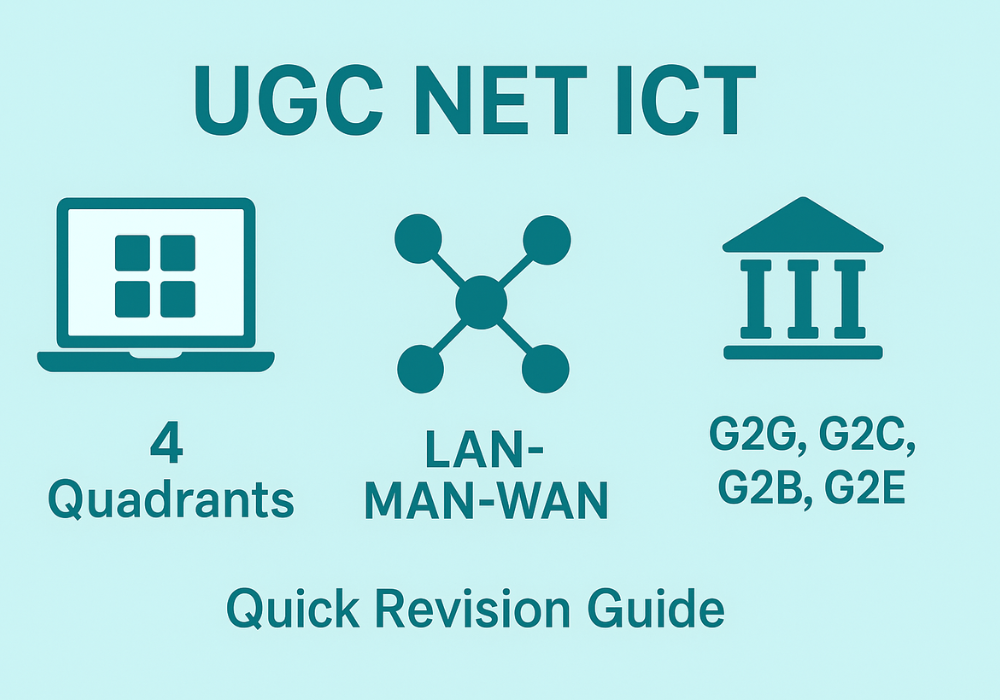
Quick revision guide for UGC NET Paper 1 ICT covering essential abbreviations, SWAYAM, digital initiatives, e-governance models, and exam strategies for high-scoring preparation. This article is written by Neeli Neelay Shah, Senior Legal Content Writer at LawSikho.

If you’re in the final stretch of your UGC NET preparation and need to consolidate your ICT knowledge quickly, this guide is designed exactly for you. Unit 8 on Information and Communication Technology typically contributes 5-6 questions worth 10-12 marks in UGC NET Paper 1, and with focused revision, you can secure most of these marks without spending disproportionate time. This quick revision guide cuts through the noise and delivers exactly what you need to know: essential abbreviations, high-scoring digital initiatives, e-governance fundamentals, and proven exam strategies that work.

Abbreviations and Terminology under ICT: UGC NET Quick Revision

Abbreviations are the building blocks of ICT questions in UGC NET. You’ll encounter at least 1-2 direct questions asking what specific terms stand for, and many other questions assume you already know these basics. Instead of memorizing an exhaustive list, focus on the high-frequency terms that appear repeatedly across exam cycles.

Computer Hardware and Software Abbreviations (CPU, RAM, ROM, OS, BIOS, GUI)

Hardware abbreviations describe the physical components that make up a computer system. The CPU, or Central Processing Unit, functions as the computer’s brain, executing all instructions and processing data. Think of it as the command center where all decisions get made. Within the CPU, the ALU (Arithmetic and Logical Unit) handles calculations, while the Control Unit manages data flow between components.

Memory terms come up frequently in matching questions. RAM (Random Access Memory) is your computer’s short-term memory; it’s volatile, meaning data disappears when power goes off. ROM (Read Only Memory) is permanent storage containing startup instructions. The key distinction examiners test is volatile versus non-volatile: RAM loses data without power, ROM retains it.

Software abbreviations are equally important for your preparation. OS stands for Operating System, the foundational software that manages everything on your computer. BIOS (Basic Input Output System) is the firmware that wakes up your hardware during startup. GUI (Graphical User Interface) is what lets you interact with computers through icons and windows rather than typing commands. Remember these as a connected chain: BIOS starts the computer, OS manages it, and GUI makes it user-friendly.

Networking and Internet Terms for UGC NET (LAN, WAN, HTTP, FTP, TCP/IP, DNS)

Network types are tested through comparison questions, so understanding their scope matters. LAN (Local Area Network) connects computers within a limited area like your home or office building. WAN (Wide Area Network) spans vast distances, connecting computers across cities or countries. The Internet itself is the largest WAN. MAN (Metropolitan Area Network) sits between these two, covering a city or town. A simple way to remember: LAN is your local neighborhood, MAN is your city, WAN is the world.

Protocol abbreviations describe how data moves across networks. HTTP (HyperText Transfer Protocol) governs how web browsers talk to websites; HTTPS adds encryption for security. FTP (File Transfer Protocol) handles file transfers between computers. TCP/IP (Transmission Control Protocol/Internet Protocol) is the fundamental language of the Internet, enabling all devices to communicate. DNS (Domain Name System) translates website names like google.com into numerical IP addresses that computers understand.

VPN (Virtual Private Network) creates secure, encrypted tunnels over public networks, which is why companies use them for remote work security. ISP (Internet Service Provider) is the company that gives you Internet access. URL (Uniform Resource Locator) is simply the address you type to reach a website. These terms appear in questions about Internet infrastructure and how users connect to online resources.

File Formats and Communication Protocols (SMTP, POP3, IMAP, MP3, PDF)

File format abbreviations describe how digital content is stored. PDF (Portable Document Format) preserves document formatting across different systems. MP3 (MPEG Audio Layer 3) revolutionized music by compressing audio files. MP4 handles video content. JPEG uses lossy compression for photographs, while PNG supports transparency and lossless compression. Questions may ask you to match file extensions with their full forms or identify which format suits specific purposes.

Email protocols determine how your messages travel and get retrieved. SMTP (Simple Mail Transfer Protocol) handles outgoing mail; when you hit send, SMTP takes over. For incoming mail, you have two options: POP3 (Post Office Protocol) downloads emails to your device and usually removes them from the server, while IMAP (Internet Message Access Protocol) keeps emails on the server and syncs across all your devices. The practical distinction: POP3 is for single-device users, IMAP is for people checking email on multiple devices.

HTML (HyperText Markup Language) is the coding language for creating web pages. CSS (Cascading Style Sheets) adds styling to HTML. XML (Extensible Markup Language) structures data for storage and transport. These web technologies form the foundation of how Internet content gets created and displayed. Understanding their basic functions helps answer questions about web development and digital content creation.

UGC NET ICT: Digital Initiatives in Higher Education

This section is your highest-scoring opportunity within ICT. Analysis of previous year papers shows that Digital Initiatives contribute a major chunk of all ICT questions. Mastering SWAYAM, its ecosystem, and related platforms can secure you 2-3 questions in every exam. Focus your revision energy here for maximum returns.

SWAYAM and the MOOCs: National Coordinators You Must Remember

SWAYAM stands for Study Webs of Active-Learning for Young Aspiring Minds. It’s India’s homegrown MOOCs (Massive Open Online Courses) platform developed by the Ministry of Education with AICTE and Microsoft. The platform provides free access to quality education from Class 9 through postgraduate levels. Remember the three principles SWAYAM addresses: access, equity, and quality in education.

The platform operates through four quadrants that create a complete learning experience. First comes video tutorials, typically 20 hours of content per course with lectures capped at 30 minutes each. Second is downloadable e-content for reading. Third is self-assessment through quizzes interspersed throughout the course. Fourth is discussion forums for clearing doubts. Questions often test whether you can identify these four quadrants or match them with their functions.

Seven national coordinators manage SWAYAM courses at different educational levels. NPTEL (IIT Madras) handles engineering courses. UGC coordinates postgraduate non-engineering content. CEC manages undergraduate programs. NCERT covers Classes 9-12 for school students. NIOS handles out-of-school learners at school level. IGNOU serves out-of-college students. IIM Bangalore coordinates management courses. A matching question might pair these coordinators with their respective domains, so memorize which coordinator handles which level.

SWAYAM Prabha and Educational DTH Channels

SWAYAM Prabha complements the online platform by delivering education through television for areas with limited Internet access. It consists of 40 DTH (Direct to Home) channels broadcasting educational content round the clock using the GSAT-15 satellite. New content airs for 4 hours daily and repeats 5 more times, letting students watch at convenient times.

The channels are uplinked from BISAG (Bhaskaracharya Institute for Space Applications and Geo-informatics) in Gandhinagar, and INFLIBNET maintains the web portal. Content comes from premier institutions including NPTEL, IITs, UGC, CEC, IGNOU, NCERT, and NIOS. The IIT-PAL channels specifically help Class 11-12 students prepare for JEE through courses in Mathematics, Physics, Chemistry, and Biology.

The key facts to remember: 40 channels, GSAT-15 satellite, BISAG Gandhinagar for uplinking, INFLIBNET for web portal. Questions typically ask about the number of channels, the satellite used, or the organization managing specific aspects. This initiative targets students in remote areas where Internet connectivity remains a challenge.

Digital Libraries and Research Platforms (NDL, e-Shodh Sindhu, INFLIBNET)

The National Digital Library of India (NDL) is a virtual repository providing single-window search access to learning resources. Developed by IIT Kharagpur under NMEICT, it hosts over 125 million digital resources covering all education levels from school to research. Think of it as a massive online library where you can access textbooks, articles, videos, and simulations through one search interface.

e-Shodh Sindhu was created by merging three previous consortia: UGC-INFONET Digital Library Consortium, N-LIST, and INDEST-AICTE Consortium. This unified platform provides access to over 15,000 international electronic journals and e-books for higher educational institutions. Researchers at eligible institutions can access premium content from major publishers without individual subscriptions.

INFLIBNET (Information and Library Network Centre) is an autonomous inter-university centre of UGC that coordinates library networking activities. It manages several key initiatives including the SWAYAM Prabha portal, Shodhganga (completed thesis repository), and e-Shodh Sindhu. N-LIST (National Library and Information Services Infrastructure for Scholarly Content) extends e-resource access to affiliated colleges, providing 6,500+ e-journals and 1.99 + lakhs e-books to institutions that might otherwise lack such resources.

Key Initiatives to Remember (NAD, VIDWAN, e-PG Pathshala, Virtual Labs)

NAD (National Academic Depository) stores academic awards digitally, including degrees, diplomas, certificates, and mark sheets. It enables paperless verification of credentials by employers and institutions. Part of the Digital India initiative, NAD eliminates the hassles of maintaining and producing physical certificates. When questions ask about digital certificate storage or verification, NAD is your answer.

VIDWAN is the expert database containing profiles of scientists, researchers, and faculty working in Indian academic and R&D organizations. Maintained by INFLIBNET, it helps identify peer reviewers, potential collaborators, and experts for various purposes. Think of it as LinkedIn for Indian researchers, but officially maintained and verified.

e-PG Pathshala provides high-quality e-content for postgraduate education across 70 subjects in arts, humanities, and social sciences. It contains over 23,000 modules including text, audio, video, and self-assessment materials. Virtual Labs offers remote access to laboratory experiments, with 205+ labs comprising 1,515 experiments across engineering and science disciplines. Both initiatives address resource gaps in institutions lacking physical infrastructure.

Teacher Training Platforms (ARPIT, DIKSHA, GIAN)

ARPIT (Annual Refresher Programme in Teaching) delivers online professional development for higher education faculty through the SWAYAM platform. It offers 40-hour refresher courses across disciplines, enabling teachers to earn credits for career advancement. This addresses the massive scale of faculty development needs in Indian higher education through online delivery.

DIKSHA (Digital Infrastructure for Knowledge Sharing) is the national platform for school education, providing curriculum-linked learning resources for teachers, students, and parents. While primarily targeting school education, it represents the broader digital education ecosystem and appears in questions comparing educational platforms by their target audiences.

GIAN (Global Initiative of Academic Networks) brings international faculty to Indian institutions for short-term courses. It taps global academic talent to enhance Indian higher education through knowledge exchange and exposure to international practices. Questions may ask you to identify which initiative involves foreign faculty engagement.

e-Governance Models and Applications: UGC NET ICT Quick Revision 

E-Governance applies ICT to government functions, transforming how citizens, businesses, and government entities interact. This sub-topic has gained importance in recent exams, with questions focusing on the four interaction models and specific government digital platforms. Understanding the framework helps you categorize any initiative correctly.

Understanding the Four e-Governance Models (G2G, G2C, G2B, G2E)

E-Governance operates through four models based on who interacts with whom. G2G (Government to Government) covers digital interactions between government departments. This includes electronic file management, digital signatures, and inter-departmental communication. The e-Office project exemplifies G2G by enabling paperless file movement across government departments.

G2C (Government to Citizen) initiatives include services directly to citizens through digital platforms. Examples include DigiLocker for document storage, Passport Seva for passport applications, Common Service Centres for rural service delivery, and various online certificate services. This model aims to make government services accessible, transparent, and convenient for citizens.

G2B (Government to Business) streamlines interactions between government and businesses. The GST portal handles tax compliance, GeM (Government e-Marketplace) manages public procurement, and MCA21 facilitates company registration. These platforms reduce compliance burden and improve ease of doing business. G2E (Government to Employee) covers internal operations like payroll management, provident fund systems through EPFO, and employee HR services.

Government to Citizen Initiatives (DigiLocker, Passport Seva, PAN Services)

DigiLocker provides citizens with cloud storage for official documents and certificates. It enables paperless verification through authentic digital documents issued directly by government agencies. Over 5 billion documents have been made available through this platform. When employers or institutions need to verify your credentials, DigiLocker eliminates the need for physical document submission.

Passport Seva transformed passport issuance into a citizen-friendly online system. You can apply online, schedule appointments, track application status, and receive updates digitally. The system significantly reduced processing time and eliminated multiple visits to passport offices. It’s a prime example of how G2C initiatives improve citizen convenience.

PAN (Permanent Account Number) services are delivered through NSDL and UTI Infrastructure Technology Services. Citizens can apply for new PAN cards, make corrections, and verify details online. This digitization streamlined tax administration and reduced paperwork. These three initiatives, DigiLocker, Passport Seva, and PAN services, frequently appear as examples of G2C governance in exam questions.

Digital India and Important Government Platforms

Digital India, launched in 2015, is the umbrella programme driving India’s digital transformation. It’s built on nine pillars covering infrastructure, governance, and empowerment. The infrastructure pillars include Broadband Highways, Universal Mobile Connectivity, and Public Internet Access Programme. Governance pillars cover e-Governance reforms, e-Kranti (electronic service delivery), and Information for All.

BharatNet (formerly National Optical Fibre Network) connects gram panchayats with optical fiber for rural broadband. It’s the world’s largest rural connectivity project, enabling digital services to reach the last mile. Aadhaar, managed by UIDAI, provides a 12-digit unique identification number that enables authentication and eKYC for accessing government services. With over 1.3 billion enrollments, it’s the world’s largest biometric ID system.

GeM (Government e-Marketplace) is the online platform for government procurement, providing transparency and efficiency in public purchases. It eliminates human interface in procurement and enables cashless, paperless transactions. Questions may ask you to identify GeM’s purpose or classify it under the correct e-governance model (G2B).

Cybersecurity Basics for UGC NET (Malware, Phishing, Firewalls)

Cybersecurity questions have increased in recent UGC NET exams, with the June 2025 exam including a question on malware characteristics. Malware (malicious software) encompasses viruses that replicate by inserting into programs, worms that spread without user action, trojans disguised as legitimate software, and ransomware that encrypts data for extortion. Know the basic distinction between these types.

Phishing is a social engineering attack where criminals impersonate trustworthy entities to steal sensitive information through fake emails or websites. Logic bombs are malicious code that activates when specific conditions are met. These threat types represent the human and technical dimensions of cyber attacks that you should be able to identify.

Firewalls act as barriers between trusted internal networks and untrusted external networks, monitoring and controlling traffic based on security rules. Encryption converts data into coded form readable only with the correct key; HTTPS uses encryption to secure web communications. Antivirus software detects and removes malware. Understanding these basic defense mechanisms helps answer security-related questions.

UGC NET ICT Quick Revision: Exam Strategy and Question Patterns

Knowing what to study is only half the battle; knowing how questions appear helps you prepare strategically. This section distills patterns from previous year papers and provides actionable strategies for maximizing your ICT score with limited revision time.

High-Frequency Topics

Digital Initiatives dominate ICT questions. Within this, SWAYAM appears most consistently, with questions testing the four quadrants, seven national coordinators, and free versus paid aspects. NDL, e-Shodh Sindhu, and INFLIBNET follow in frequency. Prioritize these topics if you’re short on time.

Abbreviation questions, Network types (LAN, MAN, WAN) and protocols (HTTP, FTP, SMTP) appear most often. E-Governance questions have increased recently, particularly about the four models and their examples. Cybersecurity concepts, while newer, appeared in June 2025 and likely signal continued emphasis.

The safest strategy allocates your ICT revision time proportionally: spend 40% on digital initiatives, 25% on abbreviations, 20% on e-governance, and 15% on Internet concepts. This mirrors actual question distribution and ensures you’re prepared for the most likely questions.

Common Question Types in ICT Section

Direct factual questions test whether you know what abbreviations stand for or which organization launched specific initiatives. These are straightforward if you’ve memorized the essential terms. Examples include “SWAYAM stands for” or “Which platform has 40 DTH educational channels?”

Matching questions present two columns for pairing. A typical format lists digital initiatives in one column (SWAYAM, NAD, NDL) and their purposes in another (MOOCs platform, academic depository, digital library). Practice these by creating your own matching exercises from the initiatives covered in this guide.

Statement-based questions present two statements for evaluation, asking whether both are true, both false, or one of each. Common traps include partially correct statements. For example: “Statement I: SWAYAM courses are completely free. Statement II: NPTEL is coordinated by IIT Bombay.” (Both are false: SWAYAM certification costs money, NPTEL is IIT Madras.) Read statements carefully for subtle inaccuracies.

Last-Minute Revision for ICT

In your final days, focus on rapid recall rather than learning new material. Create a one-page summary containing the 40-50 essential abbreviations, the 15 key digital initiatives with one distinguishing fact each, and the four e-governance models with two examples each. Review this sheet multiple times daily.

Use the SWAYAM memory chain: four quadrants (Video, e-Content, Self-assessment, Discussion) and seven coordinators (NPTEL-Engineering, UGC-PG, CEC-UG, NCERT-School, NIOS-Out-of-school, IGNOU-Out-of-college, IIMB-Management). For SWAYAM Prabha, remember: 40 channels, GSAT-15, BISAG, INFLIBNET.

Practice 10-15 previous year ICT questions in the last three days. This builds pattern recognition and confidence. Most ICT questions test recognition, not analysis, so systematic memorization combined with question practice yields excellent results. Time yourself to ensure you can answer quickly during the actual exam.

Conclusion

The ICT section offers one of the best scoring opportunities in UGC NET Paper 1 for candidates willing to invest focused effort. With 5-6 questions worth 10-12 marks and content that rewards memorization over complex analysis, you can realistically aim for full marks in this unit. Prioritize digital initiatives (especially SWAYAM and its ecosystem), master the essential 40-50 abbreviations, understand the four e-governance models, and practice previous year questions to recognize common patterns. The strategies in this guide, combined with consistent revision in your final preparation days, will position you to maximize your ICT score when you walk into the exam hall.

To dive deep into the ICT preparation for UGC NET exam, follow this link:

Other Related Readings: Data Interpretation UGC NET- , Research Aptitude for UGC NET Paper 1: Essential Concepts Simplified (Unit 2): Teaching Aptitude for UGC NET Paper 1: Essential Guide for Unit 1 Preparation: 

The post NTA UGC NET Exam: ICT appeared first on iPleaders.


News
Berita Teknologi
Berita Olahraga
Sports news
sports
Motivation
football prediction
technology
Berita Technologi
Berita Terkini
Tempat Wisata
News Flash
Football
Gaming
Game News
Gamers
Jasa Artikel
Jasa Backlink
Agen234
Agen234
Agen234
Resep
Cek Ongkir Cargo
Download Film

Quick revision guide for UGC NET Paper 1 ICT covering essential abbreviations, SWAYAM, digital initiatives, e-governance models, and exam strategies for high-scoring preparation. This article is written by Neeli Neelay Shah, Senior Legal Content Writer at LawSikho. If you’re in the final stretch of your UGC NET preparation and need to consolidate your ICT knowledge quickly, this guide is designed


Compare CPA vs CA for Indian professionals. Understand key differences in difficulty, duration, cost in INR, and career opportunities to make the right choice. This article is written by Medha Vinod, Senior Associate at LawSikho.

Planning your CPA exam preparation without knowing exactly how many hours each section demands is like starting a road trip without checking the distance. For Indian professionals juggling demanding jobs, family responsibilities, and the challenge of learning US accounting standards, accurate study hour estimates aren’t just helpful; they’re essential for success. This guide cuts through generic American advice to give you realistic, India-specific study hour recommendations for all six CPA exam sections, plus practical timelines that actually work around your schedule.

The CPA exam changed significantly in January 2024, moving from four fixed sections to a flexible model that gives you some control over your exam path. Understanding this structure is your first step toward accurate study planning, because your section choices directly impact how many total hours you’ll need.

Download Now

Core Sections: FAR, AUD, REG

Every CPA candidate must pass three Core sections regardless of career goals or specialization. 

Financial Accounting and Reporting (FAR) tests your mastery of US GAAP, financial statement preparation, and accounting for various entity types, including governments and nonprofits. This section carries the heaviest content load and consistently shows the lowest pass rates, hovering around 40-43% in recent quarters.

Auditing and Attestation (AUD) examines the complete audit process, from client acceptance through final reporting. Unlike FAR’s calculation-heavy content, AUD emphasizes professional judgment and conceptual understanding. You’ll need to know when different audit opinions apply, how to assess risk, and what evidence supports various conclusions. Pass rates for AUD typically fall in the 46-48% range.

Taxation and Regulation (REG) covers US federal taxation and business law fundamentals. For Indian candidates, this section presents unique challenges because US tax concepts differ substantially from Indian taxation. However, REG also shows the highest Core section pass rates at 60-64%, suggesting that focused preparation pays off despite the new material.

Discipline Sections: BAR, ISC, TCP

Your fourth section is a choice among three Disciplines, each building on knowledge from a related Core section. 

Business Analysis and Reporting (BAR) extends FAR concepts into advanced technical accounting, managerial accounting, and deeper governmental reporting. This Discipline demands the most study hours and shows the lowest pass rates among the three options.

Information Systems and Controls (ISC) builds on AUD foundations, focusing on IT audit, data management, and System and Organization Controls engagements. If you’re comfortable with technology concepts or interested in IT audit careers, ISC offers a solid path. Pass rates are typically around 68%.

Tax Compliance and Planning (TCP) extends REG into advanced tax planning for individuals and entities. This Discipline consistently shows the highest pass rates of any CPA section, often exceeding 75%. The strong connection to REG content means candidates who recently passed REG often find TCP manageable with efficient preparation.

Before diving into section-specific numbers, let’s establish the total picture. How many hours should you realistically budget for earning your CPA credential as an Indian professional?

Standard Hour Recommendations and Indian Adjustments

Major review providers like Becker recommend 320-420 total hours across all four sections. The AICPA doesn’t publish official guidelines, but industry consensus based on successful candidate data suggests 300-500 hours depending on background and study efficiency. These recommendations assume candidates studied US accounting principles in college and work standard schedules with predictable free time.

Indian candidates should expect to land in the middle-to-upper range of these estimates. You’re learning US GAAP from scratch rather than reviewing familiar material, which adds time to FAR preparation. US taxation in REG is entirely new, regardless of your Indian tax expertise. Factor in the reality of longer Indian workdays and family obligations, and you’re looking at 350-500 total hours for most Indian professionals.

The good news is that your rigorous Indian education provides advantages too. If you’re CA-qualified, your accounting foundations are exceptionally strong. Even B.Com and M.Com graduates have solid theoretical grounding that helps with understanding complex concepts quickly.

How Your Background Affects Study Time Requirements

Your existing qualifications significantly influence how you should allocate study hours. Chartered Accountants typically need 300-380 total hours because their deep accounting knowledge reduces FAR and AUD preparation time. However, CAs shouldn’t underestimate REG; US taxation requires full attention regardless of Indian tax expertise.

B.Com and M.Com graduates without professional certifications should budget 380-450 hours. Your academic foundation helps, but you’ll need more time building practical understanding of concepts that working professionals learn through job experience. Fresh graduates might need even more, potentially 400-500 hours, but benefit from sharp study skills and recent academic exposure.

Working professionals in accounting or finance roles fall somewhere in between. Your practical experience accelerates certain topics, while your limited weekly study hours extend your timeline. Budget 350-420 hours and plan for an 18-month completion window to maintain sustainable weekly commitments.

Now let’s break down exactly how many hours each section demands. These estimates come from analyzing review provider data, pass rate correlations, and feedback from Indian candidates who’ve successfully completed the exam.

Core Sections: FAR, AUD, and REG Hour Breakdown

FAR requires the largest time investment at 100-150 hours for most Indian candidates. The section covers vast content including financial reporting frameworks, complex transactions like leases and revenue recognition, and specialized areas like governmental and nonprofit accounting. Indian candidates typically need the upper range because US GAAP differs meaningfully from Indian GAAP and Ind AS in several areas. Plan to spend roughly 40% of your FAR time on financial reporting concepts, 35% on balance sheet accounts, and 25% on select transactions.

AUD demands 80-120 hours with time weighted toward understanding audit procedures and professional judgment. Many Indian candidates assume audit work experience will reduce AUD study time, but the exam tests theoretical knowledge that may differ from daily practice. The section’s conceptual nature means you can’t simply memorize procedures; you must understand the reasoning behind audit decisions. Allocate significant practice time to simulations, which often present complex scenarios requiring judgment calls.

REG requires 80-110 hours with emphasis on federal taxation concepts. Despite being entirely new material for Indian candidates, REG shows strong pass rates because the content, while unfamiliar, follows logical structures that diligent study can master. Individual and entity taxation comprise roughly 70% of the content, so prioritize these areas. Business law concepts, while important, carry less weight and can be covered more efficiently.

Discipline Sections: BAR, ISC, and TCP

BAR demands 100-150 hours, matching FAR as the most time-intensive section. The advanced technical content builds substantially on FAR, covering consolidations, derivatives, and governmental accounting at deeper levels. Managerial accounting concepts, including cost accounting and budgeting add breadth beyond pure financial reporting. If you struggled with FAR, expect BAR to require similar or greater effort.

ISC requires 80-100 hours for most candidates, though those without IT backgrounds should plan for the higher end. Content covers information systems, data management, security concepts, and SOC engagement requirements. The section rewards conceptual understanding over technical expertise; you don’t need programming skills, but you must grasp how controls function in technology environments.

TCP typically requires 80-100 hours with potential for less if you take it shortly after passing REG. The direct content connection means recent REG knowledge transfers efficiently to TCP preparation. Tax-focused professionals or those who performed well on REG can sometimes prepare adequately in 70-80 hours. This efficiency, combined with consistently high pass rates, makes TCP the most time-efficient Discipline choice for many candidates.

Selecting the Right Discipline Based on Study Efficiency

If minimizing total study hours is your priority, TCP offers the clearest advantage. The section’s high pass rates and direct connection to REG content create genuine study efficiencies. Candidates who take TCP within two to three months of passing REG often report needing significantly less preparation time than those who delay.

However, don’t choose your Discipline based solely on study hours. Your selection affects your professional positioning and the knowledge you carry throughout your career. If your goals involve financial reporting leadership, BAR’s advanced content serves you despite requiring more hours. If IT audit interests you, ISC’s technology focus builds relevant expertise regardless of slightly longer preparation.

For most Indian candidates without strong preferences, TCP represents the pragmatic choice. The study hour savings are real, pass rates are highest, and tax knowledge remains professionally valuable in most accounting career paths.

Study hours only become meaningful when translated into a realistic timeline. The following frameworks account for Indian professional realities, helping you choose a path that matches your actual life circumstances.

Three Timeline Options: 12, 18, or 24 Months

The 12-month aggressive timeline works for candidates who can commit 20-25 hours weekly and maintain intensity throughout an entire year. This path typically involves studying before work, during lunch, after dinner, and most of both weekend days. It’s achievable but demanding, best suited for candidates with employer support, flexible work arrangements, or particularly strong motivation.

The 18-month balanced timeline suits most Indian working professionals. At 15-18 hours weekly, you’re studying roughly two hours on weekdays plus substantial weekend sessions. This pace is demanding but sustainable, allowing for occasional missed sessions without derailing your overall plan. The 18-month window also provides buffer for potential retakes while staying comfortably within the 30-month completion requirement.

The 24-month conservative timeline fits candidates with exceptionally demanding careers, significant family obligations, or preferences for thorough preparation. At 10-12 hours weekly, progress feels slow, but consistency compounds over time. The risk with longer timelines is maintaining motivation; two years is a significant commitment, and life circumstances can change substantially.

Weekly Hour Commitments for Each Path

Your timeline choice determines your weekly commitment, which in turn shapes your daily routine. The 12-month path requires finding 20-25 hours every single week for a full year. That’s roughly three hours daily plus eight to ten weekend hours, leaving little flexibility for unexpected work demands or personal obligations.

The 18-month path’s 15-18 weekly hours typically translates to two hours on weekday evenings plus six to eight hours across the weekend. This structure leaves some breathing room; missing one evening session doesn’t create crisis-level gaps. Most successful Indian candidates follow some version of this approach.

The 24-month path’s 10-12 weekly hours can be achieved through concentrated weekend studying alone, making it viable for professionals whose weekday schedules are genuinely unpredictable. However, this pace requires exceptional consistency; missing even one weekend creates gaps that take weeks to recover.

Fitting Study Hours Around Indian Work Schedules

Indian professionals face scheduling challenges that American study guides don’t address. Workdays regularly extend beyond standard hours, commutes in metros like Mumbai, Delhi, and Bangalore consume significant time, and family and social obligations carry different weight than in Western cultures.

Two primary study structures work within these constraints. The weekday evening model dedicates two hours nightly after dinner, typically 8-10 PM, supplemented by weekend sessions. This approach requires protecting evening time from work spillover and social demands but offers consistent daily progress. The weekend intensive model concentrates eight to ten hours across Saturday and Sunday, minimizing weekday study pressure but requiring dedicated weekend commitment.

Most successful candidates use hybrid approaches, studying when possible on weekdays while protecting substantial weekend blocks for intensive work. The key is matching your structure to your actual life rather than forcing yourself into patterns that don’t fit. A sustainable 15-hour week outperforms an unsustainable 25-hour week that leads to burnout.

How efficiently you study matters as much as how many hours you log. Smart techniques can reduce total hours needed while improving retention and exam performance.

High-Impact Study Techniques That Save Time

Start each topic with practice questions before watching lectures or reading content. This test-first approach, supported by learning science research, immediately reveals what you don’t know. When you then review material, your attention naturally focuses on filling specific gaps rather than treating everything equally.

Prioritize active learning over passive consumption. Watching video lectures feels productive but builds limited exam-ready knowledge unless paired with immediate practice. For every hour of content consumption, spend at least an equal time answering questions and working simulations. Many successful candidates follow a ratio of 40% content review to 60% practice.

Practice simulations from early in your preparation, not just during final review weeks. Simulations test applied knowledge in realistic scenarios and carry significant exam weight. Candidates who neglect simulation practice often pass multiple-choice sections while struggling with task-based simulations, leading to failed attempts despite strong content knowledge.

Common Mistakes That Waste Study Hours

Over-reliance on video lectures is the most common time-waster. Lectures provide foundation but cannot substitute for practice. Candidates who watch every lecture multiple times while minimizing practice questions typically need more total hours than those who balance content and practice effectively.

Perfectionism in low-weight topics drains hours that should go elsewhere. Not all content carries equal exam weight, and the AICPA blueprints specify topic weightings clearly. Spending ten hours mastering a 5% topic while rushing through a 25% topic is poor time allocation regardless of how many total hours you invest.

Ignoring progress data leads to wasted effort. Quality review courses provide analytics showing your performance by topic area. Candidates who study without tracking progress often over-review material they’ve already mastered while under-preparing genuinely weak areas. Check your metrics regularly and adjust focus accordingly.

Earning your CPA credential requires substantial time investment, but the path becomes manageable with realistic planning. Most Indian candidates need 350-500 total hours spread across 12-24 months depending on background and weekly availability. FAR demands the most attention at 100-150 hours, while TCP offers the most efficient Discipline path at 80-100 hours with pass rates exceeding 75%.

Choose your timeline based on honest assessment of available weekly hours rather than aspirational commitments you cannot sustain. The 18-month balanced path works for most working professionals, providing sustainable weekly loads while maintaining momentum toward completion. Whatever timeline you select, consistency matters more than intensity; regular study sessions compound into exam readiness more reliably than sporadic marathon efforts.

Your CPA journey starts with understanding exactly what lies ahead. You now have the study hour estimates and timeline frameworks needed to build a concrete plan. The next step is mapping your specific situation to these frameworks and committing to a start date. Thousands of Indian professionals have earned this credential while managing demanding careers and personal responsibilities. With clear planning and sustained effort, you’ll join them.If you want a more comprehensive study plan, please check this.

Serato DJ Crack 2025Serato DJ PRO Crack


News
Berita Teknologi
Berita Olahraga
Sports news
sports
Motivation
football prediction
technology
Berita Technologi
Berita Terkini
Tempat Wisata
News Flash
Football
Gaming
Game News
Gamers
Jasa Artikel
Jasa Backlink
Agen234
Agen234
Agen234
Resep
Cek Ongkir Cargo
Download Film

Compare CPA vs CA for Indian professionals. Understand key differences in difficulty, duration, cost in INR, and career opportunities to make the right choice. This article is written by Medha Vinod, Senior Associate at LawSikho. Planning your CPA exam preparation without knowing exactly how many hours each section demands is like starting a road trip without checking the distance. For


CPA exam pass rates: Understand section-wise difficulty, choose the right discipline, and learn proven strategies to pass. This article is written by Rohit Arora, Senior Associate at LawSikho.

If you are an Indian professional considering the US CPA certification, understanding pass rates is one of the smartest moves you can make before diving into preparation. These numbers are not just statistics. 

They reveal which sections challenge candidates the most, how the exam has evolved under CPA Evolution, and what realistic expectations you should set for your journey.

Download Now

Whether you are a Chartered Accountant looking to add an international credential, a B.Com graduate exploring global opportunities, or a working professional in a Big 4 firm, this guide breaks down exactly what 2025 pass rates mean for you and how to use this data to plan a winning strategy.

Before you start preparing for any section of the CPA exam, you need to understand where candidates typically succeed and where they struggle. The American Institute of Certified Public Accountants releases pass rate data quarterly, and the 2024 and 2025 numbers tell a compelling story about the exam’s difficulty under the new CPA Evolution format.

The CPA exam now consists of three core sections that everyone must pass, plus one discipline section of your choice. 

The core sections are 

  • Auditing and Attestation (AUD), 
  • Financial Accounting and Reporting (FAR), and 
  • Regulation (REG). 

For your discipline, you choose one from Business Analysis and Reporting (BAR), Information Systems and Controls (ISC), or Tax Compliance and Planning (TCP). Each section requires a minimum score of 75 on a 0 to 99 scale, and you must pass all four within an 18 to 30-month window, depending on your jurisdiction.

Pass Rate Trends for Core CPA Sections: AUD, FAR, and REG

The three core sections show distinctly different performance patterns, and understanding these differences can shape how you approach your preparation.

FAR consistently records the lowest pass rates among core sections. 

In 2025, the cumulative pass rate stands at approximately 42.80%, with quarterly figures hovering between 41% and 43%. 

This section covers extensive financial accounting and reporting standards under US GAAP, including complex topics like consolidations, government accounting, and not for profit entities. 

For Indian candidates trained primarily in Ind AS or IFRS, the adjustment to US GAAP principles adds another layer of challenge. If you find yourself wondering why so many candidates struggle with FAR, the answer lies in its sheer volume and the depth of technical knowledge required.

AUD falls in the middle of the difficulty spectrum with a 2025 cumulative pass rate of around 48%. The section tests your understanding of audit procedures, professional responsibilities, and attestation engagements. While the concepts may feel familiar if you have audit experience, the exam requires you to apply judgment in scenario-based questions. Many candidates find AUD tricky because correct answers often depend on subtle distinctions between acceptable and best practices.

REG stands out as the strongest performer among core sections, with pass rates consistently above 60%. 

The 2025 cumulative rate sits at approximately 64%, making it the most passable core section. REG covers federal taxation for individuals, entities, and property transactions, along with business law and ethics. Indian candidates often find REG challenging initially because US tax law differs significantly from Indian taxation. However, the structured nature of tax rules means that a dedicated study typically yields good results.

Discipline Section Pass Rates: How BAR, ISC, and TCP Perform in Recent Years

The discipline sections introduced under CPA Evolution in 2024 have shown dramatically different pass rates, and these numbers should definitely influence your selection strategy.

TCP leads all sections with the highest pass rates by a significant margin. The cumulative 2025 pass rate exceeds 78%, with some quarters reaching above 80%. According to AICPA’s official pass rate data, TCP’s strong performance can be attributed to its close alignment with REG content. 

Candidates who perform well in REG often carry that momentum into TCP, especially if they work in tax or have a genuine interest in taxation. For Indian CAs with taxation experience, TCP often feels like a natural extension of what they already know.

ISC has shown remarkable improvement since its introduction. Pass rates climbed from around 51% in early 2024 to approximately 68% cumulatively in 2025. This upward trend suggests that candidates and review course providers have adapted well to the section’s content, which covers information systems, data management, and cybersecurity concepts. If you have a background in IT audit, systems implementation, or data analytics, ISC might be your strongest option.

BAR presents the greatest challenge among discipline sections. 

The cumulative 2025 pass rate hovers around 42%, with Q4 2024 dropping as low as 33%. BAR absorbed much of the advanced financial reporting content that previously lived in FAR, including topics like business combinations, derivatives, and foreign currency transactions. Candidates without strong advanced accounting backgrounds often find BAR overwhelming. If you choose BAR, expect to invest significantly more study time compared to TCP or ISC.

Understanding pass rates is valuable, but the real question is how these numbers apply specifically to your situation as an Indian professional. The CPA exam is identical worldwide, meaning you face the same questions and scoring standards as candidates in the United States. However, your path to success involves navigating challenges that American candidates simply do not encounter.

Challenges Unique to Indian Professionals

Indian candidates typically perform at par with global averages, achieving pass rates between 45% and 55% across sections. However, several factors make your journey distinct from U.S.-based candidates.

The transition from Indian accounting standards to US GAAP creates a learning curve that American accounting graduates do not face. While Ind AS has converged significantly with IFRS, US GAAP remains a separate framework with its own rules for revenue recognition, leases, and financial instruments. You will need to unlearn certain approaches and relearn them the American way, which requires additional study time.

Working while preparing for the CPA exam is the reality for most Indian candidates. 

Unlike many American candidates who take the exam shortly after graduation, Indian professionals often pursue a CPA while managing full-time jobs, sometimes with demanding schedules in Big 4 firms or MNCs. Balancing a 50 to 60-hour work week with CPA preparation requires exceptional time management.

Time zone differences affect your access to live classes, doubt-clearing sessions, and even exam scheduling. If you are working with a US-based review course, live sessions might fall at inconvenient hours. Planning your study schedule around these constraints becomes essential.

The psychological aspect matters too. Pass rates below 50% can feel intimidating, especially when you are investing significant money in exam fees, review courses, and credential evaluation. 

Understanding that roughly half of all candidates pass each section should motivate you to join the successful half through thorough preparation rather than discourage you from attempting the exam.

How to Use Pass Rate Data in Your Exam Planning

Pass rates become genuinely useful when you translate them into actionable planning decisions rather than viewing them as abstract statistics.

Start by identifying which sections play to your strengths. 

If you have a taxation background, the combination of REG and TCP gives you two sections with historically high pass rates. If your experience lies in audit, pairing AUD with ISC might leverage your existing knowledge. Matching your background to favorable sections improves your odds significantly.

Consider exam sequencing based on difficulty patterns. 

Many successful candidates recommend taking the FAR first while your motivation is highest and your study habits are fresh. Getting the hardest section out of the way early prevents it from becoming a psychological barrier later. Alternatively, some candidates prefer building confidence by passing an easier section first. There is no universally correct answer, but your decision should be informed by the data.

Pay attention to quarterly variations when scheduling your exams. Pass rates typically dip in Q1 and Q4, coinciding with the busy season for accountants and holiday distractions. Q2 and Q3 tend to show stronger performance as recent graduates enter the candidate pool with fresh academic knowledge. If your schedule allows flexibility, targeting these quarters might work in your favor.

Selecting your discipline section is one of the most consequential decisions in your CPA journey. While pass rates provide useful guidance, your choice should ultimately align with your educational background, professional experience, and career aspirations.

Matching Your Academic and Professional Background to the Best CPA Discipline

Your existing knowledge base significantly influences how difficult each discipline section will feel during preparation.

Chartered Accountants typically find TCP most accessible. Your CA curriculum covered extensive taxation concepts, and while US tax law differs from Indian law, the analytical approach transfers well. The structured nature of tax rules means you can systematically learn the differences. Many Indian CAs report that TCP felt manageable after completing REG, as the sections share conceptual foundations.

B.Com and M.Com graduates without CA should evaluate their coursework and interests carefully. If your degree included strong exposure to advanced accounting topics like consolidations and derivatives, BAR might not feel as daunting. However, if your accounting education focused more on the basics, TCP or ISC could offer smoother paths. Consider which subjects you enjoyed and performed well in during your degree.

MBA Finance professionals and Company Secretaries often gravitate toward ISC, especially if their roles involve governance, internal controls, or information systems. 

The section covers SOC reports, IT general controls, and data analytics, topics that align well with corporate governance and risk management backgrounds. If you have worked on systems implementations or IT audit engagements, ISC leverages that experience directly.

Candidates currently working in tax roles, whether in Big 4 or industry, almost always benefit from choosing TCP. Your daily work reinforces the concepts tested, and you can apply practical knowledge to exam scenarios. 

The inverse applies too. If you have never touched a tax return and find taxation concepts unintuitive, forcing yourself through TCP because of its high pass rate might backfire.

Why CPA Pass Rates Should Guide, Not Decide, Your Discipline Selection

While TCP’s 78% pass rate looks attractive compared to BAR’s 42%, choosing solely based on these numbers can lead you astray.

The AICPA has explicitly stated that higher pass rates do not mean a section is easier for every candidate. TCP’s strong numbers partly reflect self-selection. 

Candidates who choose TCP often have tax backgrounds or have just completed REG, meaning they enter the section with relevant preparation. Similarly, BAR attracts candidates pursuing careers in financial reporting, many of whom accept the challenge despite knowing it is difficult.

Your career goals should weigh heavily in this decision. If you plan to specialize in financial reporting, work in controllership, or pursue CFO track roles, BAR provides directly relevant knowledge despite its lower pass rate. The concepts you learn will serve you throughout your career. Choosing TCP solely for an easier path, while planning a career in financial reporting, means you miss valuable learning opportunities.

Consider the study time trade-off realistically. BAR might require 150 hours of preparation, whereas TCP requires 100 hours. If that extra 50 hours prevents burnout and keeps you engaged with material you find interesting, the investment pays dividends. If those extra hours feel like a grind through content you will never use professionally, TCP becomes the smarter choice.

Knowing pass rates and understanding section difficulty only helps if you translate that knowledge into effective preparation habits. Here are five strategies that consistently separate candidates who pass from those who struggle.

The Best Timing and Sequencing Strategy for CPA Exam Attempts

Strategic timing can meaningfully improve your chances of joining the successful candidate pool.

Many successful candidates recommend the FAR first approach. Since FAR has the lowest pass rate and the most extensive content, tackling it early ensures you engage with the hardest material when your energy and commitment are highest. Passing the FAR first also builds tremendous confidence. You have conquered the most feared section, and everything else feels achievable by comparison.

Alternatively, some candidates prefer the confidence builder approach, starting with REG or their chosen discipline section if they have relevant background knowledge. Passing your first section validates your preparation methods and proves you can succeed. This psychological boost carries forward into subsequent sections.

Regardless of which section you start with, avoid scheduling your toughest sections in Q4. The data consistently shows lower pass rates during October through December. Holiday commitments, year-end work pressures, and general fatigue take their toll. If possible, schedule challenging sections for Q2 or Q3 when candidate performance historically peaks.

Use the 18-month window strategically. While some candidates rush to complete all sections quickly, others space them out to allow for adequate preparation. Your ideal pace depends on your work schedule, personal commitments, and study capacity. A candidate who takes 18 months and passes all sections on the first attempt spends less money and experiences less stress than someone who rushes, fails multiple sections, and extends their timeline through retakes.

Effective Study Approaches for Working Indian Professionals

Preparing for the CPA exam while working full-time in India requires a disciplined approach tailored to your constraints.

Invest in a quality review course from providers like Becker, Wiley, Gleim, or Surgent. These courses structure the vast CPA content into manageable modules, provide practice questions aligned with exam format, and offer simulated exams that build familiarity with the testing interface. The cost feels significant, but candidates who use structured review courses consistently outperform those who attempt self-study.

Create a realistic study schedule that accounts for your actual availability. Most candidates need 300 to 400 hours of total study time across all four sections, translating to roughly 80 to 100 hours per section. If you can dedicate 15 hours weekly to studying, one section takes approximately 6 to 7 weeks. Build in buffer time for unexpected work demands, illness, or simply needing a mental break.

Prioritize practice questions over passive reading. The CPA exam tests application, not memorization. Working through hundreds of multiple-choice questions and task-based simulations builds the pattern recognition and analytical skills the exam rewards. Many successful candidates follow the 80/20 rule, spending 80% of their study time on active practice and only 20% on reviewing content.

Join study groups or online communities with other Indian CPA candidates. Platforms like Reddit, LinkedIn groups, and coaching institute forums connect you with peers facing identical challenges. Discussing difficult concepts, sharing study strategies, and simply knowing others understand your struggle provides both practical help and emotional support.

CPA exam pass rates tell a clear story for Indian candidates. FAR and BAR demand the most preparation, REG and TCP reward structured study with higher success rates, and AUD and ISC fall somewhere in between. 

Your background, career goals, and personal circumstances should guide your discipline selection rather than pass rates alone. Strategic exam timing, quality review materials, and consistent practice separate successful candidates from those who struggle. The roughly 50% overall pass rate means that half of all candidates prove it is possible. With the right preparation, you can absolutely join them.

For an in-depth article on the CPA Exam Pass Rate, read my article here.

Serato DJ Crack 2025Serato DJ PRO Crack


News
Berita Teknologi
Berita Olahraga
Sports news
sports
Motivation
football prediction
technology
Berita Technologi
Berita Terkini
Tempat Wisata
News Flash
Football
Gaming
Game News
Gamers
Jasa Artikel
Jasa Backlink
Agen234
Agen234
Agen234
Resep
Cek Ongkir Cargo
Download Film

CPA exam pass rates: Understand section-wise difficulty, choose the right discipline, and learn proven strategies to pass. This article is written by Rohit Arora, Senior Associate at LawSikho. If you are an Indian professional considering the US CPA certification, understanding pass rates is one of the smartest moves you can make before diving into preparation. These numbers are not just


Master UGC NET Paper 1 with this quick guide to high-weightage topics. Learn which units score maximum marks and prepare smartly for the upcoming exam. This article is written by Neeli Neelay Shah, Senior Legal Content Writer on LawSikho.

You have 10 units to cover, 50 questions to answer, and roughly 60 minutes to prove your teaching and research aptitude. The math is simple but the challenge is real: spreading yourself thin across all topics guarantees average performance at best. The smarter approach? Identify which topics consistently appear in exams, master those first, and allocate your remaining time strategically. This guide cuts through the clutter and gives you exactly what you need: the high-weightage topics that will maximize your UCG NET Paper 1 score with focused, efficient preparation.

Understanding UGC NET Paper 1 Structure and Why Weightage Matters

Quick Overview of UGC NET Paper 1 Exam Pattern

UGC NET Paper 1 tests general teaching and research aptitude through 50 objective questions worth 100 marks. The questions span 10 units: Teaching Aptitude, Research Aptitude, Reading Comprehension, Communication, Mathematical Reasoning, Logical Reasoning, Data Interpretation, ICT, People and Environment, and Higher Education System. 

The exam runs in Computer Based Test mode as part of a combined 3-hour session with Paper 2. Most successful candidates recommend allocating 50-60 minutes for Paper 1, leaving the remaining time for the subject-specific Paper 2. The absence of negative marking is your friend here: attempt every question, even if you need to make educated guesses on unfamiliar topics.

How to Choose Topics for Higher Scores in UGC NET Paper 1 

Here is the reality that changes everything: while each unit officially carries equal weightage, not all units are equally predictable or equally easy to prepare. Some topics repeat year after year with minor variations. Others draw from such vast pools that comprehensive preparation becomes impractical. Recognising this distinction lets you invest your preparation time where it yields maximum returns.

Think about it practically. If Teaching Aptitude questions consistently test levels of teaching and evaluation methods, mastering these specific concepts virtually guarantees 5-6 marks. Compare this to Environment, where questions might come from any corner of a massive syllabus covering pollution, climate change, SDGs, and international agreements. Both units offer 10 marks, but one rewards focused preparation far more reliably than the other.

High-Weightage Topics Across All 10 Units of UGC NET Paper 1

Teaching Aptitude: Focus on Levels of Teaching and Evaluation Methods

Teaching Aptitude rewards candidates who understand core pedagogical concepts rather than those who memorize textbook definitions. The three levels of teaching, memory level, understanding level, and reflective level, appear in some form almost every session. Memory level involves rote learning and recall, understanding level emphasizes comprehension and application, and reflective level requires critical thinking. Questions typically present classroom scenarios and ask you to identify which level applies.

Evaluation methods form another consistently tested area. Know the difference between formative assessment (ongoing feedback during learning) and summative assessment (final evaluation after learning). Continuous Comprehensive Evaluation, criterion-referenced testing, and Bloom’s Taxonomy of educational objectives also appear regularly. If you understand how different assessment approaches serve different purposes, these questions become straightforward.

Learner characteristics and teaching methods round out the high-priority topics. Understand how visual, auditory, and kinesthetic learners differ, and recognize when teacher-centred approaches (lectures, demonstrations) work better versus learner-centred methods (discussions, projects, collaborative learning). These concepts connect logically, so understanding the framework helps you answer various question formats.

Research Aptitude: Master Sampling, Hypothesis, and Research Types

Research Aptitude intimidates candidates without research backgrounds, but the testing pattern is actually quite predictable. Four categories dominate: research types, sampling techniques, hypothesis formulation, and research ethics. Master these, and you cover the vast majority of questions from this unit.

Research types include fundamental (theoretical, no immediate application), applied (solving practical problems), action (practitioners improving their own practice), and experimental (manipulating variables to establish causation). Questions ask you to identify which type suits given scenarios or to distinguish characteristics between types. Sampling questions test whether you know probability methods (random, stratified, cluster) versus non-probability methods (convenience, purposive, snowball). The key is understanding when each method is appropriate.

Hypothesis and ethics questions have increased in recent years. Know that null hypothesis assumes no relationship while alternative hypothesis predicts a specific relationship. Research ethics covers informed consent, avoiding plagiarism, proper citation, and intellectual property rights. These topics reflect growing academic emphasis on research integrity, making them likely candidates for future exams.

Logical Reasoning and Data Interpretation: Your Scoring Powerhouses

If you want reliable marks in UGC NET Paper 1, invest heavily in Logical Reasoning and Data Interpretation. Unlike factual units where questions can come from anywhere, these skill-based units follow predictable patterns that improve dramatically with practice. Candidates who dedicate 2-3 weeks to systematic practice often report scoring 16-20 marks combined from these two units alone.

For Logical Reasoning, prioritize syllogisms (drawing conclusions from premises), Venn diagrams (representing set relationships), and coding-decoding (identifying letter/number transformation patterns). Blood relations and direction sense problems also appear but less frequently. The trick is learning systematic solving methods rather than relying on intuition. Once you internalize the rules for syllogism validity or the approach for Venn diagram representation, these questions become almost mechanical.

Data Interpretation tests your ability to extract information from graphs, charts, and tables. Practice with bar graphs, pie charts, line graphs, and data tables until you can quickly identify relevant data points and perform accurate calculations. Speed matters here since DI questions naturally take longer than factual recall questions. Daily practice with 10-15 DI problems builds the speed and accuracy you need.

Mathematical Reasoning is one of the most rewarding units in UGC NET Paper 1 because the questions are purely skill-based and follow highly predictable patterns. Despite sounding intimidating, the level remains basic arithmetic that any graduate can master with practice: number/letter series, percentages, profit-loss, ratios, averages, time-speed-distance, and simple coding-decoding. In recent cycles (2024-2025), the number of questions has increased to 6-8 per shift, often including application-based twists like successive percentage changes or cumulative calculations.

ICT and Higher Education: NEP 2020 and Digital Initiatives

ICT questions have a wonderful characteristic: the pool of testable content is relatively finite. Most questions test abbreviations (HTTP, HTML, URL, LAN, WAN, TCP/IP), basic internet concepts, or government digital education initiatives. Create a comprehensive abbreviation list, review it regularly, and you secure easy marks. This is pure memorization with high payoff.

Digital education platforms deserve special attention. SWAYAM (Study Webs of Active Learning for Young Aspiring Minds), NPTEL (National Programme on Technology Enhanced Learning), DIKSHA, and e-PG Pathshala appear regularly. Know their full forms, purposes, and which organizations run them. Questions may also cover e-learning concepts, MOOCs, and virtual classroom technologies.

Higher Education questions increasingly focus on NEP 2020 provisions. The Four-Year Undergraduate Programme with multiple entry-exit options, Academic Bank of Credits enabling credit transfer, and National Research Foundation for boosting research are frequently tested. Regulatory bodies (UGC, AICTE, NAAC, NCTE) and their functions also appear consistently. Know each body’s establishment, parent ministry, and key responsibilities.

Environment and Communication: Quick-Win Topics

Environment and Communication sit in a middle ground: neither as predictable as Logical Reasoning nor as vast as Higher Education’s full scope. The strategy here is targeting high-frequency topics rather than attempting comprehensive coverage.

For the Environment, focus on Sustainable Development Goals (know the 17 SDGs, especially education and environment-related ones), major environmental agreements (Paris Agreement, Montreal Protocol, Kyoto Protocol), pollution types and their effects, and climate change basics (greenhouse gases, global warming mechanisms). Questions on international environmental summits and biodiversity conventions also appear. Skip trying to memorize every environmental fact; instead, build a solid understanding of these recurring themes.

Communication questions test types of communication (verbal, non-verbal, written), barriers to effective communication (physical, psychological, linguistic, cultural), and classroom communication dynamics. Mass media’s role in education and society also appears. These concepts are intuitive for most candidates, making this unit relatively easy to prepare. One focused study session covering communication models and barrier types typically provides sufficient foundation.

Smart Preparation Tips for UGC NET Paper 1

The 60-30-10 Time Allocation Rule

Structure your Paper 1 preparation using the 60-30-10 rule based on scoring potential. Dedicate 60% of your time to high-return units: Teaching Aptitude, Research Aptitude, Logical Reasoning, ICT, and Mathematical Reasoning. These five units offer predictable question patterns where preparation directly correlates with performance. Within this allocation, emphasize practice-heavy units like Logical Reasoning and Mathematical Reasoning.

Allocate 30% of your time to medium-priority units: Data Interpretation and Communication. DI requires consistent practice rather than extensive reading, so incorporate daily problem-solving into your schedule. Communication concepts can be covered efficiently through focused theoretical study combined with previous year question analysis.

Reserve just 10% for lower-priority units: Environment, Higher Education (beyond NEP 2020), and Comprehension. For Environment and Higher Education, focus exclusively on high-frequency topics identified earlier. Reading Comprehension tests skills that develop through regular reading practice rather than topical preparation, so excessive time investment yields diminishing returns.

Exam Day Time Management Tips

Walk into the exam with a clear time allocation plan. With approximately 60 minutes for 50 questions, you have slightly over a minute per question on average. However, not all questions deserve equal time. Factual questions from Teaching Aptitude, Research Aptitude, ICT, and Higher Education often take 30-45 seconds if you have prepared well. Bank this saved time for calculation-heavy Logical Reasoning, Mathematical Reasoning, and Data Interpretation questions.

Attempt questions strategically. Start with your strongest theoretical units to build confidence and secure quick marks. Move to Logical Reasoning and Mathematical Reasoning while mentally fresh. Tackle Data Interpretation next, allocating adequate time for graph analysis and calculations. Save Reading Comprehension for last since passage reading takes fixed time regardless of preparation. Most importantly, never leave questions unattempted. With no negative marking, even random guessing gives you a 25% chance of gaining 2 marks.

What Are the Best Resources for UGC NET Paper 1 Preparation?

Recommended Books 

For comprehensive preparation, several well-regarded books cover the Paper 1 syllabus effectively. Trueman’s UGC NET Paper 1 by M. Gagan delivers thorough syllabus coverage along with questions from previous years. KVS Madaan’s guide stands out for its clear explanations of Teaching Aptitude and Research Aptitude topics. Arihant’s UGC NET Paper 1 excels in providing quality practice questions and mock tests. When it comes to Logical Reasoning and Mathematical Aptitude, R.S. Aggarwal’s books continue to be trusted resources for building solid conceptual foundations.

Online Resources and Official Materials

The NTA UGC NET official website serves as your most reliable source for accurate examination information. Make sure to download the official Information Bulletin for each examination cycle to confirm syllabus details, exam format, and any updates. The website also provides notifications, admit cards, and result announcements. Consulting official sources helps you avoid confusion caused by outdated or incorrect information found elsewhere.

Previous Year Papers: Where to Find and How to Use

You can access previous year papers through multiple platforms, including the NTA’s official website and specialized preparation platforms like Testbook and JRFAdda. Focus on downloading papers from 2018 onwards, as these reflect the current examination pattern since NTA assumed responsibility for conducting the exam. Practice solving these papers under timed conditions, carefully review your errors, and note which topics appear frequently. This systematic analysis helps you understand question patterns and prioritize topics during your final revision.

Free YouTube Channels and Online Lectures

Numerous YouTube channels provide free preparation material for UGC NET Paper 1. Choose channels that offer structured, unit-wise content rather than scattered topic coverage. High-quality channels explain concepts using practical examples and work through previous year questions. While online content serves as a valuable supplement, it should not replace systematic book-based study. Video lectures prove especially useful for grasping Logical Reasoning techniques and learning Mathematical shortcuts.

Common Mistakes That Cost Marks in UGC NET Paper 1

Preparation Mistakes to Avoid

The biggest preparation mistake is treating UGC NET Paper 1 as secondary to Paper 2. Another costly mistake is spreading preparation evenly across all units without considering scoring potential. Spending equal time on Logical Reasoning (highly predictable) and Environment (vast and unpredictable) wastes valuable preparation hours. Similarly, many candidates skip mock tests, feeling confident after reading concepts. This confidence crumbles during the actual exam when time pressure reveals gaps in speed and accuracy. Complete at least 10 full-length UGC NET Paper 1 mock tests before exam day.

Exam Day Mistakes to Avoid 

Poor time management tops the list of exam hall mistakes. Without a planned approach, candidates often spend excessive time on difficult questions early in the paper, leaving insufficient time for easier questions later. If a question consumes more than 90 seconds without progress, mark it for review and move forward. Return only after completing other sections.

Leaving questions unattempted is inexcusable given the no-negative-marking policy. Every blank answer is a guaranteed zero, while even random guessing offers potential marks. Before submitting, verify that all 50 questions show an answer. Similarly, avoid excessive second-guessing. If you have prepared well, your first instinct is usually correct. Changing answers repeatedly wastes time and often converts correct responses to incorrect ones.

Conclusion

UGC NET Paper 1 success does not require mastering every topic in the syllabus. It requires strategic focus on high-weightage areas that consistently appear in examinations. Teaching Aptitude, Research Aptitude, Mathematical and Logical Reasoning, and ICT offer the most predictable returns on your preparation investment. Data Interpretation and Mathematical Reasoning reward dedicated practice. Environment and Higher Education demand targeted preparation on frequently tested topics rather than exhaustive coverage.

Start your preparation today with Teaching Aptitude and Research Aptitude, the conceptual foundations of UGC NET Paper 1. Build systematic solving skills for Logical Reasoning through daily practice. Memorize ICT abbreviations and NEP 2020 provisions. Complete mock tests under timed conditions to develop exam-day readiness. With this focused approach, scoring well becomes achievable, and UGC NET Paper 1 transforms from an obstacle into a scoring opportunity that strengthens your overall NET qualification prospects.

Click here, if you want to know more on this topic. 

The post UGC NET Paper 1:Important Units  appeared first on iPleaders.


News
Berita Teknologi
Berita Olahraga
Sports news
sports
Motivation
football prediction
technology
Berita Technologi
Berita Terkini
Tempat Wisata
News Flash
Football
Gaming
Game News
Gamers
Jasa Artikel
Jasa Backlink
Agen234
Agen234
Agen234
Resep
Cek Ongkir Cargo
Download Film

Master UGC NET Paper 1 with this quick guide to high-weightage topics. Learn which units score maximum marks and prepare smartly for the upcoming exam. This article is written by Neeli Neelay Shah, Senior Legal Content Writer on LawSikho. You have 10 units to cover, 50 questions to answer, and roughly 60 minutes to prove your teaching and research aptitude.


Quick guide to UGC NET Research Aptitude (Unit 2). Learn research types, positivism vs post-positivism, research methods, thesis writing, and ethics. Score 10-14 marks with simplified concepts. This article is written by Urvi Shah, Senior Associate at LawSikho.

Let’s be honest, “Research Aptitude” sounds intimidating. But here’s the secret: it’s one of the easiest scoring sections in UGC NET Paper I.

You’re looking at 5 questions worth 10 marks, and most concepts are just common sense wrapped in academic language. Think of research as organized curiosity; you already do it when comparing products online or asking friends for recommendations. Academic research follows the same logic, just more structured.

The best part? Zero negative marking means every attempt counts. This guide strips away the jargon and gives you exactly what you need to score, no fluff, no confusion.

Ready to turn Research Aptitude into easy marks? Let’s dive in.

UGC NET Research Aptitude: Overview

Understanding the Significance of Unit II in Paper I

Research Aptitude sits at the heart of what UGC NET aims to test: your readiness for academic life. Whether you plan to teach undergraduates or pursue doctoral research with JRF support, knowing how systematic inquiry works is non negotiable. The NTA designed this unit to ensure every qualified candidate understands the building blocks of knowledge creation.

How Many Questions Come from Research Aptitude?

Expect anywhere from 5 questions from this unit in your Paper I examination. That translates to 10 marks, making Research Aptitude one of the meatier sections alongside Logical Reasoning and Data Interpretation. With zero negative marking, even educated guesses here can add to your score.

Topic Wise Weightage Distribution

Questions spread across sub topics fairly evenly: research types and characteristics usually bring 1 to 2 questions, positivism concepts fetch around 0-1 question, research methods contribute 1 to 2 questions, and thesis writing with referencing styles adds another 0 to 1 questions. ICT applications and research ethics round out the unit with 0 to 1 questions each on average.

Research Meaning, Types, and Characteristics

What is Research? Definition and Primary Objectives

Think of research as detective work for knowledge. Instead of solving crimes, you’re solving knowledge gaps by asking questions, gathering evidence, and drawing conclusions that others can verify. 

The word “research” literally means “to search again,” suggesting a careful re-examination of existing knowledge to uncover deeper truths or new insights.

The primary objectives include discovering new facts, testing whether existing theories hold up, finding solutions to real world problems, and building the knowledge base of your discipline.

Types of Research: UGC NET

Basic vs Applied 

Research has different types depending on what you’re trying to achieve and how you collect information. Basic research (also called pure research) explores theories without worrying about immediate practical use, like a physicist studying particle behavior out of curiosity. 

Applied research takes existing knowledge and puts it to work solving specific problems, like engineers using physics principles to build better bridges.

Qualitative vs Quantitative

The qualitative versus quantitative distinction is about your data type. Qualitative research works with words, images, and observations to understand why people behave certain ways or what experiences mean to them. 

Quantitative research works with numbers, measurements, and statistics to identify patterns and test whether relationships between variables are significant.

Fundamental vs Action Research

Fundamental research is conducted to develop theories and contribute to academic knowledge without immediate practical concerns. 

Action research, popular in education and social work, is conducted by practitioners to solve immediate problems in their own settings. 

Descriptive, Analytical, and Experimental Research

Descriptive research describes characteristics of a phenomenon without manipulating variables, such as surveys about student satisfaction. 

Analytical research analyzes existing data to establish relationships between variables, like examining correlations between study hours and exam scores. 

Experimental research involves manipulating independent variables to observe effects on dependent variables under controlled conditions. Each type serves different research purposes.

Key Characteristics of Good Research

Solid research shares certain qualities regardless of the field or method. 

It follows a systematic approach where each step builds logically on the previous one. It relies on empirical evidence rather than assumptions or opinions. 

It maintains objectivity by minimizing researcher bias. 

Its findings are reliable (consistent across repeated attempts) and valid (actually measuring what they claim to measure). 

Finally, good research can be replicated by others following the same procedures.

What are Positivism and Post-Positivism in Research?

What is Positivism in Research?

Positivism is essentially the belief that real knowledge comes only from what we can observe, measure, and verify scientifically. Auguste Comte developed this philosophy in the 19th century, arguing that human society could be studied with the same objective methods used in physics or chemistry. 

Positivist researchers aim to stay completely neutral, using quantitative tools to discover universal laws that work the same way everywhere.

What is Post-Positivism and How Does It Differ?

Post-positivism emerged when researchers realized that perfect objectivity is a myth, especially when studying human beings. While post-positivists still value scientific methods, they accept that every researcher brings some bias and that our understanding of reality is always somewhat imperfect. 

They’re comfortable using both quantitative and qualitative methods, and they focus on disproving theories rather than proving them absolutely true. 

Karl Popper’s falsification principle is central here: a theory gains credibility not by piling up supporting evidence but by surviving serious attempts to prove it wrong.

Comparison Table for Quick Revision

Aspect Positivism Post-Positivism
Reality Single, objective truth exists Reality exists but we can’t fully know it
Researcher Role Detached, completely objective Acknowledges inherent biases
Methods Preferred Quantitative only Mixed methods acceptable
Knowledge Claims Absolute certainty possible Probabilistic, always revisable
Key Thinker Auguste Comte Karl Popper
Focus Verification of theories Falsification of theories

When choosing between these approaches, consider your research question. Positivism works well for measuring clear relationships between variables in controlled settings. Post-positivism suits complex social phenomena where context matters and multiple interpretations might be valid.

What are the Different Research Methods and Steps?

Five Major Research Methods Explained

Experimental, Descriptive, Historical, Qualitative, and Quantitative Methods

Experimental research is your go to when you want to prove that X actually causes Y. You manipulate one variable (the independent variable), control everything else, and measure what happens to your outcome (the dependent variable). 

Medical trials testing new drugs are classic examples: one group gets the treatment, another gets a placebo, and researchers compare results.

Descriptive research paints a picture of what currently exists without trying to change anything. Surveys asking about voting preferences, studies documenting wildlife populations, or reports on student satisfaction levels all fall here. You’re describing reality, not manipulating it.

Historical research looks backward, using documents, artifacts, and records to understand past events and their significance. Historians don’t just accept every old document at face value; they apply external criticism (is this document authentic?) and internal criticism (is the content accurate?) before drawing conclusions.

Qualitative methods dig deep into meanings, experiences, and contexts through interviews, focus groups, ethnographic observation, and content analysis. When you want to understand why customers feel frustrated with a service rather than just counting how many are frustrated, qualitative approaches deliver richer insights.

Quantitative methods measure, count, and statistically analyze. From calculating average income levels to running regression analyses predicting exam scores, quantitative research produces numerical findings that can be generalized to larger populations when sampling is done properly.

7 Step Research Process in Brief

Every research project, regardless of method, follows a logical sequence. 

First, you identify and define your research problem, narrowing a broad interest into a specific, answerable question. 

Second, you review existing literature to understand what’s already known and where gaps exist. 

Third, you formulate hypothesis, which are testable prediction about relationships between variables.

Fourth, you design your methodology, deciding on research type, sampling approach, and data collection tools. 

Fifth, you collect data using your chosen instruments. 

Sixth, you analyze and interpret that data using appropriate statistical or qualitative techniques. 

Seventh, you write your report, presenting findings, acknowledging limitations, and suggesting future research directions.

The sequence matters because each step depends on the previous one. Skipping literature review might mean duplicating existing research. Poor problem definition leads to unfocused methodology. Weak data collection undermines even the best analysis plans.

Thesis Writing, ICT Tools, and Research Ethics Essentials

Standard Thesis Format  at a Glance

A thesis follows a standard structure that most universities expect: title page, abstract, table of contents, introduction, literature review, methodology, findings, discussion, conclusion, references, and appendices. 

The abstract summarizes everything in about 250 to 300 words, while the methodology chapter explains exactly how you conducted research so others could replicate it.

Shodhganga, maintained by INFLIBNET under UGC, is India’s digital repository where all PhD theses must be submitted electronically. This requirement, mandated by UGC Regulations 2016, ensures Indian research is accessible globally and helps prevent duplication.

Referencing Styles at a Glance

APA, MLA, and Chicago: Quick Comparison

APA (American Psychological Association) dominates social sciences and education. Citations look like (Sharma, 2024) in text, and references list author, year, title, and publisher in that order.

MLA (Modern Language Association) rules humanities subjects, using author and page number in citations: (Sharma 45). Works cited entries put author name first, then title, publisher, and year.

Chicago style offers two systems: notes bibliography (using footnotes) popular in history, and author date similar to APA. 

Know which style your discipline uses because incorrect formatting signals carelessness to evaluators. 

For quick exam recall, remember: APA emphasizes year (social sciences care about recency), MLA emphasizes page numbers (humanities care about exact textual locations).

Style Discipline In Text Format Key Feature
APA Social Sciences, Education (Author, Year) Emphasizes publication recency
MLA Literature, Humanities (Author Page) Emphasizes exact text location
Chicago History, some Humanities Footnotes or Author Date Flexible, allows footnotes

ICT Tools Every UGC NET Aspirant Should Know

Information and Communication Technology has transformed every research stage. For literature search, Google Scholar and Shodhganga help locate relevant studies instantly. For data collection, online survey tools like Google Forms gather responses efficiently. 

For analysis, SPSS handles complex statistics while Excel manages simpler calculations. Reference managers like Zotero and Mendeley organize citations and generate bibliographies automatically. 

Plagiarism checkers like Turnitin compare your text against published databases to catch unintentional copying before submission.

Research Ethics: Plagiarism and UGC Guidelines

Research ethics boil down to honesty, respect, and responsibility. Report your findings truthfully without fabricating data or hiding inconvenient results. Respect participants by obtaining informed consent and protecting their confidentiality. Take responsibility for your work’s impact on society and the academic community.

Plagiarism, presenting others’ work as your own, is the most common ethical violation. UGC’s 2018 regulations classify plagiarism by similarity percentage: Level 0 (up to 10%) carries no penalty, Level 1 (10-40%) requires revision and resubmission, Level 2 (40-60%) bars submission for one year, and Level 3 (above 60%) cancels registration entirely. Universities must use plagiarism detection software on all theses before acceptance.

Consequences of Ethical Violations

Consequences range from paper rejection and degree cancellation to termination from academic positions.UGC regulations specify penalties including revision requirements, submission debarment periods, and registration cancellation for serious plagiarism.

Beyond formal penalties, ethical violations damage professional reputation permanently, as academia values integrity highly and information spreads quickly.

Maintain ethics by understanding what constitutes violations, keeping meticulous records of sources, using plagiarism detection software before submission, obtaining proper approvals for human subjects research, and reporting findings honestly even when results are unexpected. When uncertain about ethical issues, consult guidelines, supervisors, or ethics committees. Prevention is far easier than addressing violations.

Conclusion

Research Aptitude rewards candidates who understand concepts rather than those who memorize definitions. Once you grasp that research is systematic inquiry, that positivism and post-positivism represent different philosophical stances on objectivity, and that different methods suit different questions, the pieces fall into place logically.

Focus your revision on comparison tables, the seven research steps in sequence, and UGC‘s plagiarism penalty levels. These areas generate straightforward questions where knowing the content guarantees marks. With 10 to 14 marks available from this unit and no negative marking, Research Aptitude offers reliable scoring potential for prepared candidates.For a more detailed guide on UGC NET Research Methodology for Beginners (Unit II), you can read my article here.

The post Research Aptitude for UGC NET Paper 1 (Unit 2) appeared first on iPleaders.


News
Berita Teknologi
Berita Olahraga
Sports news
sports
Motivation
football prediction
technology
Berita Technologi
Berita Terkini
Tempat Wisata
News Flash
Football
Gaming
Game News
Gamers
Jasa Artikel
Jasa Backlink
Agen234
Agen234
Agen234
Resep
Cek Ongkir Cargo
Download Film

Quick guide to UGC NET Research Aptitude (Unit 2). Learn research types, positivism vs post-positivism, research methods, thesis writing, and ethics. Score 10-14 marks with simplified concepts. This article is written by Urvi Shah, Senior Associate at LawSikho. Let’s be honest, “Research Aptitude” sounds intimidating. But here’s the secret: it’s one of the easiest scoring sections in UGC NET Paper