
August 25, 2026 at 5:12 pm,
No comments
This article provides an in-depth comparison between XTEN-AV X-DRAW, a purpose-built AV design platform, and AutoCAD, the industry-standard CAD software, to help you determine which solution best fits your AV integration business. We’ll explore their capabilities in schematic creation, equipment documentation, signal flow representation, collaboration, automation, and overall workflow efficiency.
Choosing the right AV design software can make or break your audiovisual integration business. The software you select determines not only how quickly you can produce system documentation, but also how accurately you can communicate design intent to installation teams, how efficiently you can manage project changes, and ultimately, how competitive your proposals and workflows can be For decades, AV integrators and system designers have relied on general-purpose tools like AutoCAD and Microsoft Visio to create schematics, signal flow diagrams, and system documentation. While these platforms offer powerful drafting capabilities, they weren’t built with audiovisual systems in mind. Today, a new generation of AV schematic drawing software has emerged—tools specifically designed around the workflows, equipment libraries, and documentation requirements of commercial and residential AV integrationThis article provides an in-depth comparison between XTEN-AV X-DRAW, a purpose-built AV design platform, and AutoCAD, the industry-standard CAD software, to help you determine which solution best fits your AV integration business. We’ll explore their capabilities in schematic creation, equipment documentation, signal flow representation, collaboration, automation, and overall workflow efficiency.Whether you’re a solo AV consultant designing conference rooms or a large integration firm managing enterprise deployments, understanding the differences between generic CAD tools and AV-specific design software is essential for making an informed investment decision
Understanding AV Schematic Drawing Software: What Makes It Different?
The Evolution of AV System Documentation
AV system design has evolved significantly over the past two decades. Early AV integrators created hand-drawn schematics or used basic office software to document systems. As projects became more complex—incorporating networked AV, AV-over-IP, control systems, digital signage, and unified communications—the need for specialized documentation tools became apparent .Schematic drawing software serves as the visual communication bridge between system designers, sales teams, project managers, installation technicians, and clients. A well-constructed AV schematic should clearly represent:
- Equipment connectivity: Which devices connect to which devices
- Signal routing: How audio, video, control, and data signals flow through the system
- Physical placement: Where equipment will be installed in the space
- Cable documentation: Cable types, lengths, connectors, and labeling
- Rack organization: Equipment placement within racks and enclosures
- System architecture: The overall topology and design approach
Generic CAD vs. AV-Specific Design Tools
The fundamental difference between general-purpose CAD software and AV-specific design software lies in their underlying data models and workflows .Generic CAD tools like AutoCAD excel at:
- Precise geometric drawing
- Architectural coordination
- Custom drafting capabilities
- Industry-standard file formats
- Extensive customization options
However, they require significant manual work to represent AV-specific concepts like signal flow, equipment ports, cable schedules, and product specifications.AV schematic software platforms are built around:
- Pre-loaded AV equipment libraries with actual manufacturer products
- Signal flow representation and automatic routing
- Bill of Materials (BOM) integration
- Cable documentation and automatic labeling
- AV-specific drawing templates and symbols
- Project-centric workflows that connect design, documentation, and procurement
This distinction becomes critical when comparing AutoCAD and X-DRAW.
AutoCAD: The Industry Standard for Technical Drawing
What Is AutoCAD?
AutoCAD, developed by Autodesk, is one of the most widely used computer-aided design (CAD) platforms in the world. First released in 1982, AutoCAD has become synonymous with professional technical drawing across architecture, engineering, construction, and manufacturing industries.For AV integrators, AutoCAD offers:
- Precision drafting tools: Create geometrically accurate drawings with precise measurements
- Layer management: Organize complex drawings using layers for different system components
- Block libraries: Create and reuse custom symbols for AV equipment
- DWG file format: Industry-standard file compatibility for collaboration with architects and engineers
- Customization capabilities: Extensive scripting and customization through AutoLISP and other programming interfaces
- 3D modeling: Ability to create three-dimensional representations of AV installations
AutoCAD’s Strengths for AV Design
Many AV integration companies continue using AutoCAD because of several legitimate advantages:
1. Architectural Coordination When working on construction projects, AutoCAD’s native DWG format allows seamless exchange of floor plans, ceiling plans, and reflected ceiling plans with architects and general contractors. This coordination is essential for:
- Speaker placement relative to ceiling grids
- Display mounting locations
- Conduit and backbox coordination
- Equipment room layouts
- Cable pathway planning
2. Professional Presentation Quality AutoCAD produces publication-quality drawings suitable for engineering documentation, construction drawings, and client presentations. The platform’s precise control over line weights, text styles, dimensions, and page layouts creates professional deliverables.
3. Industry Recognition Many clients, architects, and general contractors expect to receive drawings in AutoCAD DWG format. Using AutoCAD ensures compatibility across project stakeholders.
4. Flexibility and Customization Power users can create custom blocks, dynamic blocks, tool palettes, and automated routines to streamline repetitive tasks. Companies can develop standardized libraries and drawing templates.
5. Comprehensive Documentation Beyond schematics, AutoCAD can produce floor plans, equipment elevations, rack elevations, detail drawings, and construction documentation within a single environment.
AutoCAD’s Limitations for AV Integration
Despite its strengths, AutoCAD presents significant challenges for AV-specific workflows:
1. No Native AV Equipment Libraries AutoCAD doesn’t include manufacturer-specific AV equipment databases. Designers must either:
- Create every equipment symbol manually
- Purchase third-party symbol libraries
- Build and maintain internal symbol libraries
- Copy symbols from previous projects
This creates substantial upfront work and makes it difficult to maintain consistency across projects.
2. Manual Signal Flow Documentation AutoCAD treats all lines as geometric entities—it doesn’t understand the concept of signal paths. Creating a signal flow diagram requires:
- Manually drawing each connection
- Manually labeling signal types (HDMI, audio, control, network)
- Manually maintaining cable schedules
- Manually updating drawings when connections change
There’s no inherent relationship between equipment blocks and the signals they process.
3. Disconnected BOM Management AutoCAD drawings exist independently from Bills of Materials. If you change equipment in your BOM, you must manually update:
- Equipment symbols in the schematic
- Product labels and descriptions
- Port configurations
- Connection diagrams
- Cable schedules
This creates significant rework and increases the risk of documentation errors.
4. Time-Intensive Workflow Creating AV schematics in AutoCAD is largely a manual process:
- Draw equipment blocks from scratch or copy from libraries
- Position blocks on the page
- Draw connection lines individually
- Add text labels for cables, signals, and equipment
- Create separate cable schedules
- Maintain drawing revisions manually
For complex systems with dozens of devices and hundreds of connections, this becomes extremely time-consuming.
5. Limited Collaboration Features Traditional AutoCAD is desktop-based software with limited real-time collaboration. While Autodesk offers AutoCAD Web and cloud storage, the platform wasn’t designed for distributed team workflows common in modern AV integration.
6. High Learning Curve AutoCAD is powerful but complex. New users typically require formal training and months of practice to become proficient. This creates onboarding challenges for AV firms adding design staff.
7. Subscription Cost AutoCAD requires significant investment. As of 2026, annual AutoCAD subscriptions cost approximately $2,000-$2,500 per user, which can be substantial for smaller integration firms.
When AutoCAD Makes Sense for AV Integrators
Despite these limitations, AutoCAD remains appropriate for certain AV integration scenarios:
- Large architectural coordination projects where DWG compatibility is essential
- Custom architectural millwork requiring precise fabrication drawings
- Firms with existing AutoCAD infrastructure and trained staff
- Projects requiring 3D modeling and visualization
- Companies doing multidisciplinary design (AV, electrical, mechanical) in one platform
XTEN-AV X-DRAW: Purpose-Built AV Design Software
What Is X-DRAW?
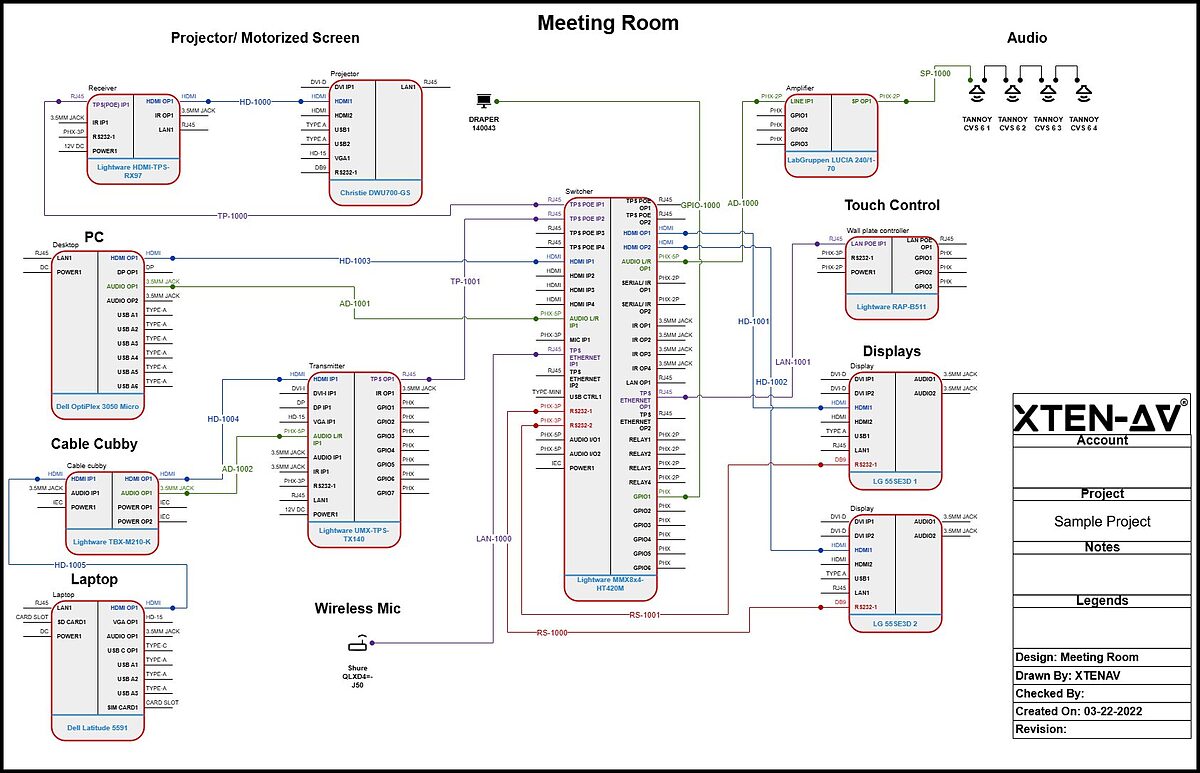
XTEN-AV X-DRAW is a cloud-based AV schematic drawing software platform specifically designed for audiovisual system integrators. Unlike generic CAD tools, X-DRAW was built from the ground up around AV workflows, AV equipment, and AV documentation requirements .X-DRAW is part of the broader XTEN-AV ecosystem, which integrates design, documentation, proposal generation, and project management into a unified platform. This integration creates a fundamentally different workflow compared to using standalone drawing tools .
The 14 Key Features That Make XTEN-AV X-DRAW Stand Out
Let’s examine the specific capabilities that differentiate X-DRAW as AV-specific schematic software:
1. AV-Specific Schematic Drawing
X-DRAW was built specifically for audiovisual system design rather than being adapted from general-purpose drafting software
Why this matters: AV designers need to represent much more than boxes and lines. A typical commercial AV system may include displays, projectors, DSPs, amplifiers, microphones, cameras, control processors, network switches, speakers, video sources, and numerous signal connections
X-DRAW allows these products to be represented as blocks with port information, helping designers create drawings that accurately represent actual AV systems. Products added to the Bill of Materials can also appear in the X-DRAW editor, keeping design documentation connected to project data
.Instead of building schematics from generic shapes, designers work with AV equipment and connections that correspond to the actual system being designed .
2. Large AV Product Library
A schematic is only as useful as the equipment information behind it. X-DRAW provides access to a large AV equipment library containing 1.5 million products from more than 5,200 brands
This means designers can search for actual products—specific DSP models, particular display manufacturers, exact amplifier part numbers—rather than manually recreating every device as a generic symbol
The library can be extended through My Library, where users maintain customized products and create items not available in the standard database
Why this matters: A manufacturer equipment library reduces repetitive work and helps teams create drawings closer to the actual equipment being installed. When specifications change, designers can swap products within the library rather than redrawing symbols
.
3. BOM-to-Schematic Integration
One of X-DRAW’s strongest differentiators is the relationship between the Bill of Materials (BOM) and the drawing
.Instead of treating the equipment list and schematic as completely separate deliverables, X-DRAW can use products from the BOM within the drawing environment. Products with port information appear as blocks in the editor
This creates a connected AV design workflow:Select equipment → Build BOM → Create schematic → Connect devices → Generate documentation
Rather than manually entering the same equipment information into multiple applications, designers work from unified project data
Why this matters: BOM integration reduces duplicate data entry and makes it easier to keep design documentation aligned with specified equipment. When equipment changes during value engineering, the schematic can reflect those changes more efficiently
.
4. Automatic Cable Labeling and Styling
Cable documentation often becomes one of the most time-consuming parts of AV projects
X-DRAW includes automatic cable labeling and styling, along with tools for creating wiring diagrams, connection diagrams, and signal flow diagrams
Cable IDs and connection information can be incorporated into the drawing workflow instead of being managed entirely through separate spreadsheets
This proves particularly useful for large systems containing dozens or hundreds of connections
Why this matters: Clear cable identification makes drawings easier for installation and troubleshooting teams to follow. Automated labeling reduces the manual work involved in preparing cable schedules and connection documentation
.
5. Signal Flow Diagram Creation
A well-designed AV schematic should make signal paths immediately understandable
.X-DRAW supports signal flow diagrams that allow designers to visually represent how audio, video, control, and network signals move through a system .For example, an AV designer can show signal paths such as:
- Laptop → HDMI Extender → Network Switch → Receiver → Display
- Microphone → DSP → Amplifier → Ceiling Speakers
- Camera → Video Encoder → Network → Decoder → Recording Server
Instead of simply showing what equipment exists, the diagram communicates how the system actually works
Why this matters: Installers, commissioning engineers, service technicians, and clients can understand system architecture more quickly. Signal flow diagrams reduce commissioning time and make troubleshooting significantly easier
.
6. Custom Symbols and Drawing Elements
Not every AV project follows identical patterns. Designers often need to modify symbols, add custom equipment, or represent unusual system components
.X-DRAW provides customization tools for layouts and symbols, including the ability to:
- Resize and reposition symbols
- Edit connection points and labels
- Use different symbol libraries
- Create custom items and save them for future use through My Library
Why this matters: Your schematic software should adapt to your design standards—not force every project into the same template. Custom symbols allow firms to maintain visual consistency while accommodating project-specific requirements .
7. Pre-Built AV Design Templates
Starting every AV schematic from a blank page wastes considerable design time, particularly for repeatable room types
X-DRAW provides pre-designed AV room templates that help users start projects faster. According to XTEN-AV, these templates can automate elements such as BOMs, schematics, rack drawings, and proposals
Templates are especially useful for common environments such as:
- Conference rooms
- Boardrooms
- Classrooms
- Training rooms
- Network rooms
- Meeting spaces
- Huddle rooms
Why this matters: Designers can create standardized starting points and then customize systems for specific projects instead of rebuilding common designs from scratch. This accelerates proposal development and maintains consistency across similar installations .
8. Floor Plan Integration
AV schematics aren’t limited to signal flow drawings—physical placement is equally important
.X-DRAW allows users to upload existing AutoCAD or Visio floor plans in multiple formats and customize them within the design workflow
This capability allows designers to represent where equipment such as displays, speakers, microphones, cameras, and other devices will physically be installed
Why this matters: Combining logical system design with physical room layouts gives installation teams better understanding of both what connects to what and where equipment goes. This reduces field questions and installation errors
.
9. Rack Layout Design
Rack documentation is another essential component of professional AV system design
.X-DRAW supports rack elevation layouts with rack-unit assignments, allowing designers to visualize equipment placement within racks
Instead of providing installers with only signal flow diagrams, teams can deliver physical representations of rack configurations
.This communicates:
- Equipment position
- Rack-unit allocation
- Device sequence
- Rack accessories
- Equipment relationships
Why this matters: Well-organized rack drawings make installation and service considerably easier. Pre-planned rack elevations reduce installation time and ensure proper equipment ventilation and accessibility .
10. AI-Powered Drawing Generation
One of X-DRAW’s newest capabilities is Draw with AI .
According to XTEN-AV’s documentation, users can generate drawings from their project design using the Draw with AI option. The system automatically arranges products and generates connections, after which users can review and modify results in X-DRAW
This transforms the workflow from: Start with blank canvas → manually place devices → manually connect devicesto: Create system/BOM → generate initial drawing with AI → review → edit → finalize
Why this matters: AI-assisted drawing generation gives designers starting points much faster, particularly for systems containing many devices. This accelerates initial documentation and allows designers to focus on refinement rather than basic layout .
11. AI-Powered Search Sense
X-DRAW includes Search Sense, an AI-powered search capability designed to help users find AV equipment and relevant information more efficiently
.XTEN-AV describes it as learning from searches and selections to provide more personalized experiences
For AV designers who regularly search for manufacturers, equipment models, specifications, and system components, improved search functionality reduces time spent locating the right products
.Why this matters: Faster equipment discovery means less time searching and more time designing. As the system learns user preferences, product selection becomes progressively more efficient .
12. Multiple Drawing Types in One Workflow
Professional AV projects usually require multiple documentation types
.X-DRAW supports:
- Line schematics
- Signal flow diagrams
- Rack layouts
- Floor plans
- Cable schedules
- Ceiling speaker layouts
- Front elevation diagrams
XTEN-AV’s documentation shows these documents as part of the integrated design-document workflow
.Why this matters: Designers don’t have to treat schematics as isolated documents. Drawings become part of a comprehensive AV design and documentation package, all maintained within a single platform .
13. Cloud-Based Access
X-DRAW is part of XTEN-AV’s cloud-based platform, meaning AV project data and designs can be accessed through browsers rather than being tied exclusively to single workstations
.This proves particularly useful for AV companies where:
- Designers work remotely
- Sales and engineering teams collaborate
- Project managers need access to drawings
- Installation teams need project documentation
- Multiple people work on the same project
Why this matters: Cloud-based workflows make it easier for distributed teams to access project information without relying on one designer’s local CAD files. This improves collaboration and reduces bottlenecks .
14. Customizable Drawing Environment
Professional designers often maintain their own drawing standards
.X-DRAW provides controls for:
- Page size and orientation
- Grids and scaling
- Cable IDs
- Unused ports
- Block resizing
- Symbols
- Other drawing options
This allows teams to create drawings that fit their documentation standards instead of accepting fixed visual formats .
Why this matters: Standardized drawings are easier for internal teams, installers, and clients to read consistently across projects. Customization ensures drawings match company branding and documentation requirements
Head-to-Head Comparison: X-DRAW vs AutoCAD
Workflow Efficiency
AutoCAD Workflow:
- Create or import equipment symbols
- Manually place equipment blocks
- Draw connection lines individually
- Add text labels for cables and signals
- Create separate cable schedule
- Update drawings manually when equipment changes
- Export drawings for documentation
X-DRAW Workflow:
- Select equipment from integrated library
- Build BOM with actual products
- Generate initial schematic with AI assistance (optional)
- Review and refine connections
- Automatic cable labeling and schedule generation
- Equipment changes update across drawings
- Integrated documentation output
Winner: X-DRAW for AV-specific efficiency. While AutoCAD offers more general flexibility, X-DRAW’s integrated workflow significantly reduces time for AV system documentation.
Equipment Libraries
AutoCAD:
- No native AV equipment library
- Requires manual symbol creation or third-party libraries
- No product specifications integrated with symbols
- No manufacturer updates
X-DRAW:
- 1.5 million products from 5,200+ brands
- Searchable manufacturer database
- Product specifications integrated with symbols
- Regular library updates
- Custom library capabilities
Winner: X-DRAW for AV equipment representation. AutoCAD requires significant manual work to build and maintain equipment libraries.
Signal Flow Documentation
AutoCAD:
- Manual line drawing for all connections
- No signal type differentiation
- Manual labeling required
- No automatic routing
X-DRAW:
- Purpose-built signal flow diagram tools
- Visual signal path representation
- Automatic cable labeling
- Connection type awareness
Winner: X-DRAW for representing AV signal architecture. AutoCAD can create signal flow diagrams, but requires significantly more manual effort.
BOM Integration
AutoCAD:
- Completely separate from equipment lists
- Manual synchronization required
- No inherent data relationship
- Equipment changes require manual drawing updates
X-DRAW:
- Direct BOM-to-schematic integration
- Products from BOM appear in drawing environment
- Connected project data
- Equipment changes can update across documentation
Winner: X-DRAW for integrated project workflow. This is one of X-DRAW’s most significant differentiators.
Collaboration and Access
AutoCAD:
- Primarily desktop-based
- AutoCAD Web available but limited
- File-based collaboration
- Requires CAD software to view drawings
X-DRAW:
- Cloud-based platform
- Browser-based access
- Distributed team collaboration
- Easier sharing with non-CAD users
Winner: X-DRAW for modern collaborative workflows, especially for distributed teams.
Learning Curve
AutoCAD:
- Steep learning curve
- Extensive features require training
- Months to become proficient
- Generic CAD concepts must be adapted to AV workflows
X-DRAW:
- AV-specific interface
- Faster onboarding for AV professionals
- Purpose-built for AV workflows
- Less training required for AV-specific tasks
Winner: X-DRAW for AV integrators. While AutoCAD’s broader capabilities require more training, X-DRAW’s focused scope allows faster proficiency for AV documentation.
Architectural Coordination
AutoCAD:
- Industry-standard DWG format
- Excellent architectural coordination
- Precise geometric drafting
- Widely accepted by architects and contractors
X-DRAW:
- Can import AutoCAD/Visio floor plans
- Focus on AV system design rather than architectural drafting
- Less emphasis on architectural coordination
Winner: AutoCAD for projects requiring extensive architectural coordination and deliverables in native CAD formats.
Pricing
AutoCAD:
- Approximately $2,000-$2,500 per user annually (as of 2026)
- Single-purpose tool requiring additional software for other tasks
- Higher total cost of ownership
X-DRAW:
- Part of integrated XTEN-AV platform
- Pricing varies based on features and user count
- Potentially lower cost when considering integrated functionality
Winner: Variable depending on firm size and requirements. X-DRAW may offer better value for AV-focused firms, while AutoCAD provides broader capabilities beyond AV design.
Real-World Use Cases: When to Choose Each Platform
Case Study 1: Corporate AV Integration Firm
Scenario: Mid-sized AV integration company performing 50-100 projects annually, including corporate conference rooms, boardrooms, training centers, and huddle spaces.
Challenges:
- Need to produce proposals and documentation quickly
- Multiple designers working on concurrent projects
- Repetitive room types require template-based workflows
- Sales team needs access to design documentation
- Limited CAD expertise among design staff
Best Choice: X-DRAW Reasoning: This firm benefits significantly from:
- Pre-built AV room templates for common spaces
- Cloud-based collaboration for distributed teams
- Faster onboarding for AV professionals without CAD backgrounds
- BOM integration connecting design to procurement
- AI-assisted drawing generation for initial schematics
Case Study 2: Architectural AV Consultant
Scenario: AV consulting firm working on large commercial construction projects, including corporate headquarters, performing arts centers, and convention facilities.
Challenges:
- Extensive coordination with architects and engineers
- Deliverables must match architectural drawing standards
- Complex custom millwork and architectural integration
- Need for precise construction documentation
- DWG format required by project contracts
Best Choice: AutoCAD Reasoning: This consultant requires:
- Industry-standard DWG format for architectural coordination
- Precise drafting for custom millwork fabrication
- Integration with broader architectural documentation
- Compatibility with project teams expecting AutoCAD deliverables
- Ability to create detailed construction drawings beyond schematics
Case Study 3: Residential AV Integration Specialist
Scenario: Small residential integration firm designing luxury home theaters, whole-home audio/video, lighting control, and smart home systems.
Challenges:
- Fast turnaround required for proposals
- Clients expect professional but accessible documentation
- Systems vary significantly between projects
- Solo designer or small team
- Limited administrative support
Best Choice: X-DRAWReasoning: Residential integrators benefit from:
- Quick proposal generation with integrated documentation
- Client-friendly signal flow diagrams
- Equipment library for specifying products quickly
- Cloud access for showing designs during client meetings
- Lower learning curve for small teams
Case Study 4: Specialized Networked AV Integrator
Scenario: AV integration firm specializing in AV-over-IP, networked video distribution, and large-scale enterprise deployments.
Challenges:
- Complex network topologies with hundreds of endpoints
- Detailed signal routing documentation required
- Multiple concurrent system designs
- Engineering team needs collaboration tools
- Integration with network infrastructure documentation
Best Choice: X-DRAW Reasoning: Networked AV specialists need:
- Signal flow capabilities for complex routing
- Automatic cable labeling for network connections
- Collaboration features for engineering teams
- Equipment library with network switches, encoders, decoders
- Ability to document both physical and logical network topology
8 Common Questions About AV Schematic Drawing Software
1. What is the difference between schematic drawing software and CAD software?
CAD (Computer-Aided Design) software is a broad category encompassing any software used for technical drawing, drafting, and design. AutoCAD, SolidWorks, and Revit are all CAD programs, but they serve different purposes
Schematic drawing software specifically focuses on creating diagrams that represent system connections, signal flow, and logical relationships rather than precise geometric representations. For AV integrators, schematic software emphasizes:
- Equipment connectivity
- Signal routing
- System topology
- Connection documentation
AV schematic drawing software like X-DRAW is purpose-built CAD software optimized for audiovisual system design rather than general drafting .
2. Can I use free software like draw.io or Lucidchart for AV schematics?
Free or low-cost diagramming tools like draw.io (diagrams.net) and Lucidchart can create basic AV diagrams and are suitable for:
- Simple signal flow diagrams
- Basic equipment connectivity
- Presentation graphics
- Informal documentation
However, they typically lack:
- AV-specific equipment libraries
- Product specifications integration
- BOM connectivity
- Automatic cable labeling
- Professional documentation output
- Project data management
For professional AV integration businesses producing client deliverables, these tools may be too limited. They work well for internal planning or very simple systems.
3. Do I need different software for different types of AV drawings?
This depends on your chosen platform .With AutoCAD, you generally use the same software for:
- Floor plans
- Schematics
- Rack elevations
- Detail drawings
However, you may need additional software for:
- BOM management
- Proposal generation
- Project management
With integrated AV platforms like X-DRAW, multiple drawing types exist within one environment:
- Signal flow diagrams
- Floor plans
- Rack layouts
- Cable schedules
- Wiring diagrams
Integrated platforms reduce the need for multiple software subscriptions.
4. How important is BOM integration for AV schematic software?
BOM integration is increasingly important for modern AV workflows .Traditional approaches treat the equipment list and schematic as separate documents, requiring:
- Duplicate data entry
- Manual synchronization
- Increased error potential
- Extra time for updates
Integrated BOM-to-schematic workflows offer:
- Single source of truth for equipment data
- Automatic synchronization between documents
- Faster value engineering and equipment substitution
- Reduced documentation errors
- Connected design-to-procurement workflow
For firms producing multiple projects monthly, BOM integration significantly improves efficiency .
5. Is cloud-based AV design software reliable enough for professional work?
Yes, cloud-based AV design platforms have matured significantly and now offer:
- Reliability: Enterprise-grade infrastructure with high uptime
- Security: Data encryption and backup
- Collaboration: Real-time team access
- Accessibility: Work from any location with internet
- Updates: Automatic feature updates without manual installation
However, cloud-based tools require:
- Reliable internet connectivity
- Consideration of data security policies
- Understanding of data ownership and portability
Many AV integration firms successfully use cloud-based platforms like X-DRAW for production work .
6. How long does it take to learn AV-specific schematic software vs. AutoCAD?
AutoCAD learning curve:
- Basic proficiency: 2-3 months
- Intermediate skills: 6-12 months
- Advanced capabilities: 1-2+ years
- AV-specific workflows: Additional time to develop custom approaches
AV-specific software like X-DRAW:
- Basic proficiency: 1-2 weeks
- Intermediate skills: 1-2 months
- Advanced capabilities: 3-6 months
- Faster for AV professionals because interface matches familiar workflows
The difference stems from AutoCAD’s broader scope versus X-DRAW’s focused AV application .
7. Can AI really help with AV schematic creation?
AI-assisted drawing generation is an emerging capability that can:
- Create initial equipment layouts from BOM data
- Suggest connection patterns based on equipment types
- Automate repetitive tasks
- Learn from previous projects
X-DRAW’s Draw with AI feature generates initial schematics automatically, which designers then review and refine .Current limitations:
- AI-generated drawings require human review
- Complex custom systems still need designer expertise
- AI works best with standard equipment and common topologies
Best use cases:
- Standard room configurations
- Initial layout generation
- Repetitive system designs
- Time-saving for experienced designers
AI won’t replace AV system designers but can significantly accelerate certain workflow steps .
8. What file formats should AV schematic software support?
Professional AV schematic software should support:Import formats:
- DWG (AutoCAD)
- DXF (AutoCAD exchange)
- VSD/VSDX (Visio)
- Common image formats (PNG, JPG) for backgrounds
Export formats:
- PDF (universal client deliverable)
- DWG/DXF (architectural coordination)
- PNG/JPG (presentations and proposals)
- Native project formats for archival
X-DRAW supports importing AutoCAD and Visio floor plans, making it compatible with common architectural deliverables .
Why X-DRAW Is One of the Best Schematic Drawing Software Options for AV Integrators
The case for XTEN-AV X-DRAW as leading AV schematic software centers on its purpose-built approach to audiovisual system documentation .
The Fundamental Difference: Connected AV Workflow
Generic diagramming tools help you create: Shapes → Lines → DiagramAV-specific platforms like X-DRAW connect: Products → BOM → Schematic → Signal Flow → Cable Schedule → Rack Layout → Floor Plan → Documentation This integrated ecosystem transforms how AV integration firms:
- Design systems
- Document projects
- Generate proposals
- Manage equipment
- Collaborate across teams
Key Advantages for AV Integration Businesses
1. Time Savings By reducing manual data entry, providing equipment libraries, enabling template-based design, and offering AI-assisted generation, X-DRAW accelerates project documentation .2. Accuracy Improvement BOM integration, automatic cable labeling, and connected project data reduce documentation errors and improve installation accuracy .3. Collaboration Enhancement Cloud-based access allows distributed teams, including sales, engineering, and project management, to work from the same project data .4. Professional Output Purpose-built AV drawing tools produce documentation that clearly communicates system design to clients, installation teams, and service technicians .5. Scalability Templates, libraries, and automation help firms handle increased project volume without proportionally increasing design staff .
The Strategic Value Proposition
For AV integrators evaluating schematic drawing software, the decision ultimately centers on whether you need:General-purpose CAD capabilities → AutoCAD AV-optimized design workflow → X-DRAW Companies choosing X-DRAW typically value:
- Faster project turnaround
- Integrated design-to-documentation workflow
- Lower learning curve for AV-focused teams
- Cloud collaboration
- Modern automation capabilities
Companies choosing AutoCAD typically need:
- Extensive architectural coordination
- Native DWG deliverables
- Custom fabrication drawings
- Broader CAD capabilities beyond AV
Conclusion: Making the Right Choice for Your AV Integration Business
Choosing between X-DRAW and AutoCAD isn’t about which software is objectively “better”—it’s about which platform best aligns with your firm’s specific needs, project types, and workflows.
Choose AutoCAD if you:
- Require extensive architectural coordination and native DWG deliverables
- Design custom millwork and fabrication requiring precise CAD drafting
- Already have significant AutoCAD expertise and infrastructure
- Work on projects where architects and contractors mandate AutoCAD formats
- Need multidisciplinary design capabilities beyond AV systems
Choose X-DRAW if you:
- Focus primarily on AV system design and documentation
- Want integrated BOM-to-schematic workflows
- Need to accelerate project documentation and proposal generation
- Value cloud-based collaboration for distributed teams
- Prefer AV-specific tools over adapting general CAD software
- Want to leverage automation and AI-assisted design
- Require faster onboarding for AV professionals without extensive CAD backgrounds
The Hybrid Approach
Some AV integration firms use both platforms strategically:
- X-DRAW for signal flow diagrams, system schematics, and standard project documentation
- AutoCAD for architectural coordination drawings and custom fabrication details
This approach maximizes each platform’s strengths while maintaining workflow efficiency.
Looking Forward: The Future of AV Design Software
The AV integration industry continues evolving toward:
- Greater automation through AI and machine learning
- Cloud-based collaboration replacing desktop-only workflows
- Integrated platforms connecting design, documentation, procurement, and project management
- Data-driven design using manufacturer specifications and product databases
- Real-time updates reflecting current product availability and specifications
AV schematic drawing software like X-DRAW represents this evolution—purpose-built tools designed around modern AV workflows rather than adapted from generic CAD platforms .
Final Recommendations
For value-conscious firms seeking maximum return on software investment, X-DRAW’s integrated approach can reduce total software costs while improving efficiency.For firms requiring architectural-grade documentation, AutoCAD remains the industry standard despite its limitations for AV-specific workflows.For growing integration companies, investing in AV-specific platforms like X-DRAW positions your firm for scalable, efficient growth as project volume increases
The most important decision isn’t merely which software to buy—it’s understanding how your chosen platform will support your business objectives, improve your workflows, and ultimately help you deliver better AV systems to your clients.Is X-DRAW the right AV schematic drawing software for your integration business?
If you prioritize AV-specific workflows, integrated documentation, cloud collaboration, and modern automation over general-purpose CAD capabilities, the answer is likely yes
.
The audiovisual integration industry has moved beyond adapting generic tools to purpose-built solutions designed specifically for our discipline. X-DRAW represents that specialized approach—software built by and for AV professionals who understand that schematic drawing is just one component of a comprehensive system design workflow
Leave a reply
PakarPBN
A Private Blog Network (PBN) is a collection of websites that are controlled by a single individual or organization and used primarily to build backlinks to a “money site” in order to influence its ranking in search engines such as Google. The core idea behind a PBN is based on the importance of backlinks in Google’s ranking algorithm. Since Google views backlinks as signals of authority and trust, some website owners attempt to artificially create these signals through a controlled network of sites.
In a typical PBN setup, the owner acquires expired or aged domains that already have existing authority, backlinks, and history. These domains are rebuilt with new content and hosted separately, often using different IP addresses, hosting providers, themes, and ownership details to make them appear unrelated. Within the content published on these sites, links are strategically placed that point to the main website the owner wants to rank higher. By doing this, the owner attempts to pass link equity (also known as “link juice”) from the PBN sites to the target website.
The purpose of a PBN is to give the impression that the target website is naturally earning links from multiple independent sources. If done effectively, this can temporarily improve keyword rankings, increase organic visibility, and drive more traffic from search results.