
June 16, 2026 at 1:30 pm,
No comments
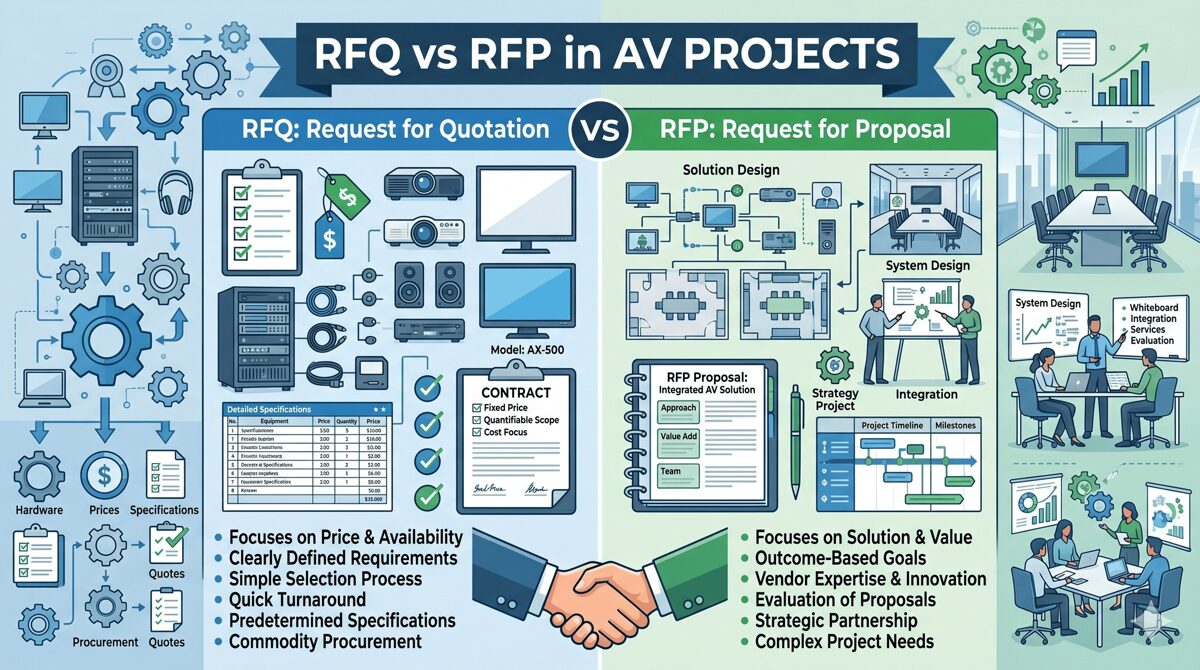
As an AV integrator, understanding the RFQ vs RFP difference is essential to your business success and win rates in an increasingly competitive market. The fundamental distinction is this: when clients issue an RFQ (Request for Quotation), they’re asking you to price their complete technical specifications—your role is execution. When they issue an RFP (Request for Proposal), they’re seeking your design expertise, strategic recommendations, and comprehensive solutions—your role is consultation. Knowing which document you’re responding to determines your bidding strategy, resource allocation, pricing approach, and likelihood of winning the project.
The importance of recognizing the RFQ vs RFP difference extends beyond simply understanding document types—it shapes how you position your company, what differentiators you emphasize, how much time and resources you invest in proposal development, and ultimately, your profit margins and project success rates. In June 2026, with AI-powered procurement platforms becoming standard and clients becoming more sophisticated, AV integrators who master these distinctions achieve 35-50% higher win rates and 20-30% better profit margins than those treating all solicitations identically.
Key Takeaways
✓ RFQ vs RFP difference fundamentally changes your response strategy: RFQs focus on competitive pricing, RFPs emphasize technical expertise and value proposition
✓ RFQ responses require minimal time investment (8-20 hours) with focus on accurate cost estimation; RFP proposals demand 80-200 hours with comprehensive design work
✓ Win rate optimization: Target 20-30% win rate on RFQs through pricing competitiveness; achieve 40-60% win rate on RFPs through technical differentiation
✓ Profit margin potential differs dramatically: RFQs yield 8-15% margins through efficiency, RFPs enable 18-30% margins through value-added services
✓ AI-powered tools available in June 2026 transform proposal development, cost estimation, and competitive intelligence gathering
✓ Pre-qualification and relationship building are critical: 70% of RFP awards go to vendors who engaged clients before solicitation release
✓ Strategic positioning matters: decide which procurement types align with your company’s strengths and market positioning
Understanding the RFQ vs RFP Difference: An Integrator’s Perspective
The RFQ vs RFP difference creates two entirely different playing fields for AV integrators, each requiring distinct strategies, resources, and competitive approaches.
What RFQs Mean for Your Business
When you receive an RFQ, the client has already made every technical decision. An AV consultant or internal team has specified exact equipment, installation methods, cable types, and system architecture. Your quotation is essentially a bid to execute their predetermined design.
RFQ Characteristics
Documentation you’ll receive:
-
Complete CAD drawings with equipment locations
-
Detailed bill of materials with part numbers
-
Comprehensive wiring diagrams and signal flow
-
Installation specifications and standards
-
Testing protocols and acceptance criteria
-
Fixed project timeline with milestones
Your competitive position:
-
Price is the primary (often 70-80%) evaluation factor
-
Qualifications matter but are secondary
-
Limited opportunity to differentiate through design
-
Profit margins compressed by competitive pressure
-
Execution capability more important than innovation
Resource requirements:
-
Estimating time: 8-20 hours typical
-
Design work: None required
-
Proposal length: 10-25 pages standard
-
Response period: 2-3 weeks typical
-
Win rate target: 20-30% realistic
What RFPs Mean for Your Business
When you receive an RFP, the client needs your professional expertise. They understand their operational goals but require design recommendations, technology selection, and implementation strategy from qualified integrators.
RFP Characteristics
Documentation you’ll receive:
-
Functional requirements and use cases
-
Business objectives and strategic goals
-
Budget parameters (ranges, not fixed)
-
Evaluation criteria with multiple factors
-
Submission requirements for comprehensive proposals
-
Flexibility for vendor creativity and alternatives
Your competitive position:
-
Technical approach weighted 30-35% typically
-
Qualifications and experience 20-25%
-
Methodology and project management 15-20%
-
Price typically only 20-30% of evaluation
-
Innovation and differentiation highly valued
Resource requirements:
-
Proposal development time: 80-200 hours
-
Design work: Substantial—system architecture, drawings, integration diagrams
-
Proposal length: 50-150 pages comprehensive
-
Response period: 4-6 weeks typical
-
Win rate target: 40-60% achievable with strong technical approach
Critical Distinctions Table
|
Factor |
RFQ Response |
RFP Response |
|
Primary Focus |
Price competitiveness |
Technical solution quality |
|
Design Responsibility |
None—execute client specs |
Full—recommend optimal design |
|
Differentiation Strategy |
Efficiency, service, qualifications |
Innovation, expertise, methodology |
|
Time Investment |
8-20 hours |
80-200 hours |
|
Team Involvement |
Estimating, PM |
Design, engineering, PM, sales |
|
Profit Potential |
8-15% typical |
18-30% achievable |
|
Win Rate |
20-30% |
40-60% with good fit |
|
Presentation Required |
Rare |
Common for shortlist |
|
Price Pressure |
Extreme |
Moderate—value matters |
Best Practices for Responding to RFQs as an AV Integrator
Maximizing your RFQ win rate and profitability requires specific strategies focused on cost accuracy, response efficiency, and qualification differentiation.
Best Practice 1: Rapid Qualification Assessment
Before investing time, determine if the RFQ is worth pursuing:
Go/No-Go Criteria (Complete Within 30 Minutes)
Pursue if:
-
✓ Specifications align with your technical capabilities
-
✓ Equipment manufacturers match your partnerships and certifications
-
✓ Project size fits your bonding capacity and resource availability
-
✓ Geographic location within your service area
-
✓ Client has realistic budget (if indicated)
-
✓ Timeline feasible given current workload
-
✓ You have competitive advantage (relationships, local presence, specialized expertise)
Pass if:
-
✗ Specifications favor competitor’s technology stack
-
✗ Project requires certifications you lack
-
✗ Geographic location creates unsustainable overhead
-
✗ Timeline impossible given current commitments
-
✗ Incumbent advantage insurmountable
-
✗ Profit margin potential below 10%
Decision rule: Only bid RFQs where you have legitimate win probability of 15%+ and acceptable profit potential.
Best Practice 2: Accurate and Efficient Cost Estimation
RFQ success hinges on pricing accuracy and competitive positioning.
Estimating Methodology
Equipment pricing strategies:
-
Leverage manufacturer volume discounts and dealer pricing
-
Use current pricing databases (updated weekly in June 2026)
-
Include freight, handling, and logistics costs
-
Factor in equipment lead times and potential backorder risks
-
Consider technology lifecycle position (avoid soon-obsolete equipment)
Labor estimation best practices:
-
Use historical data from similar projects (AI tools analyze this)
-
Account for site-specific factors (access restrictions, working hours, coordination)
-
Include realistic project management and supervision time
-
Factor in commissioning, testing, and documentation labor
-
Don’t underestimate punch list and warranty service time
Risk and contingency:
-
Include 5-8% contingency for RFQ unknowns
-
Higher contingency (10-15%) for complex integration or challenging sites
-
Document assumptions in bid to protect against scope creep
Best Practice 3: Strategic Pricing Positioning
Understanding where to position your pricing improves win rates:
Competitive intelligence (June 2026 tools):
-
AI platforms like BidIntel predict competitor pricing (±8% accuracy)
-
Historical win/loss data analysis shows your competitive positioning
-
Market rate databases provide benchmark pricing by region
Pricing strategies:
-
Price to win: Target 15-20% below estimated competition if capacity allows
-
Price for profit: Add 10-15% premium if you have competitive advantages
-
Strategic loss leader: Consider low profit margins (5-8%) for key account entry
-
Walk-away pricing: Add 20%+ premium if project is marginal fit
Best Practice 4: Differentiate Beyond Price
Even in price-focused RFQs, emphasize your qualifications:
Differentiation elements:
-
Industry certifications (CTS, CTS-I, manufacturer credentials)
-
Relevant project experience with specific references
-
Local presence and service infrastructure
-
Financial stability and bonding capacity
-
Safety record and training programs
-
Warranty enhancements beyond minimum requirements
-
Project management methodology and communication protocols
Presentation matters:
-
Professional bid formatting and organization
-
Clear pricing tables with detailed breakdowns
-
Comprehensive qualifications package
-
Proactive risk mitigation statements
-
Schedule confidence with milestone clarity
Best Practices for Responding to RFPs as an AV Integrator
RFP responses offer greater opportunity for differentiation and profit margins but demand substantially more investment.
Best Practice 5: Early Engagement and Pre-RFP Positioning
The most successful integrators win RFPs before they’re released through relationship building.
Pre-RFP Engagement Strategy
Intelligence gathering (3-6 months before RFP):
-
Identify potential projects through industry networks, construction reports, public notices
-
Connect with facility managers, technology directors, procurement teams
-
Offer educational workshops, technology demonstrations, site tours
-
Provide preliminary design concepts and budget guidance (no charge)
-
Establish trusted advisor status before procurement begins
Statistics: In June 2026, integrators who engage clients before RFP release achieve 55-70% win rates versus 15-25% for those responding cold.
Best Practice 6: Comprehensive Needs Assessment
When you receive an RFP, conduct thorough discovery:
Assessment Process
Attend pre-proposal conferences:
-
Ask insightful questions demonstrating expertise
-
Clarify ambiguities in requirements
-
Understand evaluation process and decision criteria
-
Identify key stakeholders and their priorities
Conduct detailed site surveys:
-
Document existing infrastructure comprehensively
-
Identify integration challenges and opportunities
-
Take photos and measurements for design accuracy
-
Engage on-site staff to understand workflow realities
Stakeholder interviews (if permitted):
-
Understand user requirements beyond RFP document
-
Identify pain points with current systems
-
Discover unstated needs and value opportunities
-
Build relationships with end users and technical staff
Best Practice 7: Design Excellence and Innovation
Your technical approach is typically the highest-weighted evaluation factor in RFPs.
Design Best Practices
System architecture:
-
Propose scalable solutions that accommodate future growth
-
Emphasize reliability through redundancy and quality components
-
Demonstrate integration expertise across technology platforms
-
Address lifecycle costs and total cost of ownership
-
Include technology roadmap for 5-7 year horizon
Innovation opportunities:
-
Recommend emerging technologies that provide competitive advantage
-
Propose AI-enhanced features (room analytics, predictive maintenance)
-
Suggest sustainability improvements (energy efficiency, green certifications)
-
Offer user experience enhancements beyond baseline requirements
Technical documentation:
-
Professional CAD drawings using industry-standard tools
-
Clear system diagrams and signal flow documentation
-
Detailed equipment specifications with rationale
-
Integration architecture showing all system interfaces
-
Testing and commissioning protocols
Best Practice 8: Compelling Proposal Development
Your proposal must sell your solution and your company.
Proposal Structure Best Practices
Executive summary (2-4 pages):
-
Demonstrate understanding of client objectives
-
Highlight key differentiators and value propositions
-
Summarize recommended solution at strategic level
-
Include compelling client-focused benefits
Technical approach (40-50% of proposal):
-
Detailed system design with drawings and diagrams
-
Equipment recommendations with selection rationale
-
Integration methodology and technical strategies
-
Testing and quality assurance approaches
-
Innovation elements and value engineering
Project methodology (15-20% of proposal):
-
Comprehensive project plan with timeline
-
Risk management strategies and mitigation plans
-
Communication protocols and reporting structure
-
Safety program and site coordination
-
Quality control procedures
Qualifications (15-20% of proposal):
-
Company overview and market position
-
Relevant project experience with detailed case studies
-
Team bios emphasizing credentials and experience
-
Certifications, partnerships, manufacturer relationships
-
References from similar successful projects
Cost proposal (10-15% of proposal):
-
Detailed line-item budget with transparency
-
Clear assumptions and exclusions
-
Payment schedule aligned with milestones
-
Value engineering options and alternatives
-
Warranty and service offerings
Best Practice 9: Presentation Excellence
Most RFP processes include presentations for shortlisted vendors.
Presentation Strategies
Preparation:
-
Rehearse with full team multiple times
-
Anticipate questions and prepare responses
-
Create compelling visual materials and demonstrations
-
Customize presentation to evaluation committee composition
-
Time presentation to respect stated limits (typically 30-60 minutes)
Delivery:
-
Lead with project team who will actually execute work
-
Demonstrate enthusiasm and commitment to client success
-
Address evaluation criteria explicitly
-
Show, don’t just tell—use visuals, demos, mockups
-
Close with clear differentiation and value proposition
Post-presentation:
-
Submit clarifications promptly if requested
-
Provide additional references or case studies if needed
-
Maintain professional communication throughout evaluation
-
Be prepared for contract negotiation discussions
Strategic Positioning as an AV Integrator
Understanding the RFQ vs RFP difference helps you strategically position your business in the market.
Strategic Business Decisions
Choosing Your Competitive Focus
Volume-focused integrators (RFQ emphasis):
-
Build operational efficiency for cost competitiveness
-
Invest in estimating tools and process optimization
-
Maintain broad manufacturer relationships for pricing flexibility
-
Target standardized, repeatable project types
-
Accept lower margins (8-15%) with higher volume
Value-focused integrators (RFP emphasis):
-
Invest in design capabilities and engineering talent
-
Develop specialized vertical market expertise
-
Build consultative relationships with key clients
-
Target complex, custom projects with higher margins (18-30%)
-
Accept lower volume with higher profit per project
Hybrid approach (most common):
-
Pursue RFPs for strategic clients and complex projects
-
Bid RFQs for capacity management and market presence
-
Allocate resources based on profit potential and strategic value
Market Positioning Strategies
Geographic focus:
-
Local presence provides competitive advantage for RFQs (faster service, lower overhead)
-
Regional or national reach necessary for large RFP opportunities
Vertical specialization:
-
Healthcare, education, corporate, government, hospitality—each has unique procurement patterns
-
Specialization improves RFP win rates through demonstrable expertise
-
Vertical credentials and case studies differentiate from generalists
Technology specialization:
-
Unified communications, digital signage, control systems, video walls
-
Deep technical expertise commands premium pricing in RFPs
-
Manufacturer certifications validate capabilities
AI and Technology Transforming AV Proposals in June 2026
As of mid-2026, artificial intelligence and automation technologies are revolutionizing how AV integrators respond to both RFQs and RFPs.
AI-Powered Estimating and Proposal Tools
Cost Estimation Automation
Leading platforms available June 2026:
Estimate IQ AV:
-
Analyzes RFQ documents using natural language processing
-
Extracts equipment lists and labor requirements automatically
-
Suggests competitive pricing based on historical win/loss data
-
Predicts competitor pricing with 85-90% accuracy
-
Generates line-item quotations in 2-3 hours versus 8-12 hours manually
Pricing Optimizer Pro:
-
Machine learning analyzes your historical project data
-
Recommends optimal pricing based on win probability targets
-
Accounts for current capacity, strategic priorities, competitor intelligence
-
Provides confidence intervals on cost estimates
-
Reduces estimating errors by 40-60%
RFP Response Automation
Proposal AI Suite:
-
Natural language generation creates proposal sections from templates
-
Learns from your winning proposals to replicate success patterns
-
Suggests technical approaches based on requirements analysis
-
Auto-generates equipment specifications and system diagrams
-
Reduces proposal development time by 30-50%
Design Assist Pro:
-
AI-powered system design recommendations
-
Equipment compatibility checking across manufacturers
-
Code compliance verification (NFPA, NEC, ADA)
-
3D visualization generation for client presentations
-
Integration architecture optimization
Competitive Intelligence and Market Analysis
BidIntel Platform:
-
Tracks competitor bidding patterns and win rates
-
Predicts which competitors likely to bid on solicitations
-
Analyzes pricing strategies and competitive positioning
-
Identifies emerging market opportunities and trends
-
Subscription service available in June 2026 ($2,500-$8,000/year)
Virtual Collaboration and Presentation Tools
Proposal VR:
-
Virtual reality system demonstrations during presentations
-
Interactive walkthroughs of proposed AV installations
-
Remote site surveys using VR technology
-
Immersive presentations differentiating from competitors
Digital Twin Technology:
-
Create digital replicas of proposed systems
-
Simulate performance under various scenarios
-
Demonstrate maintenance procedures virtually
-
Provide training environments before installation
Common Mistakes and How to Avoid Them
Learning from typical errors improves your win rates and profitability.
RFQ Response Mistakes
Mistake 1: Bidding Every RFQ Problem: Wastes time on unwinnable projects, dilutes focus Solution: Implement disciplined go/no-go criteria, target 15%+ win probability
Mistake 2: Incomplete or Unclear Pricing Problem: Client uncertainty leads to disqualification or questions Solution: Provide detailed line-item pricing, clear assumptions, comprehensive scope documentation
Mistake 3: Ignoring Qualifications Problem: Lowest price doesn’t always win—qualifications break ties Solution: Include strong qualifications package, relevant references, certifications
Mistake 4: Missing Submission Requirements Problem: Automatic disqualification for non-compliance Solution: Create submission checklist, review RFQ requirements multiple times
RFP Response Mistakes
Mistake 5: Generic, Templated Proposals Problem: Fails to differentiate, doesn’t address client-specific needs Solution: Customize every section, reference client context, demonstrate understanding
Mistake 6: Overengineering Solutions Problem: Exceeds budget, creates perception of unnecessary complexity Solution: Design to requirements, provide value engineering alternatives, respect budget guidance
Mistake 7: Weak Executive Summary Problem: Evaluators may only read summary—must compel them Solution: Invest heavily in executive summary, emphasize client benefits, differentiate clearly
Mistake 8: No Follow-Up or Presentation Prep Problem: Loses momentum, poor presentation performance Solution: Maintain communication, prepare thoroughly for presentations, rehearse extensively
Strategic Mistakes
Mistake 9: Wrong Market Positioning Problem: Competing on price in value markets or vice versa Solution: Clarify your market position, target appropriate procurement types
Mistake 10: Inadequate Resource Allocation Problem: Spreading too thin across too many proposals Solution: Be selective, focus resources on best-fit opportunities, track win rates by project type
Frequently Asked Questions
What is the RFQ vs RFP difference from an integrator’s perspective?
The RFQ vs RFP difference fundamentally changes your response strategy and profit potential. RFQs request pricing for complete client-provided specifications—you compete primarily on cost and execution capability with 8-15% typical margins and 20-30% win rates. RFPs solicit comprehensive solutions including design recommendations—you compete on technical expertise, innovation, and value with 18-30% potential margins and 40-60% win rates when well-positioned. RFQ responses require 8-20 hours; RFP proposals demand 80-200 hours investment.
How do I decide whether to bid an RFQ or RFP?
For RFQs, apply go/no-go criteria: only bid if you have 15%+ win probability (competitive pricing, relevant experience, no insurmountable disadvantages) and acceptable profit potential (10%+ margin). For RFPs, pursue if: (1) project aligns with your technical capabilities and vertical expertise, (2) you have or can build client relationships, (3) timeline allows quality proposal development (80-200 hours), and (4) budget supports profitable execution. Track your win rates by type—stop bidding categories where you consistently lose.
What AI tools are available in June 2026 to help with proposals?
Leading AI platforms in June 2026 include: EstimateIQ AV (automated cost estimation from RFQ documents, 85-90% pricing accuracy), ProposalAI Suite (natural language generation for proposal sections, 30-50% time savings), DesignAssist Pro (AI-powered system design recommendations and CAD generation), BidIntel Platform (competitor intelligence and market analysis), and Proposal VR (virtual reality presentations). These tools cost $1,500-$8,000 annually but deliver ROI through increased win rates (10-15% improvement) and reduced labor costs (30-60 hours saved per RFP).
Should I specialize in RFQs or RFPs strategically?
Most successful integrators pursue a hybrid approach but with clear strategic priorities. Volume-focused businesses emphasize RFQs through operational efficiency, competitive pricing, and process optimization—accepting 8-15% margins with higher project volume. Value-focused businesses emphasize RFPs through design capabilities, vertical specialization, and consultative relationships—targeting 18-30% margins with lower volume. Your choice depends on company size, technical capabilities, market position, and growth objectives. Track profitability by procurement type to optimize your mix.
How can I improve my RFP win rates?
Improve RFP win rates through: (1) Pre-RFP engagement—70% of awards go to vendors who built relationships before solicitation (attend industry events, offer educational sessions, provide preliminary guidance), (2) Design excellence—invest in professional CAD tools, hire experienced designers, showcase innovation, (3) Proposal quality—customize every section, create compelling executive summaries, include relevant case studies, (4) Presentation skills—rehearse extensively, demonstrate with actual team, address evaluation criteria explicitly, (5) Strategic targeting—only pursue RFPs matching your strengths and market position.
What profit margins should I target for RFQs versus RFPs?
Target profit margins differ significantly: RFQs typically yield 8-15% margins due to price-focused competition and limited differentiation opportunities—efficiency and volume drive profitability. RFPs enable 18-30% margins through value-added services, design expertise, and multi-factor evaluation—technical differentiation commands premium pricing. Track your actual margins by procurement type and client category. Walk away from RFQs yielding below 10% unless strategically important for account entry or market presence. For RFPs, insufficient margins (below 18%) suggest inadequate differentiation or inappropriate targeting.
How much time should I invest in RFQ versus RFP responses?
Time investment should match opportunity value and win probability: RFQ responses require 8-20 hours typical (estimating, pricing, qualifications package, submission)—limit investment since price dominates evaluation. RFP proposals demand 80-200 hours (discovery, design, proposal writing, presentations)—substantial investment justified by higher margins and win rates. Calculate ROI: if RFP win probability is 50%, project value is $500K, and margin is 25% ($125K profit), then 150-hour investment ($15K-$22K cost) yields strong return. Stop pursuing opportunities where time investment exceeds profit potential × win probability.
Conclusion
Mastering the RFQ vs RFP difference is fundamental to building a successful, profitable AV integration business in 2026 and beyond. These aren’t simply different document formats—they represent entirely different competitive landscapes, business opportunities, and strategic positioning choices that shape your company’s trajectory, profit margins, and market reputation.
RFQs offer volume opportunities with efficient, price-focused competition where operational excellence, accurate cost estimation, and execution capability drive success. While profit margins are compressed (8-15% typical), disciplined go/no-go criteria, technology-enhanced estimating, and strategic pricing enable sustainable profitability through volume. Win rates of 20-30% are realistic when targeting appropriate opportunities and competing effectively on price and qualifications.
RFPs provide value opportunities where your design expertise, technical innovation, and consultative approach command premium pricing (18-30% margins achievable) and higher win rates (40-60% with strong positioning). Success requires substantial investment in proposal development (80-200 hours), but multi-factor evaluation rewards technical differentiation over lowest price. Pre-RFP engagement, comprehensive needs assessment, design excellence, and compelling proposals separate winners from participants.
In June 2026, AI-powered tools are revolutionizing both RFQ and RFP responses through automated estimation (reducing time 40-60%), intelligent design assistance, competitive intelligence, and virtual presentations. Forward-thinking integrators investing in these technologies ($5K-$15K annually) achieve 10-15% higher win rates and 30-50% faster proposal development while maintaining quality and differentiation.
The most successful AV integrators don’t treat all procurement opportunities identically—they strategically position their businesses, allocate resources based on profit potential and win probability, and continuously refine their approaches based on tracked performance metrics. Whether you emphasize volume-focused RFQ efficiency, value-focused RFP expertise, or a strategic hybrid, understanding and exploiting the RFQ vs RFP difference positions your company for sustainable profitability, competitive advantage, and long-term success in an increasingly sophisticated and competitive audiovisual market.
Apply these best practices, leverage available AI tools, track your win rates and margins by procurement type, and continuously optimize your approach. Your mastery of the RFQ vs RFP difference will directly determine your business performance in the years ahead.
PakarPBN
A Private Blog Network (PBN) is a collection of websites that are controlled by a single individual or organization and used primarily to build backlinks to a “money site” in order to influence its ranking in search engines such as Google. The core idea behind a PBN is based on the importance of backlinks in Google’s ranking algorithm. Since Google views backlinks as signals of authority and trust, some website owners attempt to artificially create these signals through a controlled network of sites.
In a typical PBN setup, the owner acquires expired or aged domains that already have existing authority, backlinks, and history. These domains are rebuilt with new content and hosted separately, often using different IP addresses, hosting providers, themes, and ownership details to make them appear unrelated. Within the content published on these sites, links are strategically placed that point to the main website the owner wants to rank higher. By doing this, the owner attempts to pass link equity (also known as “link juice”) from the PBN sites to the target website.
The purpose of a PBN is to give the impression that the target website is naturally earning links from multiple independent sources. If done effectively, this can temporarily improve keyword rankings, increase organic visibility, and drive more traffic from search results.