

Most of the product and engineering teams I talk to are building and deploying AI agents, but these agents are blind to how customers are actually experiencing your product.
This is why I’m excited to announce that the LogRocket MCP is now available to everyone.
Let’s suppose your conversion rate dropped last week. You ask Claude or Cursor what went wrong, but find nothing obviously amiss.
When you enable the LogRocket MCP, you and your agents can watch thousands of session replays in minutes.
So now if conversion rate dips, the LogRocket MCP identifies the problem immediately: on mobile Chrome, autofill triggers a spinner that never resolves. This context, and a suggested fix, is delivered wherever you need it: Claude, Cursor, or right to your agent.
Let’s dive into how the MCP is changing the way our customers monitor their products.
What is the LogRocket MCP?
The LogRocket MCP connects your agents directly to LogRocket’s Galileo AI, which is already watching session replays, listening to customer calls, reading support tickets, and tracking product changes.
Galileo detects issues, diagnoses root causes, quantifies user impact, and suggests fixes. Via the MCP, it sends this context to your agent, without anyone on your team needing to pull up LogRocket:
How are product and engineering teams using the LogRocket MCP?
Rippling, the HR, payroll, and IT software provider, is using the MCP to identify customer issues in near-realtime.
Matt MacInnis, Rippling’s President and Chief Product Officer, posted about it on X: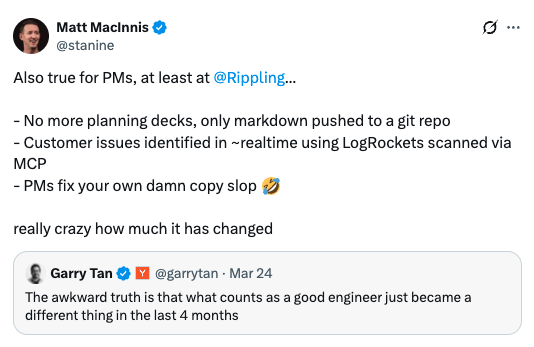
Nick Ciubotariu, CTO at ShipStation Global, the shopping and logistics provider behind products like ShipStation and Stamps.com, shared how his team is connecting its coding agents to the MCP to generate PRs to fix user issues.
“We’re using the LogRocket MCP to feed real user session data directly to our AI agents,” Nick said. “When an issue surfaces, the agent doesn’t wait for us to investigate; it pulls the sessions, diagnoses the root cause, and opens a pull request automatically. That’s an amazing advantage, and it’s a great accelerator for our engineering teams and a huge benefit to our customers.”
The pattern we’re seeing across early customers: their agents flag issues faster, which means they ship fixes faster.
What can you use the LogRocket MCP for?
Three examples of agents real LogRocket customers are building:
- An issue resolution agent that watches user sessions, surfaces usability and technical problems, and routes those issues to their coding agents to fix automatically.
- A product research agent that connects to the code base, identifies new features being shipped, and shows how customers are using and responding to them.
- A customer support agent that, when a customer has a problem, can see exactly what they experienced and help accordingly.
And that’s just a sampling. What agents will your team build?
Why this matters
When we founded LogRocket in 2016, the goal was to give teams a complete understanding of how users experience their product, without consuming all of their time.
Ask Galileo took us a big step forward. Teams could answer almost any question about their product experience in seconds.
The MCP takes it another step.
Galileo’s intelligence stops being something your team has to go look at. Now it helps you surface issues, resolve tickets, and propose fixes on its own.
The blindfold is off. We’re one step closer to software that fixes itself.
How to get started with the LogRocket MCP
The LogRocket MCP Server is available now.
Existing LogRocket customers can connect via the hosted server at mcp.logrocket.com/mcp: no local setup required, OAuth authentication, works with Cursor, Claude Desktop, Claude Code, Codex, and any MCP-compatible client.
If you’re new to LogRocket, you can learn more by checking out our docs or trying it for yourself at logrocket.com.
PakarPBN
A Private Blog Network (PBN) is a collection of websites that are controlled by a single individual or organization and used primarily to build backlinks to a “money site” in order to influence its ranking in search engines such as Google. The core idea behind a PBN is based on the importance of backlinks in Google’s ranking algorithm. Since Google views backlinks as signals of authority and trust, some website owners attempt to artificially create these signals through a controlled network of sites.
In a typical PBN setup, the owner acquires expired or aged domains that already have existing authority, backlinks, and history. These domains are rebuilt with new content and hosted separately, often using different IP addresses, hosting providers, themes, and ownership details to make them appear unrelated. Within the content published on these sites, links are strategically placed that point to the main website the owner wants to rank higher. By doing this, the owner attempts to pass link equity (also known as “link juice”) from the PBN sites to the target website.
The purpose of a PBN is to give the impression that the target website is naturally earning links from multiple independent sources. If done effectively, this can temporarily improve keyword rankings, increase organic visibility, and drive more traffic from search results.