

Editor’s note: This JWT authentication tutorial was last updated on 23 July 2026 by Emmanuel John to discuss modern JWT authentication practices, including OAuth 2.0 and OIDC, secure token storage, refresh token rotation, XSS and CSRF risks, and scenarios where server-side sessions may be a better choice than JWTs.
In web development, authentication is one of the most complex aspects to implement yourself. Many web applications delegate authentication to third-party authentication services like Auth0 or rely on authentication built into the frameworks or tools they are built with.
This also means that many developers (maybe you too  ) don’t know how to build at least moderately secure authentication into their web applications. JWT provides an easy way to to do this
With knowledge of some of the security concerns to consider when using JWT, you can implement a more secure authentication as you see with third-party authentication services. So, in this guide, we’ll begin by covering what JWTs are, then we’ll go into how they’re used and why, and finally, we’ll go into the issues and concerns to look out for when using JWTs.
What is JWT?
JSON Web Token (JWT) is a standard for structuring data to be transmitted between two parties (commonly server and client). A JWT is a single string made up of two components, a JSON Object Signing and Encryption (JOSE) header and its claims (or payload), both base64url encoded and separated by a period (.).
This is the structure of a token:
(Header).(Payload)
Here’s an example of a token:
eyJhbGciOiJub25l4oCdfQ.ewogICJpZCI6ICIxMjM0NTY3ODkwIiwKICAibmFtZSI6ICJKb2huIERvZSIsCiAgImFnZSI6IDM2Cn0K
This token is constructed with these two components:
- JOSE header:
{ "alg": "none" } // base64url encoded to: eyJhbGciOiJub25l4oCdfQ - Claims:
{
  "id": "1234567890",
  "name": "John Doe",
  "age": 36
}
// base64url encoded to: ewogICJpZCI6ICIxMjM0NTY3ODkwIiwKICAibmFtZSI6ICJKb2huIERvZSIsCiAgImFnZSI6IDM2Cn0
The JOSE header contains details about the type of encryption, signing, or both applied to the token. "alg": "none” specifies that the token isn’t encrypted or signed.
Claims are the information that JWTs carry. In the context of user authentication and authorization, you can think of it as claims about a user. The claims in this token are made up of three fields id, name, and age.
JSON Web Tokens aren’t sent directly as JSON strings because they’re UTF-8 encoded. This means that they can contain characters that aren’t URL-safe (characters like “/” or “&” for example). They can’t be put safely in HTTP Authorization headers and URI query parameters.
To make tokens URL-safe, they’re encoded into base64url format. This allows them to be safely put in query parameters and authorization headers.
However, this form of JSON Web Tokens is unsecured because there’s no way of ensuring the integrity of its claims, making it very unsafe to use in user authentication.
How are JWTs used in authentication?
The type of JWTs used in handling user authentications are signed tokens (or JSON Web Signatures, JWSs). Signed tokens are essentially JWTs with a cryptographically generated signature, to ensure that the claims in the tokens haven’t been tampered with.
Three components go into making Signed tokens:
- JOSE header — Information about the algorithm used to sign the JWT
- Payload (claims) — A payload is a JSON Web Token that holds the data to carry
- Signature — This is a string of characters created by hashing the payload and header (or just the payload) using the algorithm specified in the JOSE header. After generation, the signature is base64url encoded and added to the JWS
This is the structure of a signed token:
(Header).(Payload).(Signature)
Here’s an example of a signed JWT:
eyJ0eXAiOiJKV1QiLCJhbGciOiJIUzI1NiJ9.eyJpZCI6IjEyMzQ1Njc4OTAiLCJuYW1lIjoiSm9obiBEb2UiLCJhZ2UiOjM2fQ.4SkNQ2QZ8z5Lh7W0n2FK8KnXxXq_9yPmyMslK9YpN0A
The token is constructed from these components:
- Header:
{
  "typ": "JWT",
  "alg": "HS256"
}
Base64URL encoded as:
eyJ0eXAiOiJKV1QiLCJhbGciOiJIUzI1NiJ9
- Payload:
{
  "id": "1234567890",
  "name": "John Doe",
  "age": 36
}
Base64URL encoded as:
eyJpZCI6IjEyMzQ1Njc4OTAiLCJuYW1lIjoiSm9obiBEb2UiLCJhZ2UiOjM2fQ
- Signature: Generated by applying HMAC SHA-256 to the Base64URL-encoded header and payload:
eyJ0eXAiOiJKV1QiLCJhbGciOiJIUzI1NiJ9.eyJpZCI6IjEyMzQ1Njc4OTAiLCJuYW1lIjoiSm9obiBEb2UiLCJhZ2UiOjM2fQ
using the secret key
your-256-bit-secret. The resulting signature is Base64URL encoded and appended as the third part of the JWT.
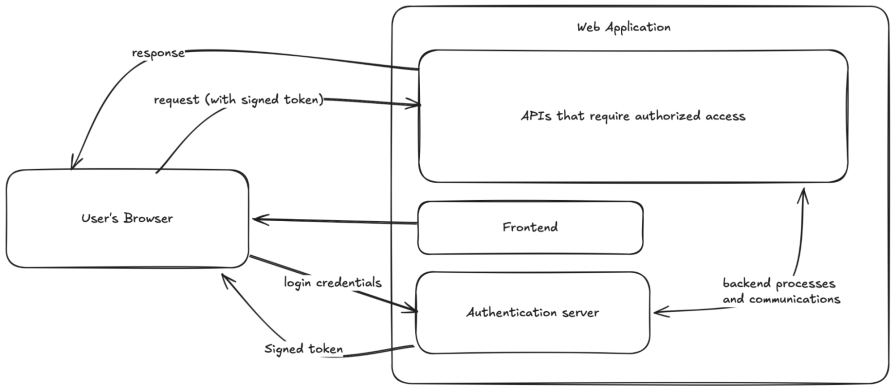
So how are signed tokens used in authentication? Here’s a simplified outline of the process:
- A user signs into their account on an authentication server
- The authentication server returns a signed token with their account information or an ID (or both)
- The signed token is stored in the browser’s localStorage or sessionStorage or anywhere the website prefers to store it
- The signed token is retrieved and used anytime a part of the website needs authenticated access
Here’s a visual representation of the process:
Where does JWT fit in OAuth 2.0 and OIDC?
JWTs are the token format. OAuth 2.0 and OpenID Connect (OIDC) are the protocols that define how those tokens are issued and used.
Many developers encounter JWTs first through OAuth 2.0 or OIDC flows, especially when integrating third-party identity providers like Google, GitHub, or Auth0. Understanding the distinction matters for implementing things correctly.
OAuth 2.0 is an authorization framework. It defines how a resource owner (a user) can grant a third-party client limited access to a protected resource (like an API) without exposing credentials. OAuth 2.0 itself does not mandate a token format, but JWTs have become the de facto standard for access tokens because they are self-contained and verifiable without a round-trip to the authorization server.
OpenID Connect (OIDC) is an identity layer built on top of OAuth 2.0. It introduces the ID token, which is always a JWT and contains claims about the authenticated user (like sub, email, name). OIDC is the protocol you are using when you click “Sign in with Google.”
Here is how they relate:
| Concept | Role | Token type |
|---|---|---|
| OAuth 2.0 | Authorization framework | Access token (often a JWT) |
| OIDC | Authentication layer on OAuth 2.0 | ID token (always a JWT) |
| JWT | Token format/standard | Used by both |
In practice, a typical OIDC flow issues three tokens:
- ID token: A JWT asserting who the user is; intended for the client to read, not the API.
- Access token: Used to call protected APIs; often a JWT but not required to be.
- Refresh token: An opaque or JWT token used to obtain new access tokens; never sent to the API.
A common mistake is using the ID token to authorize API calls. The access token is what APIs should validate. The ID token is for the client application to establish user identity.
Why should you use JWTs?
It turns out that authentication isn’t easy to implement securely. I’ve made many web projects with simple hand-written authentication processes, where I just store the user’s identifier and password as plain JSON strings in JavaScript localStorage and pass them to any region of my application that needs authenticated access.
Fortunately, those projects didn’t have many users (or any in most cases), so it wasn’t rewarding to exploit. If the web applications had many (and important) users and had authentication implemented this way, it would’ve meant disaster.
Signed tokens prevent these kinds of disasters by:
- Removing the need to store passwords in localStorage: A session ID in a signed token is enough to identify users. If the signature is generated using the HMAC SHA-256 algorithm, and the key used to create the signature is kept with extreme secrecy, and as random as possible, you can rest assured that only the authentication server can produce and verify the signature (provided that an attacker doesn’t have access to a quantum computer, and know how to use it)
- Removing the need for redundant database querying: If claims about a user can be stored in a JWT and the integrity of the claims can be assured with the signature in a JWS, an API can use those claims without raising any concerns
But JWTs aren’t perfect solutions for secure authentication. They still have issues and concerns to look out for (and possibly work around) when using them in your project.
Where should you store JWTs?
You should store access tokens in memory and refresh tokens in HttpOnly, Secure, SameSite=Strict cookies.
Token storage is one of the most debated topics in JWT security, and the answer depends on which threats you are prioritizing. Every storage option comes with trade-offs.
Here is a comparison of storage options:
| Storage location | Accessible by JS | Sent automatically | XSS risk | CSRF risk |
|---|---|---|---|---|
localStorage |
Yes | No | High | None |
sessionStorage |
Yes | No | High | None |
| In-memory (JS variable) | Yes (same tab only) | No | Medium | None |
HttpOnly cookie |
No | Yes (same-origin) | None | Medium |
HttpOnly + SameSite=Strict cookie |
No | Yes (strict same-origin) | None | Low |
Both localStorage and sessionStorage are accessible via JavaScript on the page. A successful XSS attack gives an attacker full access to the token immediately. window.localStorage.getItem('token') is all it takes. Avoid storing JWTs with meaningful access scope here.
Storing access tokens in-memory means they disappear on page refresh and are not accessible from other tabs or persisted to disk. This is the most XSS-resistant client-side option for access tokens, though it requires a separate mechanism (like a refresh token in a cookie) to restore a session after a page reload.
With HttpOnly cookies, the browser sends these automatically with every matching request, and they cannot be read by JavaScript at all. This eliminates XSS token theft but introduces CSRF risk. You can mitigate CSRF with SameSite=Strict and CSRF tokens.
How do refresh tokens and token expiration work?
Access tokens should be short-lived (5 to 15 minutes). Refresh tokens should be rotated on every use and revocable server-side.
One structural weakness of JWTs is that they are stateless by default. Once issued, a server cannot invalidate a token before its expiration unless it maintains a server-side blocklist, which reintroduces statefulness.
Token expiration and refresh token rotation are the primary tools for managing this problem.
What is access token expiration?
The exp claim defines when a token expires. Keep access token lifetimes short — 5 to 15 minutes is a common range for high-security applications, with 1 hour being a reasonable upper limit for most apps.
{
  "sub": "user_123",
  "iat": 1720652400,
  "exp": 1720653300,
  "roles": ["user"]
}
A short-lived token limits the damage window if one is stolen. An attacker with a captured token has minutes, not days, before it becomes useless.
What is refresh token rotation?
Refresh tokens are long-lived credentials (days to weeks) used to obtain new access tokens without prompting the user to re-authenticate. Because they are long-lived, they need stricter protection.
Refresh token rotation means issuing a new refresh token every time the old one is used. The old token is immediately invalidated. This means:
- If a refresh token is stolen and used by an attacker, the legitimate user’s next refresh request will fail (their token was invalidated by the attacker’s prior use).
- The server can detect reuse of an already-rotated token, which signals a potential compromise.
XSS vs. CSRF: How does your storage choice affect your attack surface?
localStorage gives you XSS risk. Cookies give you CSRF risk. Neither is inherently safer, so the question is which risk you can better mitigate given your architecture.
What is XSS (Cross-Site Scripting)?
XSS occurs when an attacker injects malicious JavaScript into a page that runs in another user’s browser. If your token is in localStorage or sessionStorage, that script can read it directly:
// What an attacker's injected script does
fetch(' + localStorage.getItem("access_token'));
Mitigations for XSS:
- Use a strong Content Security Policy (CSP) to restrict script sources.
- Sanitize all user-generated content before rendering.
- Store tokens in memory or
HttpOnlycookies instead oflocalStorage. - Keep third-party JavaScript dependencies minimal and audited.
What is CSRF (Cross-Site Request Forgery)?
CSRF occurs when an attacker tricks a logged-in user’s browser into making a request to your application without the user’s intent. Because cookies are sent automatically by the browser, a forged request from a malicious site to your API will include the victim’s cookies, including any JWT stored there.
Mitigations for CSRF:
- Use
SameSite=StrictorSameSite=Laxon cookies (the most effective modern defense). - Implement CSRF tokens (the double-submit cookie or synchronizer token patterns).
- Validate the
OriginandRefererheaders on state-changing requests. - Avoid
SameSite=Noneunless you explicitly need cross-site cookie sending.
What are the limitations of JWTs?
JWTs like many other tools in the world, aren’t perfect. They’re good for user authentication, but not without shortcomings. In this section, I’ll address some popular concerns.
So let’s start with the first concern.
Are JWTs encrypted?
Signed tokens provide the benefit of verifying the integrity of the claims in the tokens. This allows them to be useful for authentication purposes. This doesn’t mean that the claims stored in the tokens aren’t hidden.
If your web application needs to store sensitive information in tokens, the website needs to handle them with caution. Generally, you should avoid storing sensitive information in tokens because it is very difficult to protect them against all possible cybersecurity attacks.
In cases where a web application needs to store sensitive information in tokens, encrypted forms of JWTs exist for this reason.
Do JWTs require JavaScript?
Compared to the internet of the early 2000s modern-day internet is more secure. But, on its own, the modern-day internet still isn’t a hundred percent secure. Anything that JavaScript has access to can still potentially be exploited.
Because of the structure of modern applications, it has become more important for JavaScript to have access to the tokens to, for example, send requests to APIs. However, web applications have reasons for their structure, and in some cases, JavaScript having access to the tokens is unavoidable. Fortunately, the internet has gotten secure enough for access to JavaScript to be less of a concern than it was in the earlier internet.
There isn’t a good solution to this concern. Regardless of where you store tokens, you’re opening the tokens to at least one form of exploit. Storing in cookies or sessions is open to CSRF (Cross-Site Request Forgery) attacks, and storing anywhere JavaScript can access is open to XSS (Cross-Site Scripting) attacks.
Are JWTs subject to size limits?
Depending on how you store and transmit JWTs, they’re subject to size constraints imposed by browsers. For example, all browsers impose a 4 KB and 5 MB limit on the total amount of data that a web application can store in cookies and JavaScript localStorage respectively.
If your web application uses significant portions of these storage mechanisms (although unlikely), you can use session tokens instead. They’re smaller, but they can’t have payloads, with extra pieces of information, like with JWTs.
When should you not use JWTs?
The short answer to this question is when you need immediate revocation, when your clients are only browsers talking to a single backend, or when the complexity does not pay off.
JWTs vs. server-side sessions: Which should you choose?
JWTs are not the default correct answer for every authentication problem. Here are cases where traditional server-side sessions are a better fit:
| Concern | JWT | Server-side session |
|---|---|---|
| Scalability (stateless) | Excellent (no DB lookup per request) | Requires session store (Redis, DB) |
| Revocation | Hard (requires a blocklist) | Trivial (delete the session record) |
| Token size | Can grow large with many claims | Tiny (just a session ID) |
| Cross-service auth | Strong fit (verifiable without shared DB) | Harder (requires shared session store or sticky sessions) |
| Implementation complexity | Higher (needs refresh logic, rotation, storage strategy) | Lower (most frameworks handle it out of the box) |
| Suitable for mobile/API clients | Yes | Often awkward (cookie-based by default) |
When are server-side sessions the better choice?
- You have a traditional server-rendered web app (Rails, Django, Laravel, Next.js with server actions). These frameworks have mature, battle-tested session handling built in. Adding JWT on top adds complexity without obvious benefit.
- You need to revoke sessions immediately. Logging a user out of all devices, responding to a compromised account, or enforcing role changes mid-session all require instant revocation. JWTs cannot do this without a blocklist.
- Your auth surface is a single backend. JWTs shine when multiple services need to verify the same token. If only one server ever reads the token, sessions are simpler.
- Your team is not familiar with JWT pitfalls. The
alg: noneattack, weak secrets, missing expiration claims, and improper storage have all caused real breaches. If you are not going to implement JWTs carefully, sessions are safer by default.
When are JWTs the right choice?
- Microservices and distributed architectures where multiple APIs need to verify identity without a shared session store.
- Mobile applications and public APIs where stateless, bearer-token authentication is the standard expectation.
- Third-party integrations where you need to issue scoped, time-limited credentials to external services.
- OAuth 2.0 and OIDC flows where the token format is defined by the protocol.
Frequently Asked Questions
Can I decode a JWT without the secret key?
Yes, the header and payload are only base64url encoded, not encrypted. Anyone can decode them. The signature requires the secret key to verify, but the payload is readable by anyone who has the token. This is why you should never store sensitive data in JWT payloads.
What happens when a JWT expires?
The server rejects it with a 401 Unauthorized response. The client should then attempt a silent refresh using its refresh token. If the refresh token is also expired or invalid, the user must re-authenticate.
Should I validate JWTs on every request?
Yes, always. Signature validation is computationally cheap (especially with RS256 and cached public keys via JWKS). Skipping verification because “we trust the client” defeats the purpose of signing entirely.
Can I use the same JWT for both authentication and authorization?
Yes, and most applications do. The JWT can carry both identity claims (sub, email) and authorization claims (roles, permissions). The key constraint is that embedded claims are static until a new token is issued. If a user’s role changes mid-session, the access token will not reflect that until it expires and is refreshed.
Key Takeaways
JWTs are useful tools in user authorization and authentication, but they’re just standards. They’re not built directly into programming languages or many frameworks. Using them in many cases is based on how you (or the library you choose to generate and handle them) implement JWTs. If you want to learn how to implement them, you can check out our guide on implementing JWT authentication with Vue and Node.js.
The post JWT authentication: Best practices and when to use it appeared first on LogRocket Blog.
PakarPBN
A Private Blog Network (PBN) is a collection of websites that are controlled by a single individual or organization and used primarily to build backlinks to a “money site” in order to influence its ranking in search engines such as Google. The core idea behind a PBN is based on the importance of backlinks in Google’s ranking algorithm. Since Google views backlinks as signals of authority and trust, some website owners attempt to artificially create these signals through a controlled network of sites.
In a typical PBN setup, the owner acquires expired or aged domains that already have existing authority, backlinks, and history. These domains are rebuilt with new content and hosted separately, often using different IP addresses, hosting providers, themes, and ownership details to make them appear unrelated. Within the content published on these sites, links are strategically placed that point to the main website the owner wants to rank higher. By doing this, the owner attempts to pass link equity (also known as “link juice”) from the PBN sites to the target website.
The purpose of a PBN is to give the impression that the target website is naturally earning links from multiple independent sources. If done effectively, this can temporarily improve keyword rankings, increase organic visibility, and drive more traffic from search results.