
June 15, 2026 at 2:22 pm,
No comments
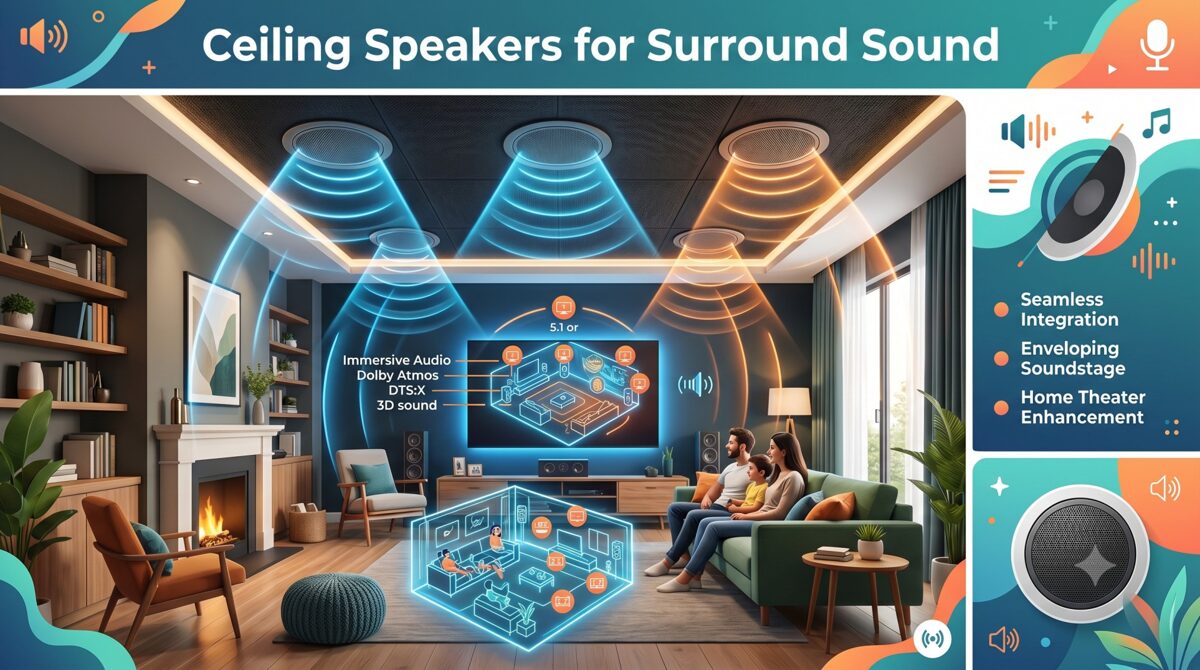
Open-concept living spaces present unique acoustic challenges for home theater installations, particularly when implementing ceiling mount surround sound speakers in environments where traditional wall placement isn’t feasible. As modern architecture increasingly favors open floor plans that combine living rooms, kitchens, and dining areas into expansive connected spaces, AV integrators face complex decisions about speaker positioning, acoustic treatment, and system calibration to deliver immersive audio experiences. The importance of choosing the best ceiling mount surround sound speakers extends beyond simple product selection—it requires understanding acoustic principles, architectural constraints, and client lifestyle patterns to create surround sound systems that perform effectively in acoustically challenging environments.
Open-concept homes lack the defined boundaries and reflective surfaces that help contain and direct sound in traditional enclosed rooms, creating issues with sound localization, dialogue intelligibility, and bass response. Ceiling speakers become the practical solution when walls are occupied by windows, artwork, or architectural features, or when aesthetic preferences demand minimal visible equipment. However, successful implementation requires addressing specific challenges: vertical sound delivery creating unnatural listening experiences, ceiling height variations affecting coverage, and hard surface materials (wood, tile, glass) causing excessive acoustic reflections that muddy audio clarity.
This comprehensive guide examines the technical challenges inherent in ceiling-mounted surround sound for open-concept spaces and provides practical solutions that AV professionals can implement to deliver superior audio performance despite architectural limitations.
Key Takeaways
-
Open-concept spaces create acoustic challenges including excessive reverberation (RT60 often 0.8-1.2+ seconds), weak bass response, and poor sound localization
-
Ceiling mount surround sound speakers require strategic positioning accounting for listening zones, ceiling height, and architectural features affecting sound propagation
-
Angled in-ceiling speakers with aimable tweeters improve sound localization and create more natural surround effects compared to downward-firing models
-
Acoustic treatment is essential in open-concept homes, targeting first reflection points, ceiling surfaces, and hard flooring to reduce reverberation by 30-50%
-
Atmos-enabled speakers or dedicated height channels in ceiling locations provide immersive 3D audio while addressing open-space challenges
-
DSP room correction (Dirac Live, Audyssey MultEQ XT32, Anthem ARC Genesis) compensates for acoustic deficiencies, improving frequency response and imaging
-
Zone-based design creating focused listening areas within larger open spaces through speaker placement and acoustic boundaries improves performance
-
In-ceiling subwoofers or strategically placed floor subs address bass reinforcement needs in spaces lacking corner loading benefits
Understanding Open-Concept Acoustic Challenges
What Makes Open-Concept Spaces Difficult for Audio
Open-concept homes present several acoustic obstacles:
Excessive Reverberation
Problem: Sound energy reflects off multiple hard surfaces without absorption, creating prolonged decay times.
Typical measurements:
Impact: Dialogue intelligibility decreases, imaging becomes diffuse, dynamic range is compressed
Lack of Acoustic Boundaries
Problem: Sound energy disperses into adjacent areas rather than containing within listening zone.
Consequences:
-
Weak surround effects from sound bleeding into other spaces
-
Reduced bass impact without room modes reinforcing low frequencies
-
Poor sound localization as reflections come from unexpected directions
Reflective Surface Materials
Common materials in open-concept design:
-
Hardwood floors (highly reflective)
-
Tile or stone (extremely reflective)
-
Large glass windows (perfect reflectors)
-
Exposed ceilings with hard drywall or wood
-
Kitchen surfaces (granite countertops, stainless appliances)
Problem: 95-98% sound reflection from these materials creates slap echoes and flutter echo patterns.
Variable Ceiling Heights
Architectural features common in open-concept:
-
Vaulted ceilings (12-20 feet)
-
Tray ceilings with height variations
-
Exposed beams creating partial boundaries
Challenge: Inconsistent speaker-to-listener distances affect arrival times and volume balance.
Why Ceiling Mount Surround Sound Speakers for Open-Concept Spaces?
When Ceiling Placement Becomes Necessary
Practical reasons for ceiling mounting:
Architectural Constraints:
-
Floor-to-ceiling windows occupying wall space
-
Open sightlines between functional zones (kitchen to living area)
-
Minimalist design preferences rejecting visible speakers
Functional Requirements:
-
Furniture flexibility without speaker placement limitations
-
Child and pet safety concerns with floor-standing or bookshelf speakers
-
Multi-zone audio serving overlapping spaces
Aesthetic Preferences:
-
Client demands for “invisible” audio systems
-
Architectural integrity preservation
-
WAF (Wife Acceptance Factor) considerations
Advantages of Modern Ceiling Speakers
Technology improvements making ceiling mounting viable:
Aimable Tweeters:
-
Pivot mechanisms directing high frequencies toward listening positions
-
Improved localization compared to downward-firing designs
-
Wider sweet spot accommodating multiple listeners
Improved Driver Technology:
-
High-excursion woofers delivering bass extension from ceiling locations
-
Carbon fiber and polypropylene cones providing clarity and power handling
-
Butyl rubber surrounds for long-term reliability
Integrated Atmos Capabilities:
Key Challenges of Ceiling-Mounted Surround Sound in Open Spaces
Challenge 1: Vertical Sound Localization
Problem: Human auditory system evolved to localize horizontal sounds (predators, voices) more accurately than vertical sounds.
Impact on surround sound:
-
Overhead effects lack realistic spatial cues
-
Rear surround information feels detached from screen action
-
Dialogue from ceiling-mounted center channel sounds unnatural
Measurement: ITD (Interaural Time Difference) and ILD (Interaural Level Difference) cues are minimal for vertical sources, reducing localization accuracy by 60-70% compared to ear-level speakers.
Challenge 2: Direct vs. Reflected Sound Balance
Problem: Ceiling speakers create strong direct sound from overhead while lacking the early reflections that provide spatial information in traditional setups.
Acoustic principle:
Result: Unnatural soundstage that feels compressed or disconnected from visual content.
Challenge 3: Inconsistent Coverage Across Listening Zones
Problem: Single listening position optimization leaves other seating areas with poor audio quality.
Coverage issues:
-
Off-axis response of ceiling speakers creates tonal imbalances for listeners not in primary position
-
Volume differences of 10-15 dB between optimal and suboptimal seating
-
Surround effects work well for one couch position but fail for adjacent dining area
Challenge 4: Ceiling Construction and Accessibility
Installation obstacles:
Structural Limitations:
-
Joist spacing restricting speaker placement options
-
HVAC ducts, electrical conduit, plumbing occupying ceiling cavities
-
Ceiling heights requiring long wire runs and complex pathways
Acoustic Coupling:
-
Thin drywall allowing speaker vibrations to transmit to entire ceiling
-
Lack of backing volume in shallow ceiling constructions
-
Flanking paths letting sound travel to adjacent rooms
Challenge 5: Balancing Aesthetics and Performance
Client expectations vs. acoustic reality:
Client Desires:
-
Minimal visible speakers (8 or fewer for entire space)
-
Symmetric visual placement (even spacing, aligned with architectural features)
-
Small speaker grilles that “disappear”
Acoustic Requirements:
-
Adequate speaker quantity for proper coverage (often 10-14 speakers for large open concept)
-
Strategic positioning based on listening zones, not visual symmetry
-
Sufficient driver size (6.5″ or 8″ woofers) for adequate output and bass extension
Solutions for Effective Ceiling-Mounted Surround Sound
Solution 1: Strategic Speaker Positioning
Optimization strategies:
Define Primary Listening Zone
Approach: Identify main seating area for critical listening and optimize speaker placement for that zone first.
Speaker layout for 5.1.2 Atmos in open-concept:
Front Stage:
-
Center channel: Ceiling-mounted directly above TV, aimable tweeter directed toward primary seating at 15-20 degree angle
-
Front L/R: Positioned at 30-degree angles from center, aimed at listening position
Surround Channels:
-
Side surrounds: 110-120 degrees from center, aimed toward listeners (not straight down)
-
Rear surrounds (if 7.1): 135-150 degrees, angled toward seating
Height Channels (Atmos):
Account for Ceiling Height Variations
Adjustment strategies:
High ceilings (12+ feet):
-
Use higher sensitivity speakers (90+ dB @ 1W/1m)
-
Increase power amplification (150-200W per channel)
-
Narrow dispersion patterns to maintain focus over longer distances
Vaulted/Sloped ceilings:
-
Mount speakers at consistent height relative to listening position
-
Use extension mounts or angled brackets maintaining proper aim
-
Compensate with level adjustments in AVR setup
Solution 2: Selecting Optimal Ceiling Speakers
Critical specifications for open-concept applications:
Essential Features
Must-have characteristics:
✓ Aimable/Pivoting tweeters (minimum 20-degree range) ✓ Wide frequency response (60Hz-20kHz +/- 3dB or better) ✓ High power handling (100W+ continuous) ✓ Sensitivity of 88dB or higher ✓ Controlled dispersion (90-120 degree coverage) ✓ Dual-tweeter designs for enhanced off-axis performance
Recommended Speaker Types
In-ceiling LCR speakers (Left, Center, Right):
-
8″ woofers for adequate bass and dynamic range
-
Triple-tweeter arrays for consistent dispersion
-
Sealed or aperiodic enclosures providing controlled bass
In-ceiling surrounds:
-
6.5″ woofers (adequate for surround effects)
-
Aimable tweeters directed toward listening positions
-
Dipole or bipole designs creating diffuse soundfield appropriate for surrounds
Atmos-enabled ceiling speakers:
-
Dedicated height drivers separated from primary channels
-
Full-range response (80Hz-20kHz)
-
Modular designs allowing independent aiming
Performance Comparison Table
|
Feature |
Budget In-Ceiling |
Mid-Range In-Ceiling |
Premium In-Ceiling |
|
Woofer size |
5.25″ |
6.5″-8″ |
8″-10″ |
|
Tweeter type |
Fixed dome |
Aimable dome |
Pivoting array |
|
Frequency range |
80Hz-20kHz ±5dB |
65Hz-20kHz ±3dB |
50Hz-20kHz ±2dB |
|
Power handling |
50W |
100-150W |
200W+ |
|
Sensitivity |
86dB |
88-90dB |
90-93dB |
|
Dispersion control |
Limited |
Moderate |
Excellent |
|
Off-axis performance |
-6dB @ 30° |
-3dB @ 30° |
-2dB @ 45° |
|
Typical price |
$150-300/pair |
$400-800/pair |
$1,000-2,500/pair |
|
Best application |
Secondary zones |
Standard installs |
Critical listening |
Solution 3: Acoustic Treatment for Open Spaces
Essential treatments addressing open-concept challenges:
Ceiling Treatments
Purpose: Reduce early reflections from ceiling surfaces creating comb filtering and poor imaging.
Solutions:
-
Acoustic panels (2-4″ thick, NRC 0.8+) at first reflection points
-
Cloud panels suspended 12-24″ below ceiling in primary listening zone
-
Spray-applied acoustic coatings for large ceiling areas (NRC 0.5-0.7)
Coverage: 20-30% of ceiling area in listening zone reduces RT60 by 0.2-0.4 seconds
Wall and Window Treatments
Strategies:
Window treatments:
Wall absorption:
Floor Treatments
Addressing hard surfaces:
Area rugs:
-
Large rugs (8’x10′ or larger) in listening area
-
Thick pile or layered construction (NRC 0.2-0.4)
-
Coverage of 60-80% of primary listening zone floor
Underlayment:
Solution 4: DSP and Room Correction
Electronic solutions compensating for acoustic deficiencies:
Advanced Room Correction Systems
Leading technologies for open-concept spaces:
Dirac Live (premium):
-
Mixed-phase correction addressing frequency and time domain issues
-
Target curves customizable for open-space acoustics
-
Multiple listening positions optimization
-
Effectiveness: ±2-3dB frequency response throughout listening area
Audyssey MultEQ XT32 (mid-range):
-
32,768 resolution points for detailed correction
-
Sub EQ HT optimizing multiple subwoofers
-
Dynamic EQ maintaining tonal balance at varied volumes
-
Effectiveness: ±3-4dB frequency response improvement
Anthem ARC Genesis (premium):
-
Advanced algorithms for difficult rooms
-
User-adjustable parameters for custom tuning
-
Room gain compensation addressing open-space bass loss
Manual Calibration Strategies
For systems without automatic correction:
Delay Adjustment:
-
Measure distances from each speaker to listening position
-
Set delays compensating for path length differences
-
Formula: (Distance difference in feet) ÷ 1.13 = delay in milliseconds
Level Calibration:
-
Use SPL meter measuring each channel at 75dB (C-weighted, slow)
-
Adjust levels creating uniform soundfield across listening positions
-
Account for ceiling height requiring higher levels from distant speakers
Crossover Optimization:
-
Set crossovers at 80Hz for ceiling speakers (typical), allowing subwoofer to handle bass
-
Experiment with higher crossovers (100-120Hz) in very open spaces to improve bass integration
Solution 5: Subwoofer Strategy for Open Spaces
Bass management in rooms lacking boundaries:
Multiple Subwoofer Approach
Why it works: Multiple subs create more uniform bass distribution by exciting different room modes.
Configurations:
Dual opposing (2 subs):
4-corner placement (4 subs):
-
Subwoofer in each corner of listening area
-
Creates uniform excitation of room modes
-
Most effective for large open spaces
Scattered asymmetric (3-4 subs):
In-Ceiling Subwoofers
Purpose-built solutions for open-concept spaces:
Advantages:
Limitations:
-
Lower output compared to equivalent floor subs (typically 3-6dB less)
-
Ceiling mounting must support weight (40-80 lbs per sub)
-
Cost premium ($1,500-3,500 vs. $500-1,200 for equivalent floor sub)
Best applications: Supplementary bass in combination with 1-2 floor subs, or spaces where floor subs absolutely prohibited
Installation Best Practices
Pre-Installation Planning
Critical steps:
Ceiling Cavity Inspection:
-
Verify depth (minimum 6-8″ for quality in-ceiling speakers)
-
Map obstructions (joists, HVAC, electrical)
-
Identify backing (drywall thickness, insulation presence)
Load-Bearing Assessment:
-
Standard ceiling: Supports speakers up to 15 lbs without reinforcement
-
Heavy speakers (20+ lbs): Require mounting brackets attached to joists
-
In-ceiling subs: Always attach to structural members
Installation Techniques
Professional methods:
Cutting Clean Holes:
-
Use templates provided with speakers
-
Rotary cutout tools for precise circular cuts
-
Edge sealers preventing drywall crumbling
Minimizing Ceiling Vibration:
-
Rubber gaskets between speaker frame and drywall
-
Mounting clamps evenly distributing pressure
-
Acoustic sealant around cutouts reducing air leaks
Cable Management:
-
In-wall rated cable (CL3 or CL2 for in-ceiling)
-
Service loops at each speaker for future maintenance
-
Label all cables at AVR and speaker ends
Future Trends: AI and Wireless Technologies
AI-Powered Spatial Audio Optimization
Emerging capabilities in June 2026:
Machine Learning Room Analysis:
-
AI algorithms analyzing room acoustics via microphone arrays
-
Automatic speaker positioning recommendations based on space geometry
-
Real-time adaptation to furniture changes and occupancy patterns
Personalized Listening Profiles:
Wireless Ceiling Speaker Systems
Technology maturation:
Current capabilities (June 2026):
-
WiSA (Wireless Speaker and Audio) supporting 24-bit/96kHz with <1ms latency
-
Proprietary systems (Sonos, Denon HEOS) offering ceiling-compatible wireless modules
Installation advantages:
-
Eliminates ceiling wire runs (major cost/time savings)
-
Easier retrofit installations in existing homes
-
Flexible speaker repositioning
Limitations:
-
Power still required at each speaker
-
Higher cost ($400-800 premium per speaker)
-
Potential interference in crowded RF environments
Frequently Asked Questions
What is the ideal ceiling height for mounting surround sound speakers?
Optimal ceiling height for ceiling mount surround sound speakers ranges from 8-12 feet. At 8-9 feet (standard residential), speakers can effectively deliver sound with minimal distance-related losses. For vaulted ceilings (12-20 feet), specify higher sensitivity speakers (90+ dB) and increase amplifier power (150-200W per channel). Use aimable tweeters to compensate for increased distance, directing high frequencies toward listeners. Ceiling heights below 8 feet can create oppressive sound from overhead sources; consider wall-mounted alternatives if possible.
Can ceiling speakers provide the same surround sound quality as wall-mounted speakers?
Ceiling speakers can deliver excellent surround sound but require proper selection and installation. Key factors: Choose aimable/pivoting tweeters directing sound toward listeners rather than downward, specify adequate driver sizes (6.5″+ woofers) for dynamic range, implement DSP room correction compensating for vertical placement, and use acoustic treatments addressing open-space acoustics. Properly installed ceiling systems achieve 90-95% of wall-mounted performance in subjective listening tests. For critical listening rooms, wall mounting remains preferable; for open-concept spaces, ceiling mounting offers practical solution with minimal compromises.
How many ceiling speakers do I need for surround sound in an open-concept space?
Speaker count depends on space size and desired format. Basic 5.1 system: 5 speakers (L/C/R + 2 surrounds) + 1-2 subwoofers. Atmos 5.1.2: Add 2 height speakers (7 total). Large open-concept (500+ sq ft): Consider 7.1.4 (11 speakers) or 9.1.4 (13 speakers) for adequate coverage. General rule: One speaker per 75-100 sq ft for primary listening zone, plus height channels for Atmos. Multiple listening zones may require additional speakers or compromise optimizing primary area. Professional assessment recommended for spaces exceeding 600 sq ft.
What acoustic treatments work best for open-concept homes with ceiling speakers?
Priority treatments for open-concept spaces: Ceiling absorption (2-4″ panels at first reflection points, covering 20-30% of listening area ceiling), thick area rugs (minimum 8’x10′, covering 60-80% of listening zone floor), heavy window treatments (acoustic curtains or dual-layer drapes reducing glass reflections by 70%+), and strategic wall panels at side reflection points (fabric-wrapped 2″ absorbers). Avoid over-treatment: Target RT60 of 0.4-0.6 seconds (too much absorption creates dead, unnatural sound). Diffusion (bookshelves, diffusive art panels) helps scatter reflections without over-deadening space. Budget: $1,500-4,000 for adequate treatment in 400-600 sq ft space.
Should I use in-ceiling subwoofers in open-concept spaces?
In-ceiling subwoofers work as supplementary bass in open-concept homes but rarely as sole bass sources. Advantages: Aesthetic invisibility, placement flexibility, and distributed bass from multiple units. Disadvantages: Lower output (3-6dB less) than equivalent floor subs, high cost ($1,500-3,500 each, typically need 2-4), and demanding installation (ceiling must support 40-80 lbs). Best approach: Combine 1-2 floor subs (primary bass) with 1-2 in-ceiling subs (fill/extension), or use in-ceiling exclusively when client absolutely prohibits floor placement. Open spaces benefit from multiple subwoofers regardless of type, smoothing bass distribution.
How do I prevent ceiling speakers from vibrating the entire ceiling?
Vibration control strategies: Mount speakers directly to ceiling joists using manufacturer-provided brackets (not just drywall), install rubber isolation gaskets between speaker frames and ceiling surface, apply acoustic sealant around cutout perimeter reducing air coupling, ensure even tension on mounting clamps (overtightening increases vibration transfer), and consider mass-loaded vinyl on ceiling backside in critical areas (adds damping). For problem installations: Install speakers in sealed backing boxes attached to joists, isolating speaker energy from ceiling membrane. Ceiling vibration often indicates undersized speakers being overdriven; specify adequate speaker sizes/quantities for space.
What DSP room correction system works best with ceiling speakers in open spaces?
Top DSP systems for ceiling speaker applications: Dirac Live (most effective, mixed-phase correction addressing frequency and time issues, $500-2,000 depending on channel count), Anthem ARC Genesis (excellent for difficult acoustics, user-adjustable, included with Anthem processors), and Audyssey MultEQ XT32 (strong performance, affordable, included with mid-high Denon/Marantz AVRs). For open-concept spaces, multi-point measurement (8-12 positions) crucial for broad optimization. Effectiveness: Good DSP improves frequency response from ±8-10dB variance to ±2-4dB and reduces decay time issues, but cannot fix severe acoustic problems—combine with physical treatments for best results. Manual calibration adequate for budget systems but time-intensive.
Conclusion
Successfully implementing ceiling mount surround sound speakers in open-concept homes requires understanding and addressing the unique acoustic challenges these architectural spaces present. While open floor plans offer aesthetic appeal and functional flexibility, they create reverberation issues, weak sound localization, and coverage inconsistencies that AV professionals must overcome through strategic speaker selection, thoughtful positioning, acoustic treatment, and advanced calibration.
The solutions outlined in this guide—aimable tweeter technology, zone-based design approaches, targeted acoustic treatments, DSP room correction, and distributed subwoofer strategies—enable AV integrators to deliver excellent surround sound performance despite architectural constraints. Success requires moving beyond simple speaker installation to comprehensive system design that accounts for space acoustics, client usage patterns, and aesthetic requirements.
As technology continues advancing through June 2026 with AI-powered optimization, wireless solutions, and improved speaker designs, the gap between ceiling-mounted systems and traditional wall-mounted installations continues narrowing. For AV professionals serving clients with modern open-concept homes, mastering these techniques and staying current with emerging technologies ensures the ability to deliver immersive audio experiences that meet both acoustic performance and lifestyle expectations.
The key to success lies in choosing the best ceiling mount surround sound speakers for the specific application, implementing them with proper acoustic support, and calibrating systems to compensate for environmental limitations. By following the principles and practices detailed in this guide, AV integrators can confidently tackle open-concept projects and deliver results that exceed client expectations while establishing reputation for expertise in acoustically challenging installations.
PakarPBN
A Private Blog Network (PBN) is a collection of websites that are controlled by a single individual or organization and used primarily to build backlinks to a “money site” in order to influence its ranking in search engines such as Google. The core idea behind a PBN is based on the importance of backlinks in Google’s ranking algorithm. Since Google views backlinks as signals of authority and trust, some website owners attempt to artificially create these signals through a controlled network of sites.
In a typical PBN setup, the owner acquires expired or aged domains that already have existing authority, backlinks, and history. These domains are rebuilt with new content and hosted separately, often using different IP addresses, hosting providers, themes, and ownership details to make them appear unrelated. Within the content published on these sites, links are strategically placed that point to the main website the owner wants to rank higher. By doing this, the owner attempts to pass link equity (also known as “link juice”) from the PBN sites to the target website.
The purpose of a PBN is to give the impression that the target website is naturally earning links from multiple independent sources. If done effectively, this can temporarily improve keyword rankings, increase organic visibility, and drive more traffic from search results.